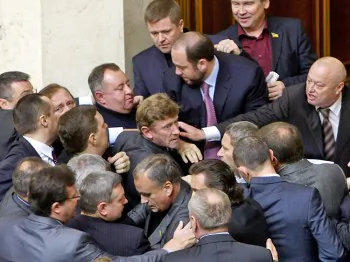

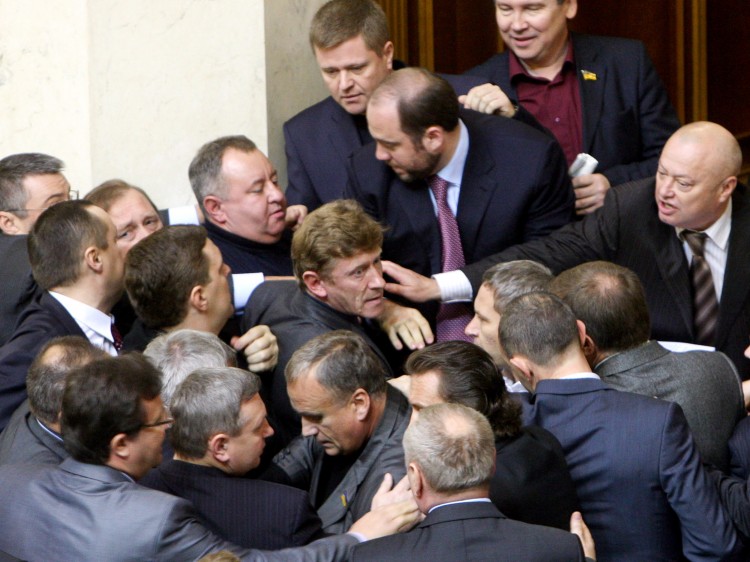
Last year the country transitioned from the democratic pro-western government of Victor Yushchenko, to an authoritarian Russian-leaning government led by Viktor Yanukovych and the Ukrainian national Parliament has been a center of political conflict with disagreements among parliamentarians turning to fisticuffs.
Last month in Kyiv, the presiding lawmaker at chamber session of Parliament, Communist Party member Adam Martynuk, grabbed his deputy, Oleg Lyashko, by the throat and throttled him to the floor.
The cause of the outburst was that Martynuk was upset at a remark Lyashko made after Martynuk refused to let him speak to the parliament.
In another incident last year, when the Ukrainian Parliament approved a controversial plan to allow the Russian navy to extend its stay on the Crimea Peninsula by 25 years in exchange for lower prices on Russian gas; the session was thrown into chaos when opposition lawmakers began hurling eggs and smoke bombs.
Ukrainian politicians are also notorious for not showing up to sessions of parliament and under current Ukrainian law, members of parliament are allowed to vote for absent members.
Reforms Refused
Some lawmakers have tried to implement measures to correct the unethical behavior of parliamentarians, but so far none of their proposed measures have gained support from Parliament.
A bill aimed at regulating the conduct of Ukrainian Parliament members, proposed by Parliament member Yuriy Gnatkevych, stalled in the profile committee on the grounds that legislators should not have to abide by the measures due to their parliamentary status.
In his next attempt, Gnatkevych wrote another bill proposing cuts to lawmakers’ pay if they do not attend sessions of parliament; that bill was also never debated.
Parliament member Vladimir Lytvyn proposed a system that would make it illegal for lawmakers to vote for absent members by requiring legislators to keep their fingers on the voting buttons until voting is over. Another lawmaker also proposed that those who vote more than once be held criminally responsible.
The governing coalition, of which the majority is the president-backed Party of Regions, has refused to support the reform measures claiming that it would cause a stalemate in Parliament and no bills would be passed.
“This party [of Regions] will never vote for such measures as it represents interests of big business in the country,” Gnatkevych said in an interview, adding that there are about 20 members who don't come to parliament. “The most interesting thing currently is that our legal system allows such things to happen," he added.
In the last year Yanukovych has made many changes including returning the country to it’s 1996 Constitution, which extends presidential powers. There are also concerns that Ukraine’s press freedom is eroding in the new leadership.
The parliamentary Party of Region faction includes the country’s most influential businessman, Renat Achmetov; President Yanukovych’s son; and Vladimir Derkach, one of the owners of the country’s power industry. These members are among those who rarely attend parliamentary sessions.
Continued on the next page … changes need to be made
 Friends Read Free
Copy
Facebook
Tweet
Friends Read Free
Copy
Facebook
Tweet