
Two major railroad unions are on opposite sides of the debate over a merger that would create the United States’ first transcontinental single-line freight railroad.
As the proposed $85 billion merger-acquisition of Norfolk Southern by Union Pacific chugs its way through the U.S. Surface Transportation Board for approval, the Brotherhood of Locomotive Engineers and Trainmen (BLET) has positioned itself against it.
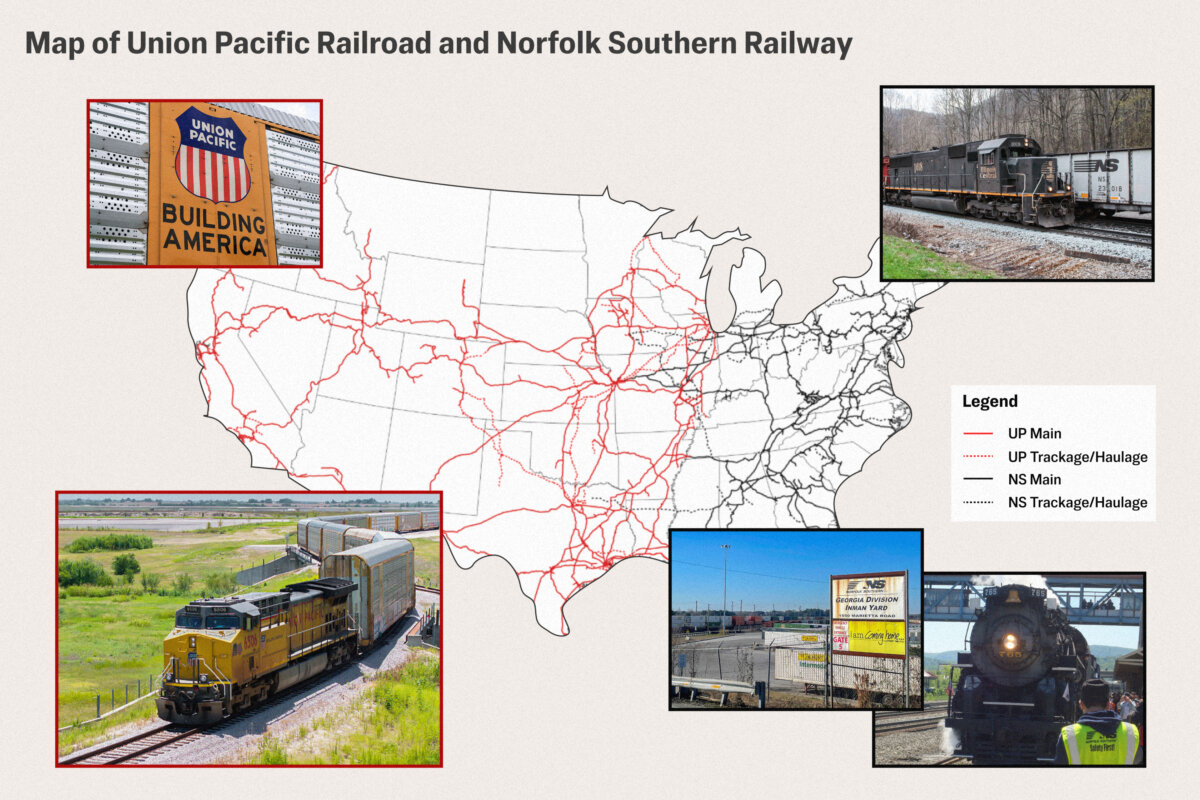
The combined Union Pacific Transcontinental Railroad would connect about 50,000 route miles across 43 states and have an estimated market cap of $250 billion. It would be the largest railroad merger in history.
Last year, Union Pacific moved almost 8.5 million paid train carloads along its tracks, and Norfolk Southern moved more than 7 million paid carloads on its own rail network, according to financial disclosure filings.
“This merger is bad for workers, customers, and our communities,” BLET’s president, Mark Wallace, said in a statement.
BLET pointed out that Wallace also wears the hat of president of the Teamsters Rail Conference, which “represents the majority of the unionized workforce at what would be the combined railroad.”
On the other side of the tracks is the International Association of Sheet Metal, Air, Rail and Transportation Workers, known as SMART, with a total advertised membership of about 230,000 workers.
SMART responded to the warnings by BLET and others in a statement saying that the “fearmongering, speculation, and rhetoric” need to “stop now.”
“The BLE-T and the BMWED (who make up the Teamsters Rail Conference) are claiming that a railroad going coast to coast will destroy our supply chain and kill all kinds of railroad jobs,” wrote SMART’s transportation division.
“It isn’t hard to prove that wrong.”
The unions made those statements in early August. Neither union responded to requests for comment by The Epoch Times.
Layoffs or Paychecks?
SMART said that it is the “union employees of both railroads” who would “win” from the merger.
BLET pointed to an analysis that says the merger would result in roughly 1,000 jobs lost and 500 transfers.
Which union is right?
Both may be correct.
If regulators allow the deal to proceed, there could be benefits to railroad workers from the merger, including a legal guarantee of jobs for life for the current unionized workers as well as more blue-collar jobs created to service the reorganized, single railroad.
There could also be some jobs lost. These would be mostly white-collar jobs held by non-unionized railroad employees.
Shedding office jobs was one way that Norfolk Southern freed up money in recent years to help deal with the financial and environmental fallout from its famous derailment near East Palestine, Ohio, and the accompanying plumes of toxic smoke.
This was revealed in a filing with the federal agency charged with regulating railroads, the Surface Transportation Board. The agency ordered that the filing be made public.
The 109-page document plans for about 1,200 net union jobs to be created at the new railroad in the first three years after the merger goes through and for more than 1,100 office jobs to be cut.
A Jobs-for-Life Pledge
To help sell the deal, Union Pacific and Norfolk Southern have made a promise to current unionized rail workers should the merger go through.
Every unionized employee of the railroads “with a job at the time of the merger will continue to have one,” the railroads wrote on a single website that has been created by both to promote the merger.
This would be something like tenure for the rank-and-file rail workers. They could still be fired for cause, but the promise that the railroads put in writing to their unions is that there will never be layoffs.
The Epoch Times inquired of the railroads if the jobs guarantee applies even to the unions that oppose the merger.
A spokesperson confirmed that it applies to the holdout unions as well as the ones on board.
The Pledge Meets the Rails
BLET and some experts are skeptical that the pledge is a good deal for workers.
The skeptical union wrote that Union Pacific CEO Jim Vena had “negotiated with a few other rail unions contract language for job security covering the length of their members’ careers,” but that such protections are “mostly hollow promises.”
It made the case that the jobs-for-life agreement does not keep workers from being transferred, demoted, or “forced into another craft or even another railroad.”
On the last point, it said that an acquisition of one of the lines by another railroad, post-merger, could void the agreement.
Diana Moss, vice president and director of competition at the Progressive Policy Institute, believes the problems in the contract might lie elsewhere, by reducing workers’ leverage in salary negotiations.
“A lifelong protection agreement is a complicated document, but my suspicion is that there are most certainly ways that a merged [railroad] could degrade wages and benefits post-merger, even within the confines of the agreement,” she told The Epoch Times.
SMART would know something about the complexity of that document. It was the union that negotiated a jobs-for-life contract with the Illinois Central Railroad in 2008.
The Illinois railroad had been acquired by Canadian railroad CN, where Vena was an executive.
That set up what SMART calls “the toughest tests imaginable” during the Great Recession and the COVID-19 shutdowns, which showed that the agreement held for all of the rail workers who were there when it was inked.
“The trains all dried up in those bad economies, but their paychecks and benefits didn’t,” SMART writes.
The Illinois Central guarantee then became the basis of the pledge that Union Pacific and Norfolk Southern signed onto as a way of assuring workers that a merger would not lead to mass layoffs.
SMART refuted charges that workers would be transferred or forced into jobs for which they are not trained.
“It’s in black and white that it isn’t the truth,” the union told its members. “Your craft and territory are locked in by the Jobs for Life Agreement.”
Canada and Conflicts of Interest
SMART brought up Canada, where “coast-to-coast railroads have been the backbone of the Canadian economy and supply chain since 1885,” as evidence that the U.S. economy has little to fear from a transcontinental railroad.
It also wrote that BLET has a conflict of interest because it is “part of the Teamsters Rail Conference, which ultimately belongs to an organization whose membership is overwhelmingly made up of truck drivers.”
Economists have documented trade-offs between moving freight by rail and long-hauling it with semi-trucks. In an economy with supply-chain slack, more rail miles will make for fewer road miles and vice versa.
More freight on rail still leaves short-haul trucking as the primary solution to what is called the last mile problem, or the logistics involved in getting goods from distribution nodes to store shelves.
What that means in practice is that truckers and railroad workers are both competitors and cooperators, and that tension is reflected in SMART’s reply to BLET over the merger.
“Nobody is suggesting Teamsters leaders want railroads to fail,” the union wrote. “But is it unreasonable for railroaders to ask whether a rail-only union and an organization built primarily around trucking will always see a stronger, more competitive freight railroad the same way?”
The Competition Problem
The American Chemistry Council reached out to The Epoch Times to signal its opposition to the merger.
Its members transport a significant volume of chemicals via freight rail.
Along with several other major shipping groups, the council believes that the merger would harm competition in freight pricing.
These groups are pressing this case to the regulators on the Surface Transportation Board, who will have to weigh input and approve the merger.
Union Pacific and Norfolk Southern have “failed to show how this merger would enhance competitive rail service or support the manufacturing renaissance taking place across the country,” American Chemistry Council President Chris Jahn said in a statement.
Moss agrees that the merger could create competition problems by making it harder for the remaining regional railroads to compete against a truly transcontinental shipper.
“Shipper rates could go up as a result and, ultimately, prices for commodities for consumers,” she said.
Moss also said SMART’s comparison of the American and Canadian markets is “deeply flawed.”
“The reason is, Canada has two transcontinental railroads, CN and CPKC. They compete head to head,” she said. “The United States would have only one if [the merger] goes through, with zero competition—big difference.”
Examining the Evidence
Tracy Miller, an economist based in the Washington area who formerly served as senior research editor at the Mercatus Center, isn’t won over by all the objections to the merger.
He said that mergers can have anticompetitive effects when they reduce competition in a territory where the two merged firms used to compete. That is not the case with Union Pacific and Norfolk Southern.
The two railroads have distinct territories that do not overlap much. Union Pacific is primarily a central and western railroad. Norfolk Southern is more eastern and southern.
“The merger appears unlikely to reduce or eliminate head-to-head rail competition on most routes. And by improving single-line service, the merger could enable the railroads to better compete with trucking,” Miller told The Epoch Times.
The lack of a single transcontinental railroad poses some difficulties for shippers that want to send freight all the way across the country.
The freight has to be transferred from one railroad to another, which causes bottlenecks and other delays.
A well-run coast-to-coast line could save time. In shipping, time is money.
“The available evidence does not demonstrate that the merger will be harmless, and the Surface Transportation Board should closely examine its effects on routes, gateways, and captive shippers,” Miller said.
Ultimately, Miller does think that if the board “imposes appropriate conditions on the merged railroad,” this would limit any “competitive harms” of the country’s first truly transcontinental railroad line and lead to substantial benefits down the tracks.
 Friends Read Free
Copy
Facebook
Tweet
Friends Read Free
Copy
Facebook
Tweet