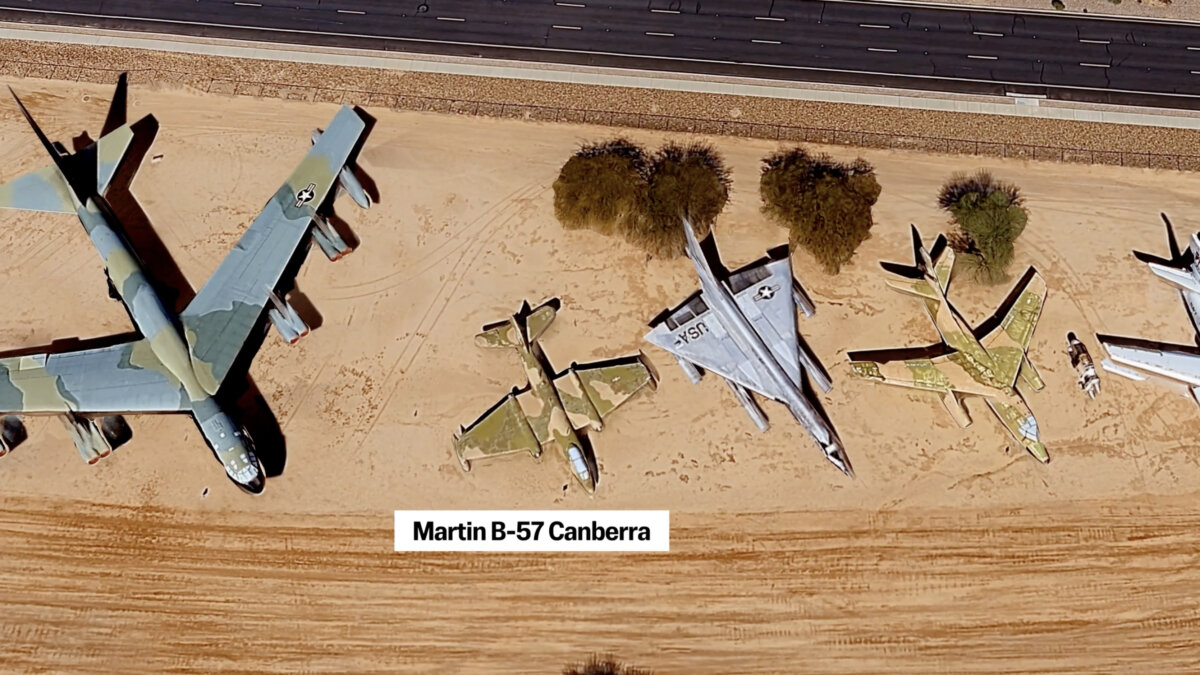
TUCSON, Ariz.—They are the dinosaurs of the modern age—hulking retired aircraft baking in the Arizona sun, stretching in rows across the desert.
Once America’s defenders of the sky—B-52 Stratofortress and B-1B Lancer bombers, F-16 Fighting Falcon fighters, and C-130 Hercules and C-5 Galaxy cargo planes—they now sit idle, preserved for parts or history.
Maintaining and reclaiming these aircraft is no small task at the nation’s only military aircraft “boneyard.”
At Davis–Monthan Air Force Base, the 309th Aerospace Maintenance and Regeneration Group (AMARG) oversees that work.
“Most of these planes have been decommissioned, but the parts are still very useful. The parts are all viable,” public relations manager Robert Raine said during an April 21 tour of the 2,600-acre (four-square-mile) AMARG facility in Tucson.
Each aircraft is secured for long-term storage, drained of fluids, stripped of explosive components, and preserved against the slow wear of the desert.
Depending on the aircraft, some could be brought back into service, Raine said.
Since 1964, the maintenance group has served as the sole designated storage, salvage, and disposal center for U.S. military and government organization aircraft.
The facility employs more than 700 workers and encompasses more than half a million square feet of industrial space.
Here, aircraft come to die, hibernate, or be reborn, their components cleaned, repaired, and repurposed for use in other machines—for conflicts now and those yet to come.
The facility opened shortly after World War II on April 1, 1946. The site was chosen for its dry desert climate and its ability to store vast quantities of surplus aircraft and military equipment.
Hard caliche soil, along with the absence of earthquakes and extreme weather such as tornadoes and hurricanes, made it an ideal place for long-term storage.
The sprawling boneyard is home to 3,488 aircraft, ranging from supersonic fighter jets to massive refueling and cargo planes to strategic bombers—75 aircraft types and 6,700 engines in all.
“AMARG is the last stop for parts” for legacy aircraft, Raine told The Epoch Times. However, it is “not an infinite source.”
When a component is needed, the request typically begins in the global supply system, he said.
If it is not available there, the request moves up the chain to Air Force weapon system program offices, Navy and Marine Corps program management authorities, or Navy Supply Weapon Systems Support.
Those agencies can then draw from the maintenance group’s vast inventory.
In that system, the boneyard functions as a deep reserve—an industrial fallback where retired aircraft continue to serve, one part at a time.
Raine noted that AMARG does not own any of the aircraft or other assets stored at the facility.
Ownership remains with the original service branches or organizations that delivered them, including U.S. government agencies such as the Coast Guard and Forest Service, allied governments, and private institutions such as the Smithsonian Institution.
The group has roughly 80 customers. But when it comes to procuring and delivering parts, its crews often work on short notice and tight timelines.
Each year, AMARG receives an average of 250 to 300 aircraft. Its five core missions are storage, reclamation, regeneration, modification, depot-level maintenance, and disposal.
The planes are inventoried, flushed of fluids, washed, sealed tightly with tape and a special spray material, and stored for years or decades.
“They’ve taken off hazardous materials,” Raine said. “They’ve taken off anything that might be classified. They’ve taken off anything that might need to be broken down to demilitarization.
“They’ve drained it to make sure that any residual preservative oil is out of it. They’ve drained the hydraulics out of the landing gear. They’ve depressurized any systems in the aircraft.
“It’s basically clean and ready to go.”
The most recent aircraft to arrive was an F/A-18E Hornet in mid-April. The longest-stored aircraft is a Navy T-1A Sea Star, which arrived on April 6, 1970.
Among the rarest are the XC-99 heavy cargo aircraft, a YC-14 military transport aircraft, and a T-46 light jet trainer aircraft.
The F-16 Fighting Falcon is the boneyard’s most numerous resident, with more than 350 aircraft. Some have been dismantled and sent to Ukraine for use as training platforms.
It is followed by more than 315 C-130 Hercules aircraft, nearly 300 F-15 Eagle fighters, and 235 A-10 Thunderbolt II aircraft.
In April, the Air Force moved a retired KC-135 Stratotanker out of long-term storage at the base for possible reactivation following losses of aerial refueling aircraft in the Iran conflict, according to FlightGlobal.
“[In 1948,] when the Soviet Union closed road, rail, and canal traffic into Berlin … about a quarter of the stored C-47 Skytrain cargo aircraft were withdrawn from storage and returned to flying service in support of the Berlin Airlift,” the War Department stated.
Aviation History
Some equipment hails from the Vietnam era, including the helicopter used in evacuating the last Marines from the U.S. Embassy in Saigon on April 30, 1975.
Another historic fighter jet kept at the site is a modified F-15 Eagle, nicknamed “Celestial Eagle,” which was used in the only successful satellite destruction by an aircraft-launched missile on Sept. 13, 1985.
Air Force Maj. Wilbert Doug Pearson launched an anti-satellite missile that destroyed a Solwind P78-1 satellite at an altitude of 375 miles.
The airplane got up to about 38,000 feet when Pearson fired the missile at Mach 1.22, Raine said. The weapon used a kinetic kill vehicle rather than an explosive warhead.
“So it just hit it, basically—skin to skin,” he said.
Raine said each aircraft in the boneyard is categorized by type based on condition and utility.
For example, Type 2000 aircraft are used for parts, while Type 3000 aircraft remain flyable but are rarely used.
Reclamation is the process of removing parts from aircraft to support warfighters or replenish supply inventories.
Regeneration involves returning aircraft to a serviceable condition.
Disposal is the final stage, when an aircraft no longer has a use and is ultimately dismantled and sold as scrap metal.
A number of aircraft with historic value have found their way into the Pima County Air and Space Museum in Tucson.
Among the museum’s decommissioned aircraft are F-16s and older jet fighters, including the SR-71 Blackbird, capable of reaching speeds of Mach 3.
The longest-serving AV-8B Harrier II+ was added to the museum after accumulating 9,671 flight hours.
“There are different levels of decommission for aircraft,” Kaylei, a museum tour guide who asked to only have her first name used, told The Epoch Times.
“Some are more just like waiting in the wings. But if needed, they’re kept in good enough repair to put back into service.”
Cost Avoidance
The Post Block Repair project at the AMARG is one of the Air Force’s major modernization efforts, keeping F-16s operational until they enter service life extension programs, according to the War Department.
The first aircraft for modification arrived at the boneyard in August 2022.
At AMARG, specialists carry out inspections, repairs, and upgrades to maintain F-16 performance and combat readiness, including avionics improvements to keep pace with evolving air combat.
The Air Force returned two B-1 Lancer bombers to active service after restoring them from the boneyard.
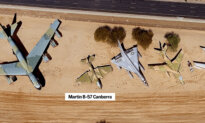
The service also regenerated C-23 Sherpa aircraft for use by the U.S. Forest Service and transferred B-57 Canberra aircraft to NASA for high-altitude missions, including eclipse observation.
The War Department noted that work also continues on A-10 Thunderbolt II components, such as engine cowlings, following the completion of the A-10 wing overhaul program in 2024.
In May 2019, a B-52 nicknamed “Wise Guy” became only the second B-52 Stratofortress to return to service from the boneyard, according to Air Force Times. It had entered storage in 2008.
Raine said AMARG not only provides the vital parts needed to keep fleets airborne but also generates billions of dollars in “cost avoidance.”
Every dollar not spent on new equipment is a taxpayer dollar saved, he said.
From fiscal years 2016 through 2026, AMARG reclaimed 79,358 parts—86 percent of them priority items—totaling $4.37 billion in value.
In Fiscal Year 2025, the facility reclaimed 8,399 parts, 85.3 percent of them priority, worth nearly $495 million.
So far this fiscal year, group crews have salvaged 6,434 parts, 71.8 percent of them priority, valued at $380.6 million.
For high-priority reclamations, the process can take as little as 24 to 48 hours from the time AMARG receives a request, Raine said.
More involved reclamations can take longer. On average, parts requests take seven to 10 working days from the time AMARG receives the request, he said.
In most cases, storage is long-term and requires extensive preparation.
“They’re going to clean all the bugs and gunk and grime off,” Raine said. “Then they’ll start the taping process. So cardboard first, then barrier paper.
“The tape holds that in place. This seals up openings. These are the openings that are in the back of the aircraft, and they’ll wax the canopy to keep the spray seal from getting too adhered to the canopy.”
It is mostly for temperature control, but it completes the seal, he said. Then the aircraft is placed in cold storage.
“So the big guys—like these KC-10s—can be put right out in the desert,” Raine said. “When the temperature gets too high or too low, we have to move the plane.”
Cost savings are further driven by more than 271,000 pieces of aircraft production equipment kept on site.
These specialized tools include the original mold for the B-2 Spirit cockpit canopies.
“You can see where the windows went out of the cockpit for the B-2,” Raine said. “And it looks kind of weirdly speckled because it originally had aluminum—what they call an armor shield aluminum coating—on it.”
Driving through the aircraft tooling storage area is like moving through a small city. But the scale of the boneyard becomes clear once one sees the B-52 Stratofortress bombers in various stages of disassembly and the C-5 Galaxy cargo planes with their 223-foot wingspans.
An F-16 Fighting Falcon sat in pieces as a crew performed “egress,” removing explosive components such as ejection-seat systems.
The sprawling landscape is dotted with outbuildings, among them a 1,000- by 180-foot covered facility with adjustable docks for work on C-130 Hercules aircraft and Northrop’s T-38 Talon jet trainer.
Three hard-sided hangars house 20 docks configured for regeneration, modification, and structural repair work, along with commodity shops and adaptive workspaces.
The site also includes a dedicated engine test shop, laser systems for paint removal, and two cranes for heavy lifting.
In October, AMARG expects to complete a temporary maintenance shelter with eight docks designed for F-16 aircraft.
Raine said about 70 percent of the boneyard is used for storage, a figure that fluctuates each year as aircraft and parts move in and out.
“By and large, everything flies itself in,” he said. “As long as stuff goes out, there’s room for aircraft to come in.”
 Friends Read Free
Copy
Facebook
Tweet
Friends Read Free
Copy
Facebook
Tweet