
President Donald Trump recently softened his hardline approach to higher education, offering financial incentives to nine universities if they promise to eliminate preferential treatment by race, enhance viewpoint diversity, and freeze tuition for five years, among other conditions.
This is a pivot from the previous heated exchanges with elite schools that lost federal funding following investigations into campus anti-Semitism and civil rights violations rooted in left-leaning policies.
Those episodes yielded mixed results, with some schools agreeing to the Trump administration’s demands and others challenging them in federal court.
The Compact for Academic Excellence in Higher Education, offered by the Department of Education to a mix of public and private universities in early October, could become the industry standard for all U.S. colleges and universities, according to some policy experts.
In exchange for more consideration in the competitive federal grant process and more leeway for overhead costs in research funding, the schools would limit the enrollment of undergraduate international students to 15 percent, freeze tuition rates for five years, ban racial preferences in hiring and admissions, require SAT scores in the student application process, and maintain institutional neutrality on political issues at all levels of administration.
It also requires schools to post average earnings from graduates in each program and refund tuition to undergraduates who drop out during their first semester.
Universities with endowments that equate to more than $2 million per student must provide free tuition to undergraduate candidates pursuing “hard science” programs, and institutions that enter this compact must accept all college transfer credits from military members or veterans.
“These are the best practices,” Matthew Beienburg, education policy director at the Goldwater Institute, told The Epoch Times. “It’s an indictment that higher education has strayed so far from its mission.”
The Massachusetts Institute of Technology (MIT) has rejected the offer, and the other schools are still considering it.
Here’s what we know.
DEI, Admissions, and Neutrality
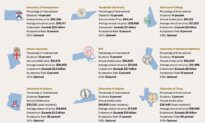
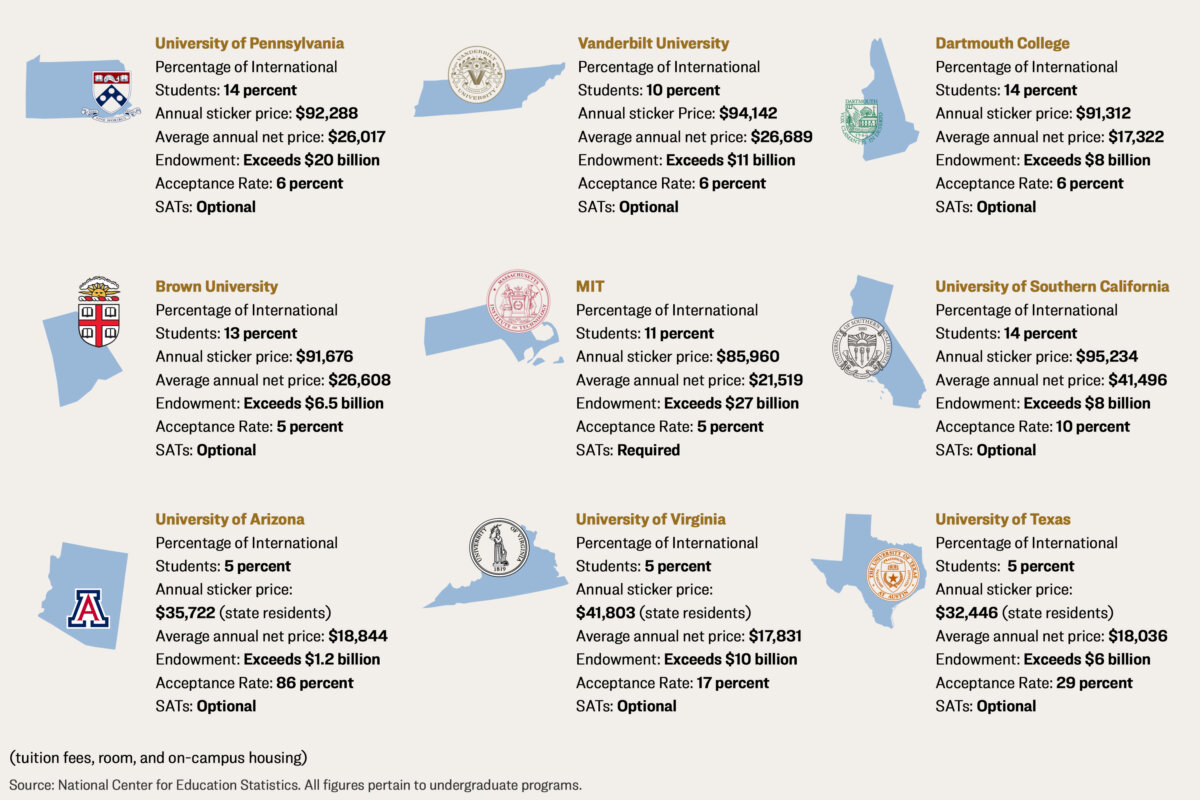
The Department of Education made the offer to nine institutions: private schools Vanderbilt University, Dartmouth College, Brown University, the University of Pennsylvania (UPenn), the University of Southern California (USC), and MIT, and the flagship public state campuses in Arizona, Virginia, and Texas.
Every school’s endowment exceeds $1 billion, and all offer financial aid that’s deeply discounted from the schools’ sticker prices.
All of them have scrubbed their websites of indications of diversity, equity, and inclusion (DEI) programs or policy frameworks for the current year.
The percentage of international student enrollment at every school is below 15 percent, according to the National Center for Education Statistics.
All except MIT and the University of Arizona have adopted a policy or principles of institutional neutrality, noting that they’ll abstain from declaring a collective opinion on political and social issues, according to the American Council of Trustees and Alumni.
The acceptance rate for all of the private schools is below 7 percent, while the public institutions are far less selective.
Eight of the schools, however, don’t require SAT scores for admission; MIT does.
Beienburg said the requirements of personal statements or essays instead of SAT scores are a red flag that universities are possibly trying to circumvent the ban on racial preferences and the 2023 U.S. Supreme Court ruling prohibiting affirmative action.
“The left believes standardized testing promotes racial inequality,” he said. “They pushed [for substituting tests with personal essays] very hard.”
The Ivy League
Two schools that were offered the compact previously pleaded no contest to Civil Rights infractions following federal investigations.
Brown University agreed to pay $50 million for state-level workforce development programs, and UPenn agreed to strip all previous records and awards from a male graduate identifying as transgender who won an NCAA national women’s swimming championship in 2022.
Dartmouth, based on an analysis of its website, maintains an “Office of Institutional Diversity and Equity” that promoted social justice awards for employees earlier this year, but the school did not extend its three-year “Toward Equity” program that began in the fall of 2022.
Similarly, Brown has an Office of Diversity and Inclusion with an administrative fellows’ program.
Public Universities
University of Virginia President James Ryan resigned in June following pressure to end the school’s DEI programs.
The school has a department of Belonging and Inclusion, and, other than an Office of African-American Affairs, the university website does not list many affinity programs or initiatives for students and employees based on race.
Other Elite Private Institutions
Vanderbilt Chancellor Daniel Diermeier has been outspoken about institutional neutrality, saying “the purpose of a university is to encourage debate, not settle it.”
MIT President Sally Kornbluth announced on Oct. 10 that she had rejected the Education Department’s offer.
In a letter to Education Secretary Linda McMahon, she said MIT abides by the law and meets or exceeds the standards noted in the compact, and that the accord would restrict the university’s independence and freedom of expression.
“And fundamentally, the premise of the document is inconsistent with our core belief that scientific funding should be based on scientific merit alone,” Kornbluth stated in the letter.
USC, which was on Trump’s list of 60 institutions cited for anti-Semitism, implemented layoffs and a hiring freeze in anticipation of federal funding cuts.
What Is Next?
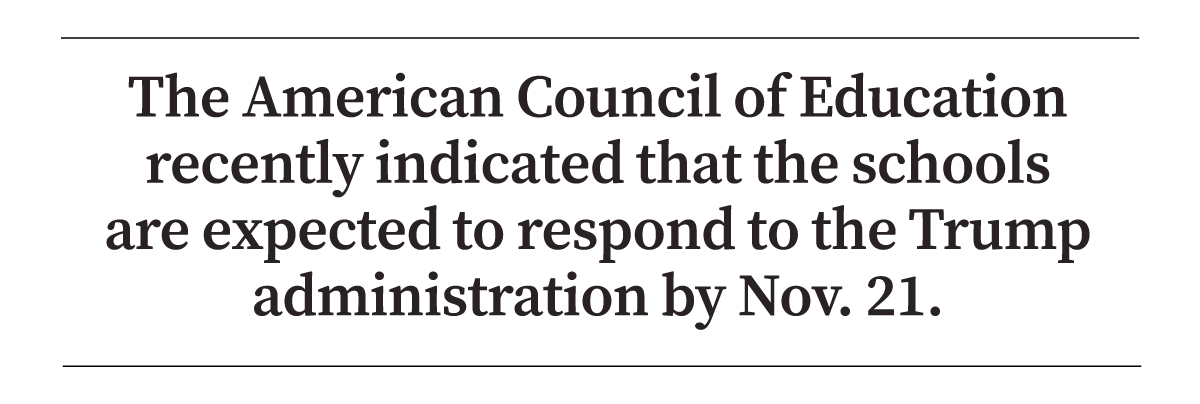
The American Council of Education, during a recent livestreamed discussion on the compact, indicated that the schools are expected to respond to the Trump administration by Nov. 21.
Jon Fansmith, a senior vice president of the council, called the compact offer “a grand escalation” in which Trump goes national with a school-by-school approach because prior attempts to impose his policies through executive orders were unsuccessful.
On Oct. 2, American Federation of Teachers President Randi Weingarten and American Association of University Professors President Todd Wolfson called on the nine schools to reject the compact, calling it a “partisan ideological agenda that stinks of favoritism, patronage, and bribery.”
“They would reward campuses that toe the party line and punish those that cherish their independence,” they said in a joint statement.
Beienburg said universities should be interested in cutting costs and making higher education more affordable, so the requirement for tuition freezes and reporting graduate earnings by programs could pave the way for eliminating the most ideological majors with low enrollments and few career prospects.
“There’s enormous bloat,” he said. “A lot of those majors don’t fulfill a public purpose.”
Steven McGuire, fellow with the American Council of Trustees and Alumni, said he credits the compact as a step in the right direction for much-needed higher education reform, but he said short-term deals and executive orders that change with administrations won’t solidify long-term change.
He suggested legislation that prohibits schools from mandating left-leaning general education requirements for all students.
McGuire also said Trump should listen to First Amendment concerns and give schools flexibility on tuition freezes.
“Schools should be allowed to figure out how they can make it more affordable,” he said.
The Epoch Times reached out to the Department of Education and all nine schools that received Trump’s compact offer.
Officials from the University of Arizona, USC, UPenn, and Vanderbilt noted in emailed responses that they were still deciding.
 Friends Read Free
Copy
Facebook
Tweet
Friends Read Free
Copy
Facebook
Tweet