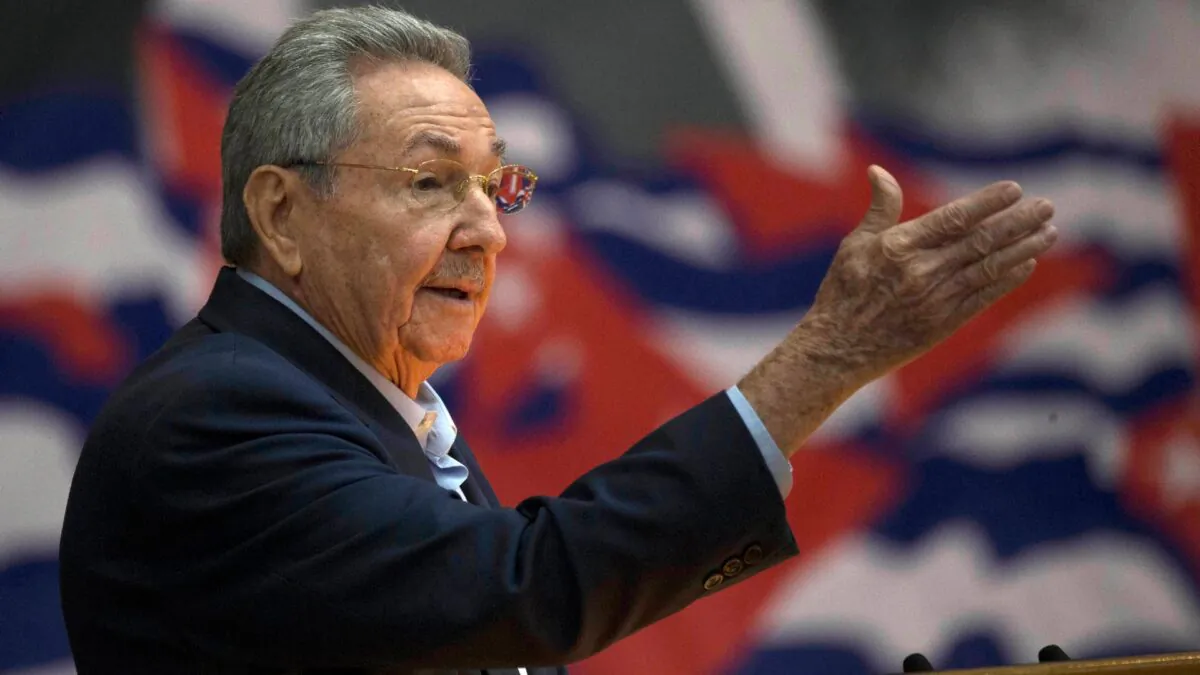
Raul Castro, the brother of revolutionary Cuban leader Fidel Castro, has been charged for allegedly shooting down planes operated by a humanitarian group in 1996 and killing their occupants, according to an indictment unsealed by the U.S. Attorney General’s Office on May 20.
A federal grand jury based in Miami returned the indictment in April, charging Raul Castro, 94, and five other people with conspiracy to kill U.S. nationals, destruction of aircraft, and four individual counts of murder.
A crowd cheered for nearly a minute when United States Acting Attorney General Todd Blanche revealed the charges against Castro on Wednesday inside the Freedom Tower at Miami Dade College.
Castro’s fate remains to be seen as he resides in Cuba, and U.S. officials did not reveal how they planned to extradite the aging political figure to the United States.
Here’s what to know about the controversial Cuban leader and his past.
Rise to Power
Castro was born in the Cuban hamlet of Biran in 1931.
The future political figure attended college in Havana to study social sciences. Eventually, he participated in protests and political activities organized by his brother, Fidel, in a guerrilla war as they worked to overthrow then-dictator Fulgencio Batista.
The brothers were successful in causing Batista to flee the country.
Fidel took over as leader and his government imposed a communist system on the island nation. He tapped his brother to run Cuba’s military, and Raul Castro held that position from 1959 through 2008.
As defense minister, Raul Castro oversaw military operations during the unsuccessful U.S.-backed Bay of Pigs invasion in 1961.
Service
Castro became leader of the island nation in 2006 after his brother, Fidel, fell ill.
Castro, who did not make as many public appearances as his brother, served under the title of acting president until he formally took over the presidential seat in 2008.
His leadership was seen as less strict than his brother’s reign.
During his tenure as Cuba’s communist dictator, Raul Castro was known for launching social and economic reforms that allowed foreign investment to enter the country, mom-and-pop businesses to open, and people to buy and sell homes and cars starting in 2011.
The former leader gifted then-U.S. President Barack Obama more than $2,000 worth of cigars and a bottle of rum in 2015, as the Obama administration worked to reopen an embassy on the island.
The mutual efforts to restore diplomacy resulted in a three-day visit by Obama to Cuba in 2016, which was the first time a U.S. president had set foot on the island in 88 years.
Retirement
Castro retired in 2018 and handed over the job to his protégé, current Cuban leader Miguel Diaz-Canel, as he took the title of army general and head of the country’s Communist Party.
Castro officially announced his retirement from office in 2021.
The last time Castro was seen in public was in the capital of Havana on May 1 for an International Workers’ Day event. He appeared tired during the event and had to sit down suddenly during the ceremony.
Charges
Castro and five codefendants were accused of shooting down humanitarian planes over international waters in February 1996, killing three U.S. citizens and one lawful U.S. resident.
The four unarmed people who were killed were Carlos Costa, Armando Alejandre Jr., Mario de la Peña, and Pablo Morales.
The codefendants named in the indictment are Lorenzo Alberto Perez‑Perez, Emilio José Palacio Blanco, José Fidel Gual Barzaga, Raul Simanca Cardenas, and Luis Raul Gonzalez‑Pardo Rodriguez.
“This is the first time in almost 70 years that a senior leadership of the Cuban regime has been charged in the United States for acts of violence resulting in the death of Americans,” U.S. Attorney Jason A. Reding Quiñones said when the indictments were announced.
“The passage of time does not erase murder. It does not diminish the value of those lives, and it does not weaken our commitment to the rule of law.”
Reuters contributed to this report.
 Friends Read Free
Copy
Facebook
Tweet
Friends Read Free
Copy
Facebook
Tweet