
TALLAHASSEE, Fla.—As federal agents conduct immigration enforcement operations around the country, protests often erupt, at times involving violent attacks.
Some high-profile Democratic politicians have urged their followers to fight back against law enforcement officers as they seek to arrest illegal immigrants.
In Florida, by contrast, the removal of illegal immigrants mostly moves along peacefully, even as the state leads the nation in cooperating with federal immigration enforcement efforts, a state official and a top federal immigration official told The Epoch Times.
And what may surprise some is that it’s a Democrat—appointed by Florida’s Republican governor, Ron DeSantis—who’s leading the state’s collaboration with federal agencies.
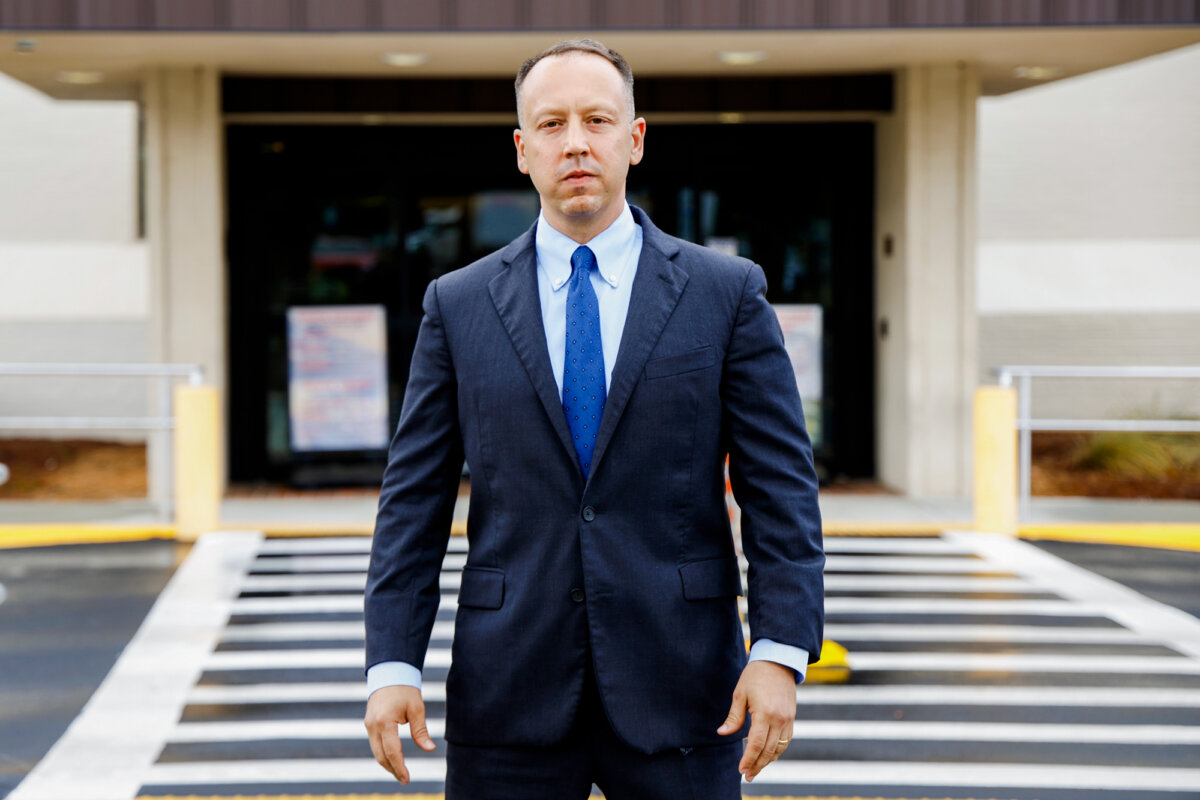
As executive director of the Florida Department of Highway Safety and Motor Vehicles, a big part of Dave Kerner’s mission has become capturing and removing illegal immigrants from the Sunshine State. And under his leadership, the state’s effort to assist federal law enforcement agencies is setting records, a report from Immigration and Customs Enforcement (ICE) shows.
Since late March, 7,361 people have been arrested in collaborative immigration enforcement operations, according to Kerner.
Texas is second in number of agencies collaborating with federal immigration enforcement. Only a few states don’t have any law enforcement agencies with existing or pending agreements to help with federal immigration enforcement, ICE records show.
Still, as successful as Florida’s collaboration has been in the eyes of law enforcement officials, the job of removing illegal immigrants from the state has no clear end in sight.
“But give us a little time,” said Jeffrey Dinise, chief patrol agent with the Border Patrol’s Miami Sector.
Dinise oversees border security operations between the ports of entry across about 187,000 square miles, including 1,279 miles of Florida shoreline along the Atlantic Ocean and the Gulf of America.
About 1.1 million illegal immigrants told federal officials that they had a sponsor in Florida and would be headed there, he said. There is no way to know how many of those actually made it to the state, according to Dinise.
Then there are the so-called gotaways, the unknown millions of people who crossed the border illegally and evaded capture.
About 45 percent of illegal immigrants arrested in Florida are gotaways, Kerner said. So there is no way to know exactly how many of them make their home in the state.
It’s generally assumed that most gotaways avoided Border Patrol because of a criminal past in another country or an intention to break other laws here in the United States, Kerner and Dinise told The Epoch Times.
Now, with Kerner orchestrating Florida’s effort, law enforcement agencies in all 67 of the state’s counties collaborate with federal operations to remove illegal immigrants. And troopers with the Florida Highway Patrol, an agency Kerner manages, work daily with officers from both ICE and Customs and Border Protection.
‘Harmonious Partnership’
Florida’s help with federal immigration enforcement sharply contrasts with what federal agents have been experiencing in some other areas of the country, said Dinise, a 23-year law enforcement officer.
“I’ve lived all over the nation, from California to Washington state to Washington, D.C., to Texas,” he said. “Florida does it the best right now. I’ve never seen such a harmonious partnership.”
Around the country, federal agents working on immigration enforcement and their families have been doxed. Attacks on them have escalated by more than 1,000 percent, Homeland Security Secretary Kristi Noem has said. And death threats against ICE agents have escalated by more than 8,000 percent, the Department of Homeland Security (DHS) said in October.
Some blame the rhetoric of political leaders within the Democratic Party for the surge.
California Gov. Gavin Newsom, a Democrat, has frequently criticized federal immigration enforcement under the second Trump administration and has framed his state’s response as resistance.
In September, while signing legislation aimed at “protecting immigrant communities,” Newsom said of immigration enforcement operations, “That’s Trump’s America, but it is not the America we’ve grown up in, and so we’re pushing back.”
On Nov. 12, a group of 40 Democratic members of Congress sent letters to state governors complaining that the states were providing “frictionless” access to personal data of residents.
“We urge you to block ICE’s access, as Illinois, New York, Massachusetts, Minnesota, and Washington have already done and Oregon is in the process of doing, and to consider going further by blocking access to other federal agencies that are now acting as Trump’s shock troops,” they wrote.
Although there has been some resistance to immigration enforcement efforts in Florida, it has been far less severe than what agents experience in many other places, according to Dinise.
Kerner said he believes that Florida’s new anti-riot law helps keep protests from spiraling into violence.
The law, passed in 2021 by the state’s Republican-led legislature and signed by DeSantis, stiffens penalties for riot behavior. The idea, lawmakers said, was to preserve freedom of speech and the right to protest but prevent violent protests like those seen after the 2020 death of George Floyd.
It matters, according to Kerner.
“I can tell you from the heart and from experience that when the chief executive of a state or of any government stands up to highlight the heroism and risks and dangers that law enforcement face, it changes the culture,” he said.
In January 2023, DeSantis crossed the political aisle to appoint Kerner to lead the Florida Department of Highway Safety and Motor Vehicles.
The trust placed in a Democrat in such a high level of government sparked fury from some on the political right. Kerner recalls being accosted in public by a right-leaning political commentator when out with his then-fiancée, who was frightened by the incident. The commentator has since been “very kind,” Kerner said.
He said he understands that some might see him as an unlikely champion of immigration enforcement because of his political registration.
But the mission has nothing to do with politics and everything to do with a respect for “law and order,” he said.
“For me personally, there’s nothing political about compliance with our federal and state laws,” he said.
It’s a “huge personal and professional honor” to be leading Florida’s efforts to remove illegal immigrants, Kerner said. He aims to build a model that can be duplicated in other states.
Then, he said, the United States “can really make a meaningful impact on what has become a crisis of illegal immigration in this country.”
Under his watch, he said, federal officers “don’t have to use some of the tactics that they use in these larger, urban cities, where the police are basically prohibited from helping.”
“[In Florida] there’s never a time where ICE and Border Patrol are going to be outnumbered,” he said. “They will always have support 100 percent of the time … and I think that’s the game changer.”
The partnership Kerner created allows federal agents to embed with state troopers.
“[Florida is] ranked constantly number one in the nation in terms of apprehensions and deportations,” Kerner said.
“We attack the problem every day in a very safe, very professional, and dignified manner. And when you do it in that model, you ensure that there’s a whole government approach and you don’t get the problems in the pushback that you see in other states.”
Since late March, about 1,800 of the 2,000 state troopers he manages have been trained to handle encounters with people suspected of being illegal immigrants as they carry out their normal daily duties. About 20 are in a special task force and now “focus 24/7 on actively enforcing immigration law,” he said.
“[Now] a trooper can encounter an undocumented immigrant on the side of the road during a traffic stop, and within an hour, we can have that person taken into custody [and] transported just a couple miles to the processing facility that we set up in that particular jurisdiction,” Kerner said.
“He or she will be processed, and when the ICE bus reaches its capacity, will leave with [a Florida Highway Patrol] escort down to Alligator Alcatraz or another federal facility, all within an hour or two.”
Alligator Alcatraz, a federal immigration detention facility in the Florida Everglades, opened on July 1 and has been loudly decried by the political left as an improper place to detain illegal immigrants. A second facility, known as Deportation Depot, was added in the northern part of the state in September.
Kerner said on a typical day, when his officers are doing “directed enforcement operations,” they will arrest about 100 illegal immigrants within a couple of hours.
“So 100 people need to be processed, moved, detained, secured, fed—all of the logistics that go into that. … We definitely need Deportation Depot and Alligator Alcatraz to hold these folks,” he said.
“I think we’re up to two flights a day in Florida, so that they can go to outlying facilities for their final due process and ultimate deportation.”
Kerner, the son of a retired law enforcement officer, was sworn in as a police officer at age 19. A year later, while enrolled full-time at the University of Florida, he was honored as Police Officer of the Year in the city of Alachua.
He has served continuously in appointed or elected public office since 2004, including as a special prosecutor, a member of the Florida House of Representatives, mayor of Palm Beach County, and a DeSantis-appointed member of the state’s Re-Open Florida Task Force during the COVID-19 pandemic.
Immigration Enforcement Unleashed
On Jan. 20, the day President Donald Trump was sworn in for his second term, he issued Executive Order 14159, “Protecting the American People Against Invasion.” It required ICE to start authorizing state and local law enforcement officials to help with immigration enforcement “to the maximum extent permitted by law” under Section 287(g) of the Immigration and Nationality Act.
Florida was first to jump in to help, Kerner said.
“ICE and Border Patrol never have to worry about going into a jurisdiction alone; they are never without state trooper and Florida Highway Patrol assistance,” Kerner said.
“When we were deployed to the Panhandle a couple months ago, we had protesters show up at our hotel where we were housed for the operation. And people have a right to protest.
“But what you’ll see less of are physical and unlawful attempts to try to interfere with our operations. And that’s because people in Florida know, whether you disagree with it or not, the mission is going to be accomplished, and that ICE … has the full backing of state and local law enforcement.”
“It’s definitely a different temperature [in Florida],” he said.
He’s well aware that authorities in places in Florida with predominantly liberal leanings may disagree with prioritizing immigration enforcement and removing illegal immigrants.
“But [the governor] has required, through the law, that they give their best efforts, that they participate in our enforcement prerogatives and priorities,” Kerner said. “And the results speak for themselves.”
As of December, more than 275 Florida law enforcement agencies across all 67 of the state’s counties were collaborating with federal agencies to detain illegal immigrants, according to an ICE report. Texas had about 200 local and state agencies involved.
As of Dec. 18, ICE had signed 1,255 agreements to work with agencies in 40 states in immigration enforcement.
Monthly reports documenting states’ collaborative work with ICE include a sampling of criminal aliens recently arrested by state or local law enforcement.
Case after case details immigrants who have been convicted of serious crimes. The latest available report at the time of publication was for November 2025.
The 2,000 troopers in the Florida Highway Patrol likely have a variety of political beliefs, Kerner said. But when it comes to immigration enforcement, they express unity and “passion about what it is we’re doing,” he said.
Efforts Nationwide
Across the nation, more than 605,000 illegal immigrants have been removed since Trump started his second term, DHS announced on Dec. 10.
That is more removals than in the previous four years during the Biden administration, according to an ICE annual report.
And in the 11 months since Trump took office, 1.9 million people have “voluntarily self-deported,” DHS Assistant Secretary Tricia McLaughlin said in a DHS statement.
“The Trump administration is shattering historic records with more than 2.5 million illegal aliens leaving the U.S.,” McLaughlin said.
“Illegal aliens are hearing our message to leave now. They know if they don’t, we will find them, we will arrest them, and they will never return.”
DHS is now running ads encouraging illegal immigrants to “take control of their departure” by using the CBP Home app. Users register their intent to depart the country through Project Homecoming, which offers potential fine forgiveness and travel assistance. Participants receive $1,000, a free flight out of the country, and a chance to come back to the United States legally. On Dec. 22, Noem announced that the bonus will be bumped to $3,000 until the end of the year.
If they do not self-deport, illegal immigrants “will be arrested and deported without a chance to return,” the ads warn.
‘The Secret Sauce’
Unlike in many other states, illegal immigrants in Florida cannot obtain a driver’s license, Kerner said.
“[And] the vast majority of people here illegally will drive, and they will eventually get caught,” he said.
Federal agents working with troopers with the Florida Highway Patrol have proven strategies for identifying which cars to pull over. Details are part of “the secret sauce” that cannot be revealed in a news story, Dinise said.
But the resulting roadside encounters often trigger a trip to a federal detention facility for the vehicle occupants, he said.
Gotaways that are arrested often have the most troubling pasts, Kerner said.
“[They] intentionally crossed the border and evaded apprehension, had no desire whatsoever to obtain and maintain a lawful status,” he said. “They had no desire to be known … whether for nefarious reasons or other reasons.”
“[We have] no real idea about how many gotaways there are that entered during the Biden administration, but it’s certainly in the millions,” Kerner said.
“We have encountered gotaways that we’ve apprehended that have had murder warrants from Guatemala, that have had rape warrants and current rape allegations on children in the state of Florida … and they have existed in this country through evasion for sometimes generations.”
About one-third of those arrested in immigration enforcement operations have a criminal history, Dinise said.
During a November operation in the Florida Keys, 44 illegal immigrants were arrested and “27 of them had prior convictions for terrorist threats, DUI, alien smuggling, [or] assault,” he told The Epoch Times.
Dinise said he understands why immigration enforcement causes a mix of emotions for many. But the issue should not spark division along political lines, he said, and does not excuse the demonization of law enforcement officers.
“Law enforcement is nonpolitical, right?” he said. “There are laws on the books, and we’re just here to enforce those.”
 Friends Read Free
Copy
Facebook
Tweet
Friends Read Free
Copy
Facebook
Tweet