
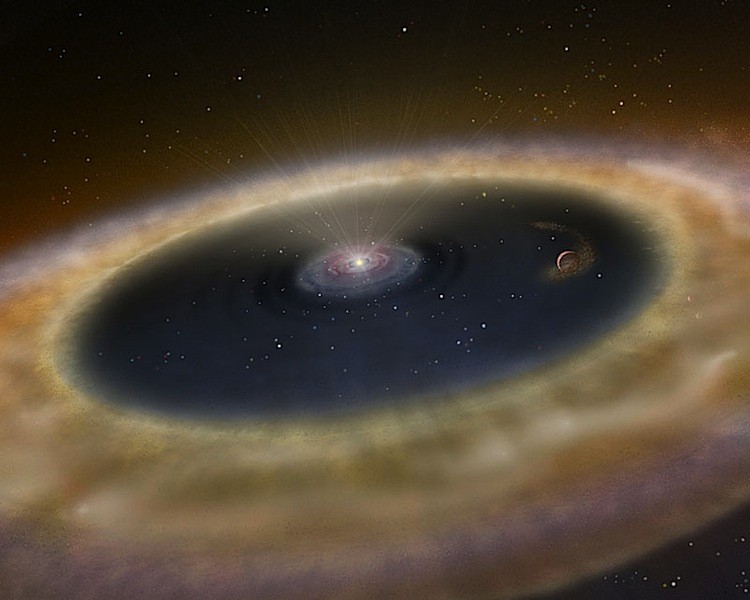
Known as LkCa 15 b, the hot "protoplanet" is surrounded by cooler dust and gas that are falling inwards. Its parent star is about the same size as our sun, and only around two million years old.
"LkCa 15 b is the youngest planet ever found, about five times younger than the previous record holder," said Adam Kraus at the University of Hawaii in a press release. "This young gas giant is being built out of the dust and gas.
The astronomers used aperture mask interferometry to concentrate light into the telescope’s deformable mirror, which enabled them to directly measure the planet even though it is so close to its parent star.
The technique cancels out a star’s light to resolve the dust disks around it and look for gaps containing protoplanets.
"Interferometry has actually been around since the 1800s, but through the use of adaptive optics has only been able to reach nearby young suns for about the last seven years," said Michael Ireland at Australia’s Macquarie University in the release.
"Since then we’ve been trying to push the technique to its limits using the biggest telescopes in the world, especially Keck."
The baby planet was found after a survey of 150 young dusty stars led to a focused study of a dozen stars.
"LkCa 15 was only our second target, and we immediately knew we were seeing something new," said Kraus. "We could see a faint point source near the star, so thinking it might be a Jupiter-like planet we went back a year later to get more data."
Later, by studying the star at varying wavelengths, the astronomers found that there was more than just a single companion object.
"We realized we had uncovered a super Jupiter-sized gas planet, but that we could also measure the dust and gas surrounding it," Kraus said. “We’d found a planet at its very beginning."
Currently, the planetary infant may have the mass of about six Jupiters, but may be much smaller once it is fully formed.
Kraus presented the findings at meeting at NASA’s Goddard Space Flight Center on Oct. 19. The paper will be published in The Astrophysical Journal.
 Friends Read Free
Copy
Facebook
Tweet
Friends Read Free
Copy
Facebook
Tweet