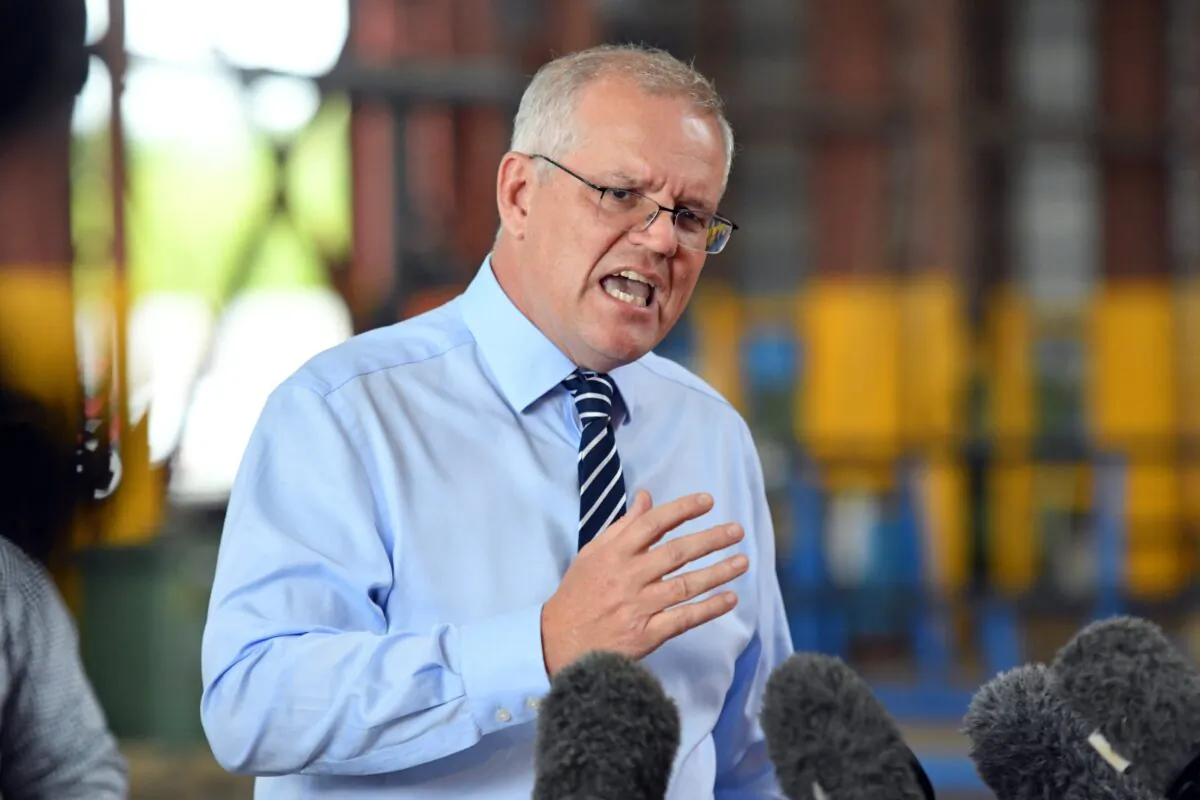

A conflict with Beijing will not be limited to tanks and weapons, and instead will encompass a wide array of domains including cyber, according to Australian Prime Minister Scott Morrison.
The prime minister was responding to questions over Australia’s readiness to confront a more aggressive Chinese Communist Party (CCP) in the region, saying the AUKUS agreement with the United States and United Kingdom would help bridge capability gaps across different areas of modern warfare.
“The first shot fired in any conflict is actually in bits and bytes. It’s not in bullets,” Morrison told 2GB on April 26 in reference to the emerging field of cyber warfare, which has seen governments invest billions in counteracting increasingly sophisticated hacking activities.
“A lot of the focus has been on the nuclear-powered submarines,” he said. “But the AUKUS agreement is way bigger ensuring that we have a comprehensive defence in modern warfare.”
The headline initiative from AUKUS is Australia’s potential acquisition of nuclear-powered submarines from the United States and United Kingdom, a highly classified technology that was shared only once to the British in 1958.
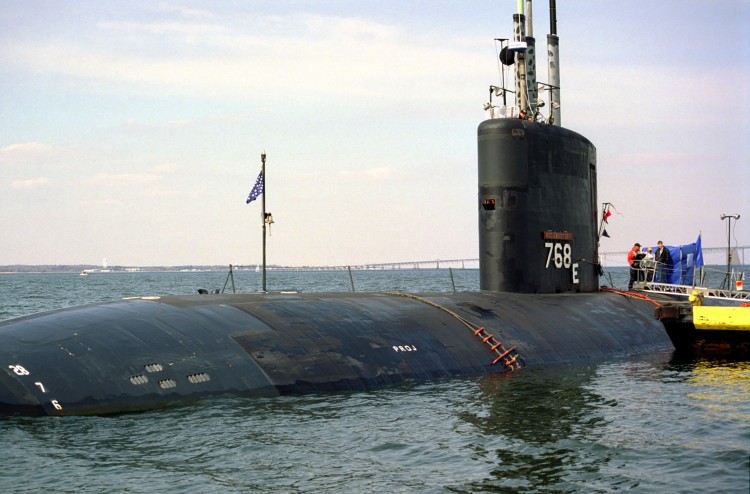
Yet, AUKUS has ushered in close collaboration between the allies in other advanced fields including quantum technology, undersea capabilities (drones), hypersonic weapons, artificial intelligence, and advanced cyber.
“We prepare for these things to ensure we can keep stability and peace within our region. That’s why we did the AUKUS agreement … That’s why we drove the step up of the QUAD,” Morrison said, referring to the security dialogue between Australia, Japan, United States, and India.
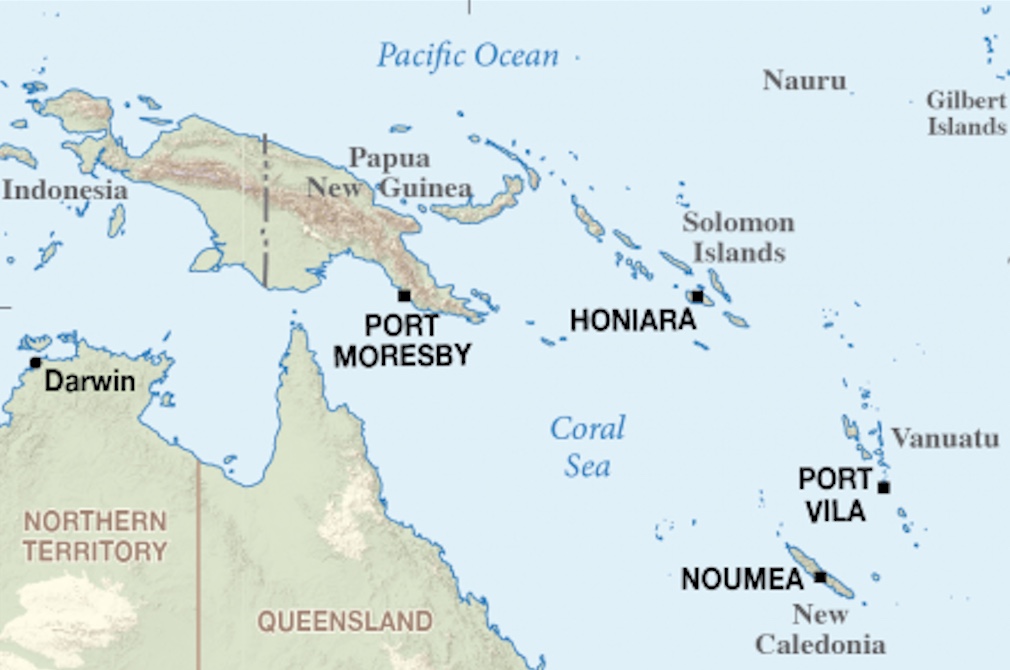
The prime minister said the efforts were designed to “counterbalance” the expansionist activities of the CCP in the South China Sea and more recently the Solomon Islands.
The federal opposition Labor Party has launched an ongoing political campaign criticising the Morrison government for not preventing the Beijing-Solomon Islands security deal from happening—a stance experts say is unrealistic.
The deal, in essence, would allow the CCP—with the consent of the Solomons—to dispatch police, troops, weapons, and even naval ships to “protect the safety of Chinese personnel and major projects in the Solomon Islands.”
If fully realised, it would extend the reach of the Chinese People’s Liberation Army into the heart of the South Pacific just 1,700 kilometres (1,050 miles) from Australia’s northern city of Cairns.
“The government should have acted sooner. We live in a world where the strategic circumstances we face are riskier and more uncertain than in any time since the end of World War II,” she told the Australian Broadcasting Corporation (ABC) on April 20.
[morearticles mode=”false”]4427308[/morearticles]
Morrison however said he was one of the few Australian leaders to visit Fiji, Vanuatu, and the Solomon Islands in recent times, while also noting the opening of six diplomatic missions in the South Pacific.
“We are concerned for all of the countries in the region,” he said. “There are 20 Pacific Island foreign nations … there are 20 areas which we’re looking to ensure we counter that (CCP) influence.”
Morrison warned last week that Australia’s northern neighbour, Papua New Guinea, was facing “pressure” from Beijing to consent to a similar security agreement to the one with the Solomons.
“We’re the only country in the world to have an embassy in every single one of those Pacific island nations,” he added. “So it’s an area which is tightly contested, and we’ve always been heavily forward leaning. But we’re dealing with the Chinese government that doesn’t play by the same rules.”
 Friends Read Free
Copy
Facebook
Tweet
Friends Read Free
Copy
Facebook
Tweet