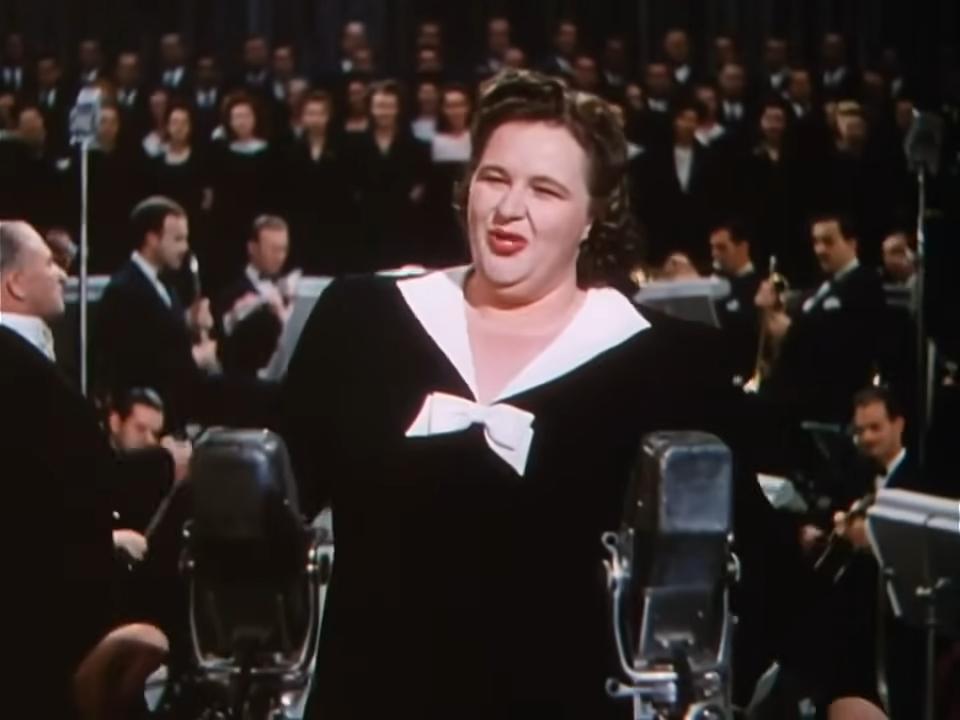
The United States was founded on the idea of being unafraid to fight for personal liberty and the freedom of others. Many of our greatest patriotic songs were written during military conflicts. The words to our national anthem, “The Star-Spangled Banner,” were inspired by the hope that the flag would keep flying during the War of 1812. In the days leading up to World War II, another patriotic anthem—most commonly heard before sporting events—had its debut.
Americans first heard Kate Smith sing “God Bless America” on an Armistice Day radio broadcast in 1938. Irving Berlin had written the words and music 20 years earlier. As war in Europe was brewing, he retooled it as an anthem for peace.
The song is brilliantly inspiring in and of itself, but there was something about the way Smith sang it that captured the hearts (and ears) of the American people. From inspiring World War I soldiers as a child to her later years selling war bonds, the “First Lady of Radio” truly had a heart for America.
Songbird of the South
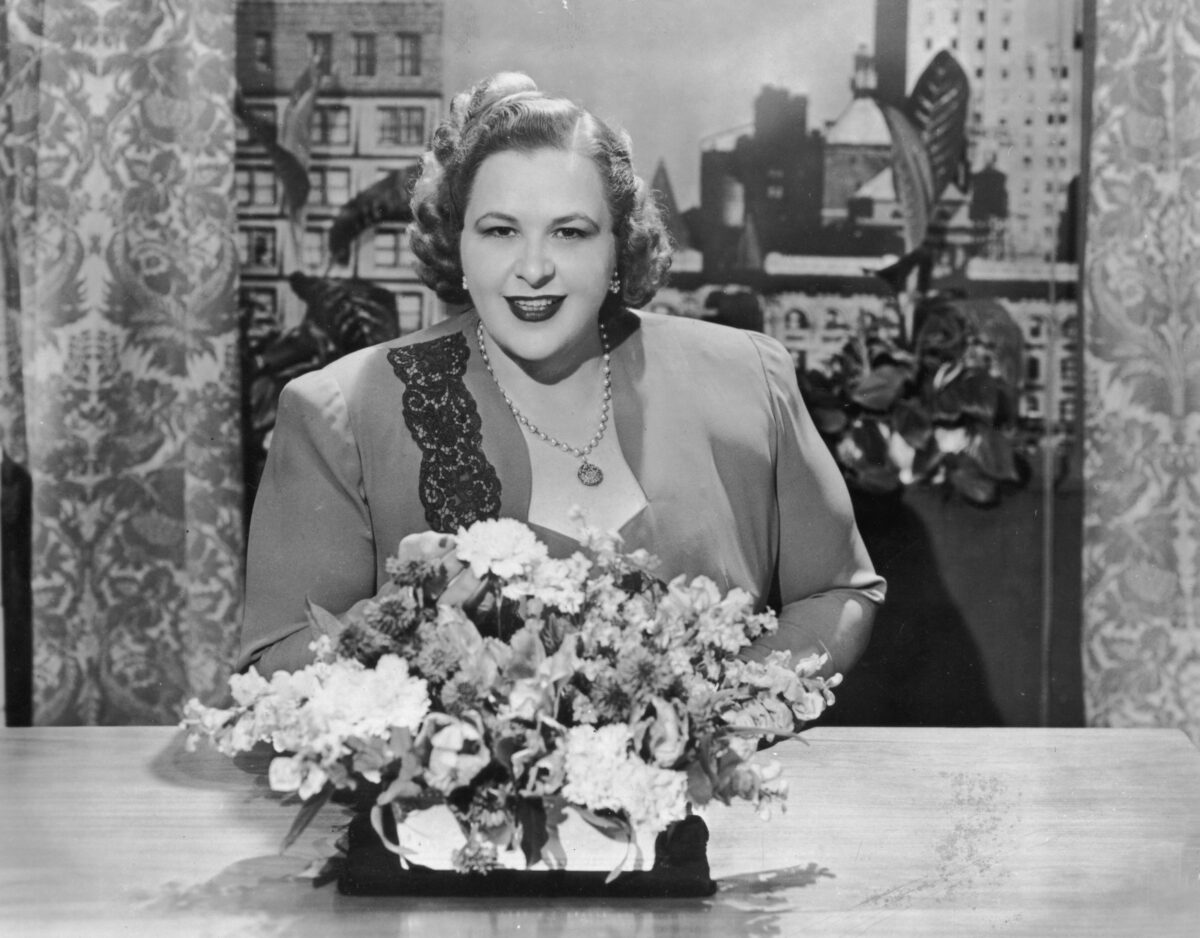
Kathryn Elizabeth Smith was born on May 1, 1907, in Greenville, Virginia. Although she was often called the “Songbird of the South,” she spent very little time in her native Virginia, living most of her life in the Washington D.C., area.
She couldn’t talk until she was 4 years old, yet she was singing at church social events by age 5. By 8, she was performing at Army camps near the capital, inspiring soldiers during World War I. As she got older, she performed in amateur nights at vaudeville theaters.
Although she never had a formal singing lesson, Smith had a naturally powerful and resonant voice with a two-and-a-half-octave range. Her father didn’t want her to pursue the notoriously unstable career of a musician and encouraged her to attend the George Washington University School of Nursing after she graduated from Business High School. After nine months at nursing school in 1924-25, she dropped out, deciding that she would heal people’s spirits with her beautiful voice instead.
One of her first breaks came when she appeared on the bill at Keith’s Theater in Boston. Also on the bill was actor and producer Eddie Dowling, who recruited her for his 1926 revue “Honeymoon Lane.” The show ended up moving to Broadway that summer, and the 19-year-old Smith was compared to renowned vaudeville superstar Sophie Tucker by a New York Times reviewer, who also remarked that her weight was “in the immediate neighborhood of 200 pounds.”
Radio and Recording Star
This wouldn’t be the last time that the singer’s fame went hand in hand with derision about her size. Over the next few years, her appearances were hit-and-miss as she tried to build a steady career in show business.
In 1930, she played the lead role of Pansy Sparks in George White’s “Flying High,” a Broadway show that ran for 122 performances. She often cried in her dressing room because of the cruel jokes about her weight made by co-star Bert Lahr both on and offstage. Smith was passed over for the film adaptation of the story the next year, but she would soon meet the person who recognized her talent.
That same year, she caught the attention of Columbia Records A&R executive Ted Collins. Though she had recorded intermittently for Columbia since 1926, Collins noticed her while she was performing in the road company of Vincent Youmans’s “Hit the Deck.” She sang “Hallelujah!” in blackface, mammy-style, to acclaim. He realized her potential as a radio singer and recording artist.
Collins became her manager, and they had a longtime 50-50 partnership. Smith recalled, “Ted Collins was the first man who regarded me as a singer, and didn’t even seem to notice that I was a big girl.” Through his kind encouragement, she overcame her self-consciousness.
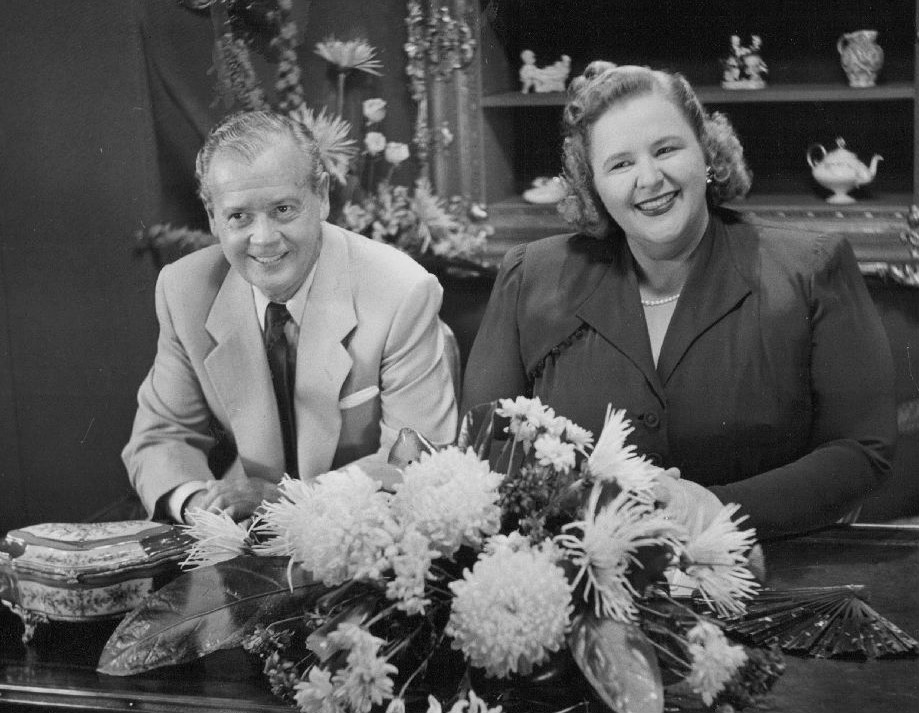
In 1931, under Collins’s management, Smith’s career took off. On the radio, she had a series of hit songs, starting with “Dream a Little Dream of Me” and “River, Stay ‘Way From My Door.” In 1933, she made her film debut in “Hello, Everybody!” She earned a gold record in 1941 for her recording of “Rose O’Day,” which was her first to sell over a million copies.
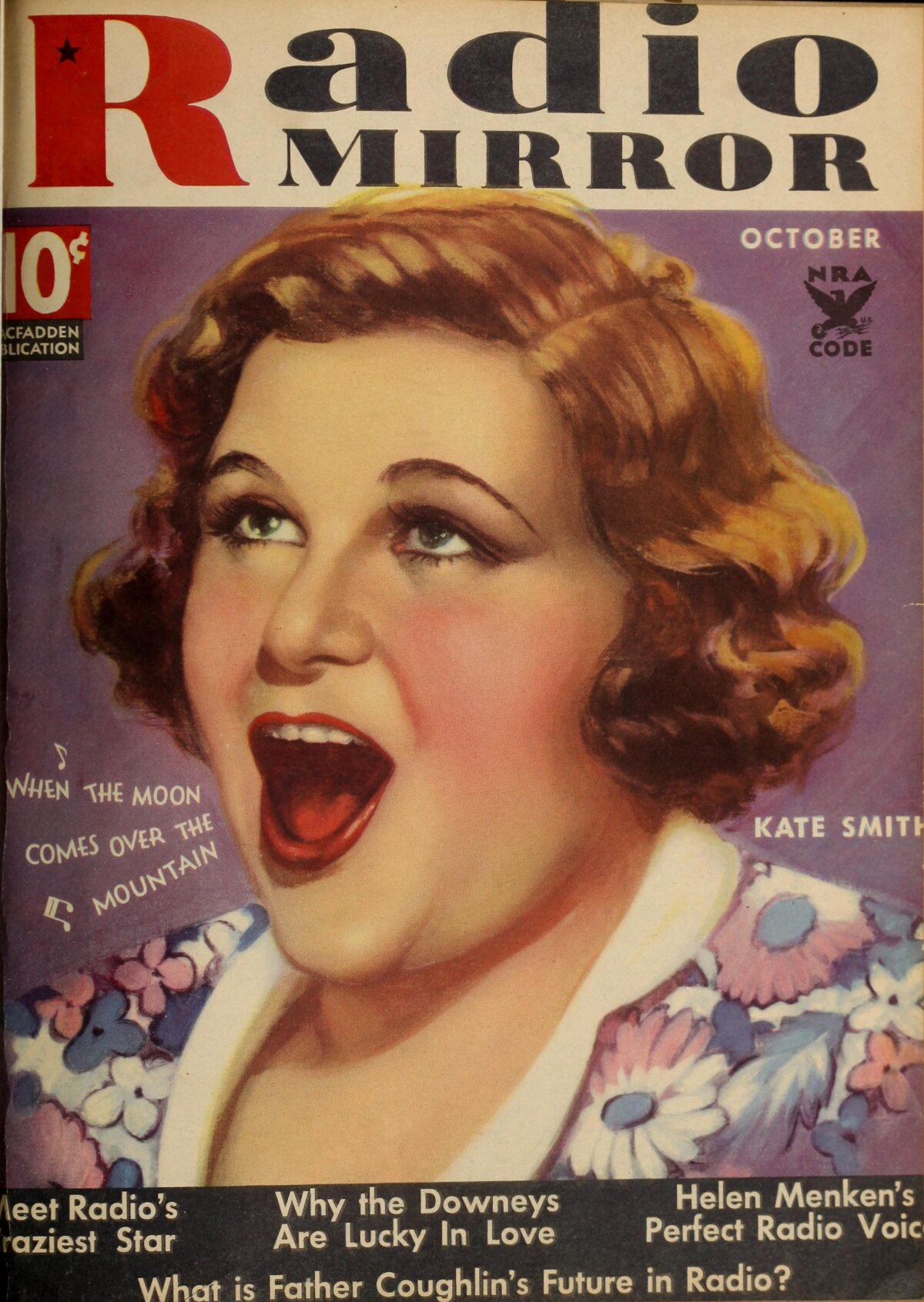
Smith earned the nickname “First Lady of Radio” for the numerous shows she hosted, usually backed by Jack Miller’s Orchestra. She started with the semi-weekly “Kate Smith Sings,” which quickly expanded to six shows per week because of its popularity.
Throughout the 1930s, she hosted seven radio programs, the longest-running of which was “The Kate Smith Hour,” which aired from 1937 to 1945. This variety show featured Broadway talents, film personalities, comedians, and musicians.
Across her various programs, she opened with her theme song, “When the Moon Comes Over the Mountain,” which she-wrote. She greeted listeners with “Hello, everybody!” and signed off with “Thanks for listenin’, establishing a sense of familiarity and trust with audiences.
A Patriotic Voice
Smith inspired great patriotism during World War II, largely through her rendition of “God Bless America,” which she sang in the Warner Bros. film “This Is the Army” (1943). She sold far more war bonds than any other celebrity, helping raise $600 million through a series of marathon broadcasts.
Her influence extended beyond radio. She appeared in print advertising for companies ranging from the Pullman Company to Jell-O. Throughout the 1950s, Smith expanded to television with two programs and continued broadcasting on radio and television for NBC through 1960.
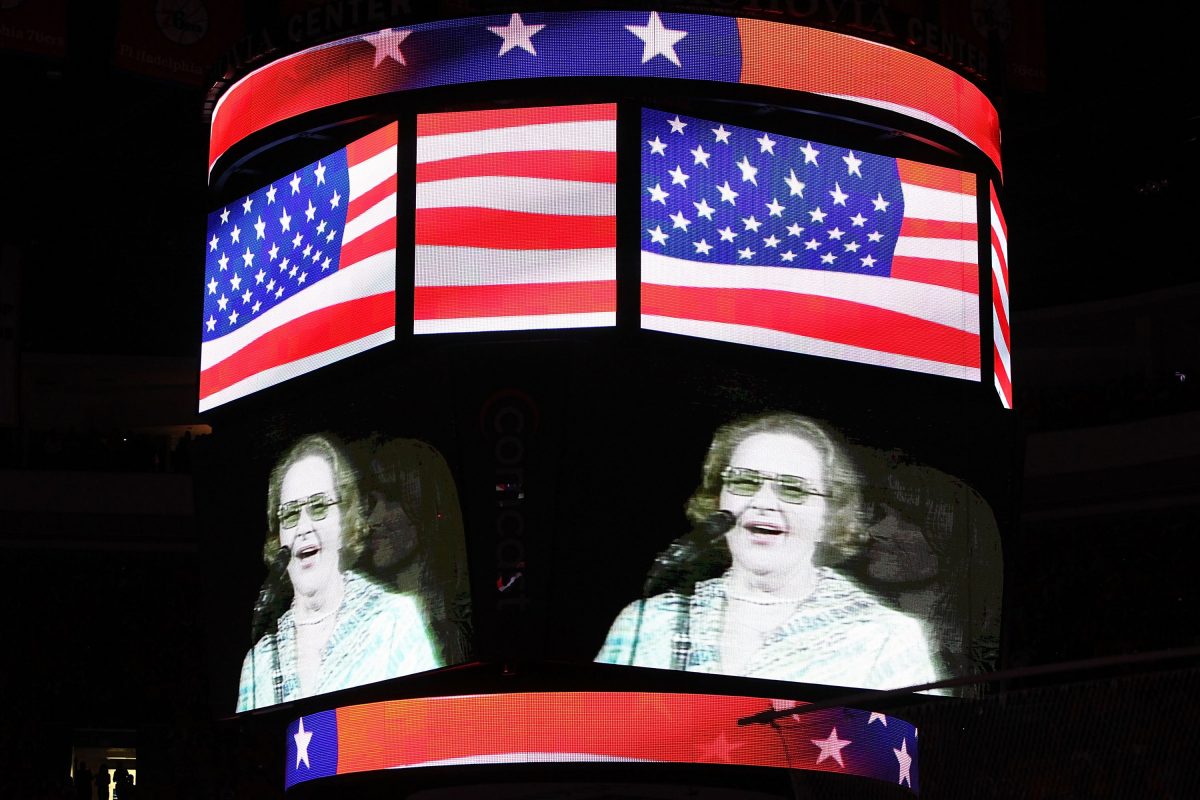
Smith gained a surprising new audience a decade later when her rendition of “God Bless America” was played before a Philadelphia Flyers ice hockey game on Dec. 11, 1969. At a time when some fans objected to “The Star-Spangled Banner” amid the Vietnam War, the team adopted Berlin’s song as an alternative.
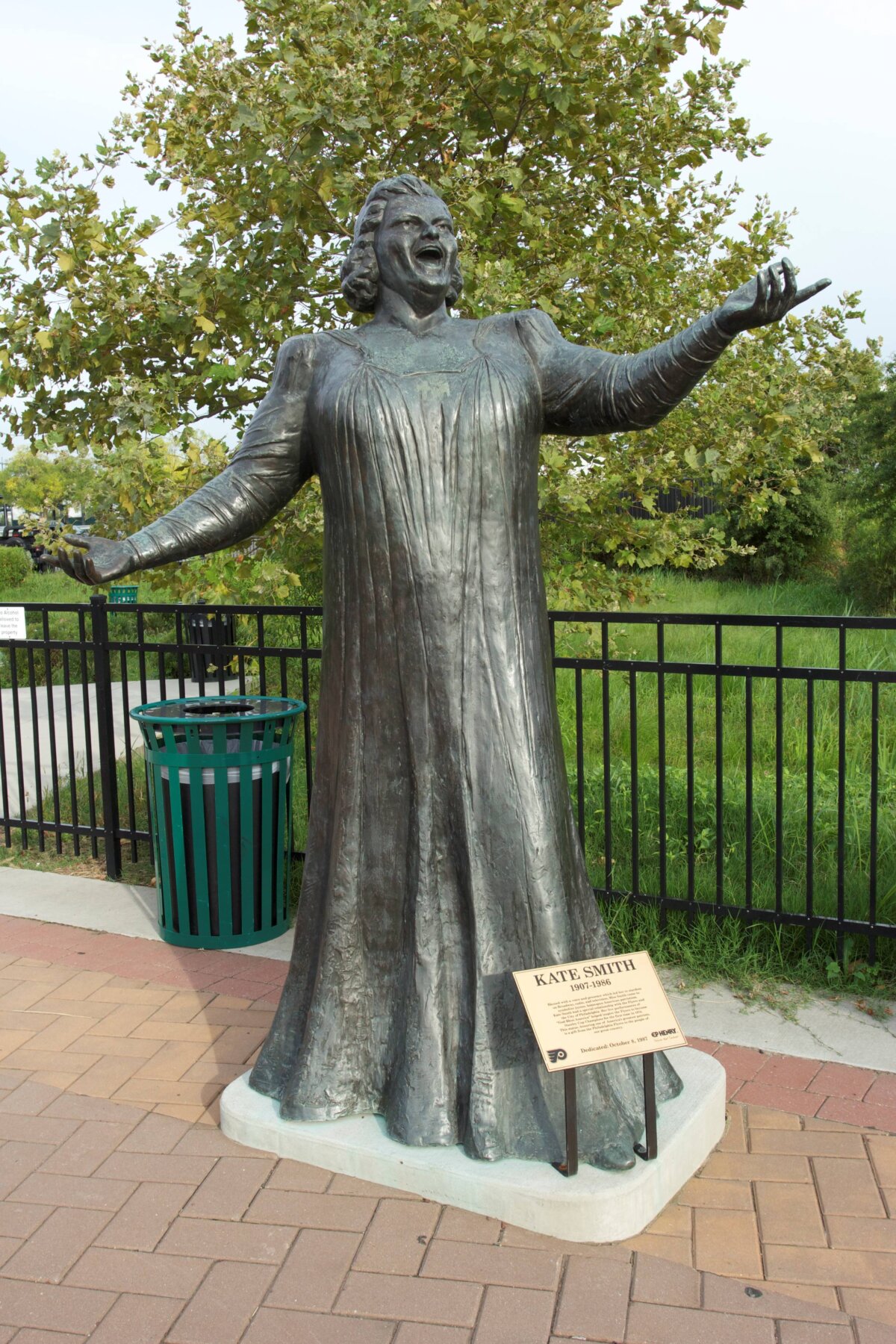
The song ended up becoming the team’s “good luck charm.” Smith sang it live before several important games. Her rendition on May 23, 1985, before Game 2 of the Stanley Cup Final,s was her last public performance. In recognition of her place in team history, the Flyers erected a statue of Smith outside their arena, the Spectrum, in 1987, a year after she died.
In 1982, President Ronald Reagan, who had appeared in “This Is the Army” almost 40 years earlier, presented Smith with the Presidential Medal of Freedom, saying:
“The voice of Kate Smith is known and loved by millions of Americans, young and old. In war and peace, it has been an inspiration. Those simple but deeply moving words, ‘God bless America,’ have taken on added meaning for all of us because of the way Kate Smith sang them. Thanks to her they have become a cherished part of all our lives, an undying reminder of the beauty, the courage, and the heart of this great land of ours. In giving us a magnificent, selfless talent like Kate Smith, God has truly blessed America.”
What arts and culture topics would you like us to cover? Please email ideas or feedback to features@epochtimes.nyc