The ancient Greeks saw live theater as essential for moral development. Despite brutal deaths, self-fulfilling curses, and fraught finales, their tragedies were intended to encourage emotional maturity and inspire reflection on honesty, justice, and other paramount values.
Among the greatest Greek tragedians was Aeschylus (circa 525 B.C–circa 456 B.C.), whose “Prometheus Bound” reminded spectators to accept their mortality and embrace their role in a cosmos ruled by superhuman forces.
Theater, Catharsis, and Self-Knowledge
The Greek philosopher Aristotle (384 B.C.–322 B.C.) was the first to theorize the psychological effects of drama. An astute observer of nature and humanity, Aristotle suggested that live theater had a cathartic power. “Catharsis” is Greek for “cleansing” or “purification.” In the philosopher’s words, “through pity and fear [tragedy] effects relief to these and similar emotions.”
A classic example is Sophocles’s “Antigone,” a masterful tragedy that depicts, among other things, the eponymous princess’s overwhelming grief for her dead brother, who lies unburied and thus can’t journey safely to the afterlife. For Aristotle, watching a live enactment of Antigone’s grief could prompt viewers to feel pity for the fictional character, giving them an opportunity to express the emotion healthily in a controlled group setting.
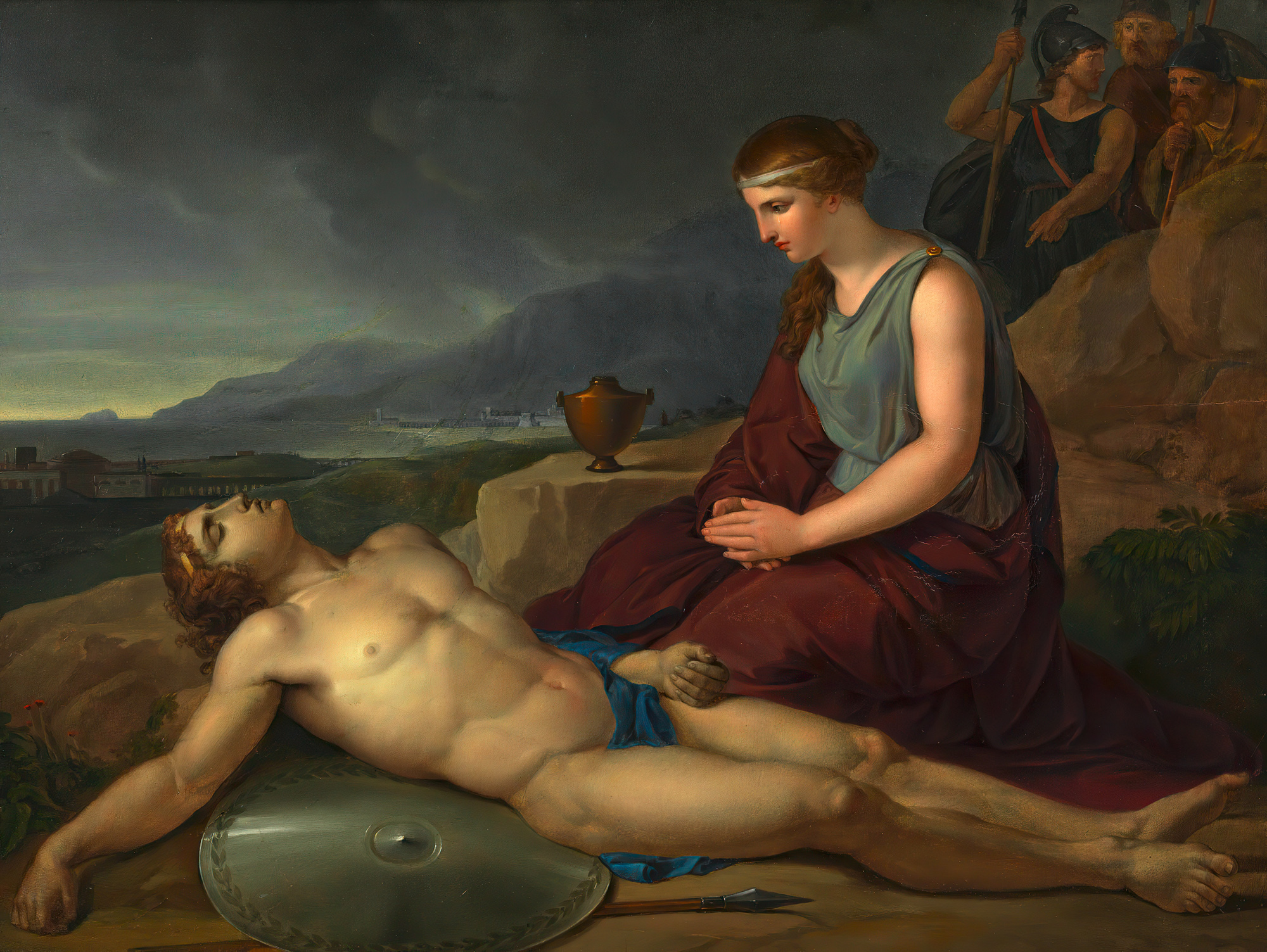 Josef Abel’s 19th-century painting shows Antigone beside the body of her brother, Polynices. (Public Domain)
Along with emotional catharsis, live theater posed the Greeks challenging questions. In “Antigone,” the questions are mainly political. The play’s intense emotions provide a backdrop for musings on the rule of law and divine authority. Other dramas, like “Prometheus Bound,” tackled different themes, such as war, loyalty, or mortality.
Prometheus the Fire-Bearer
Prometheus is one of the most popular ancient Greek mythological characters. His story was first written down by Hesiod in “Theogony” (circa 700 B.C.), a poem about the origins of the most important Greek gods.
The family tree began with Gaia (Earth) and Uranus (Sky), who gave birth to the first generation of Titans, including Oceanus, god of water, and Iapetus, god of mortality, progenitor of humankind, and father of Prometheus. A member of the second generation of Titans, Prometheus was a cousin to the first Olympians. The Olympians included Hades, Poseidon, and Zeus, who had orchestrated a war to claim his generation’s supremacy over the Titans.
Like the cities they were meant to protect, the Greek deities competed for power, often neglecting familial ties for the sake of violent domination. That was certainly the case with Zeus and Prometheus, whose animosities played out in a “cold war” full of perfidy and deceit.
Prometheus tried several times to undercut Zeus’s authority. In his most significant attempt, he stole “the far-seen gleam of unwearying fire in a hollow fennel stalk.” Out of spite for Prometheus and human beings, Zeus had Pandora created. Once opened, her famous “box” unleashed unparalleled poverty and disease upon humanity.
 “Pandora’s Box” by Charles Edward Perugini. (Public Domain)
Aeschylus’s ‘Prometheus Bound’
Fire enabled humans to speak, reason, write, use numbers, interpret divine omens, and keep track of the seasons. It helped them domesticate animals, outsource strenuous labor, and use their free time for drama and philosophy.
Prometheus enumerated the benefits in Aeschylus’s play, which established the Titan’s fame for millennia to come.
The tragedy opens with a dismal description of the desolate landscape where Prometheus is forced to endure his punishment. Two characters—personified Power and Hephaestus, god of smithing—are bickering about what to do with the prisoner. Power, Zeus’s right hand, urges a begrudging Hephaestus to enchain Prometheus. After expressing pity for the suffering Titan, Hephaestus obeys.
As punishment for his transgression, Prometheus is chained to a rock, where he has to endure eternal torment. Every day, a famished eagle pecks at his liver. Every night, his wounds heal. The eagle isn’t mentioned until the end of the play. But the story was so popular that a Greek audience would have easily understood.
A 12-person “chorus” suddenly appears. In Greek drama, the chorus functioned as a collective character. Through a chorus leader, it expressed emotional reactions, judged the characters’ actions, and offered clues about the plot.
In “Prometheus Bound,” the chorus is a group of sprightly water nymphs, daughters of Oceanus. The nymphs ask Prometheus to relate his story. As the Titan explains the causes of his plight, the nymphs weep, voicing their sympathy.
Yet, far from a soft shoulder to cry on, the chorus also admonishes Prometheus’s pessimism. The Titan refuses to do anything about his imprisonment, for “the might of Necessity permits no resistance.” In other words, everything is already determined. For Prometheus, there’s no reason to try escaping.
Halfway through the play, Oceanus enters. He offers Prometheus assistance, should he want to free himself. Prometheus dismisses the offer, and Oceanus leaves, afraid that all-seeing Zeus might catch him talking to a criminal.
Prometheus and the chorus resume their conversation, which finally reveals the full gravity of the Titan’s theft. The “fire” sparked technological revolutions that transformed humanity from a lowly, bestial people into a powerful, flourishing civilization.
In another sudden appearance, a figure “with a cow’s horns sprouting from her head” enters the scene. Her name is Io, a princess who had become the object of Zeus’s implacable desire. Out of jealousy, Hera, Zeus’s wife, transformed Io into a cow, condemning her to a life of agony.
When Io reaches Prometheus’s desolate cliff, her body is swathed by a thick cloud of gadflies that pinch her incessantly. Prometheus knows her. She is also a victim of Zeus’s injustice. The chorus asks the Titan to tell Io’s story, offering spectators a chance to empathize with this new character’s woe.
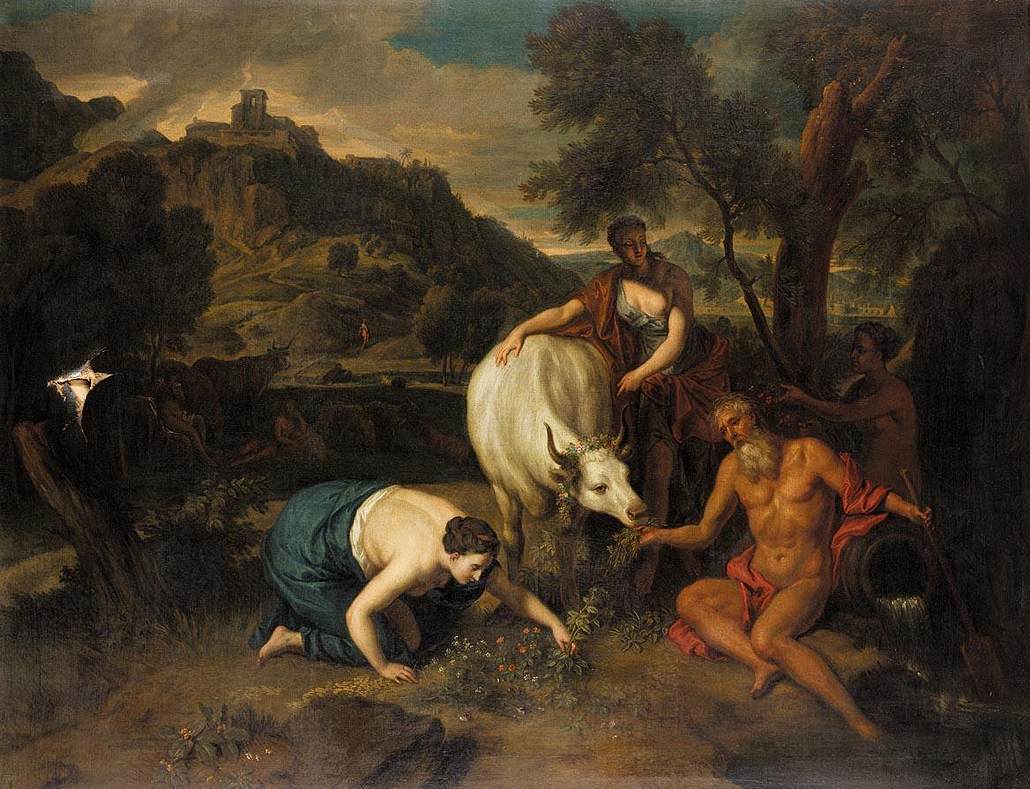 “Io Recognized by Her Father,” by Victor Honoré Janssens. (Public Domain)
Prometheus, whose name means “forethought,” reveals a prophecy about Io’s future. The woman will be transformed back into a human. She will marry, as will her many children. One of their descendants will free Prometheus. The Titan doesn’t disclose the rescuer’s identity, though his name would have been on any spectator’s tongue: Herakles, or, as the Romans later called him, Hercules.
Worried by the prophecy, Zeus sends the messenger-god Hermes to extract more information out of Prometheus. The Titan doesn’t budge, citing immortality as a shield against fear: “Why should I fear anything, when it’s not my fate to die?”
The play concludes with Zeus’s wrath: Thunder and lightning engulf the defiant Prometheus, who will suffer until his fated liberation.
Reckoning With Mortality
The Greeks took death seriously. Their acute awareness of mortality is apparent in Aeschylus’s diction. Out of many Greek synonyms for “human,” Aeschylus almost exclusively used “brotos” and “thnetos,” which literally mean “mortal” and “one who dies.”
Early in the play, Prometheus justifies his actions as a demonstration of pity towards mortals’ wretched condition: “That’s why I’m bent under tortures like this/ Painful to suffer and pitiful to see/ Because I placed mortals ahead in pity.”
The chorus also invokes mortality. In occasional moments of stern reprobation, the nymphs remind Prometheus that he “honour[s] mortals too much,” and that he should not “benefit mortals beyond what is their due.” They ask the Titan to consider whether his efforts were worthwhile:
“Didn’t you see/ The feebleness of little strength/ Like a dream, in which the blind/ Race of humans were shackled? Never/ Will the plans of mortals surpass the arrangements of Zeus.”
Prometheus embodies an alternative to Zeus’s “arrangements.” But the Titan isn’t human. Indeed, none of the play’s characters are. Death doesn’t concern them as it does “the blind race of humans,” with its “little strength” and trivial plans. Despite the great advantages of fire, the play suggests that human beings shouldn’t forget their mortal nature, lest they call upon themselves a punishment as serious as the Titan’s.
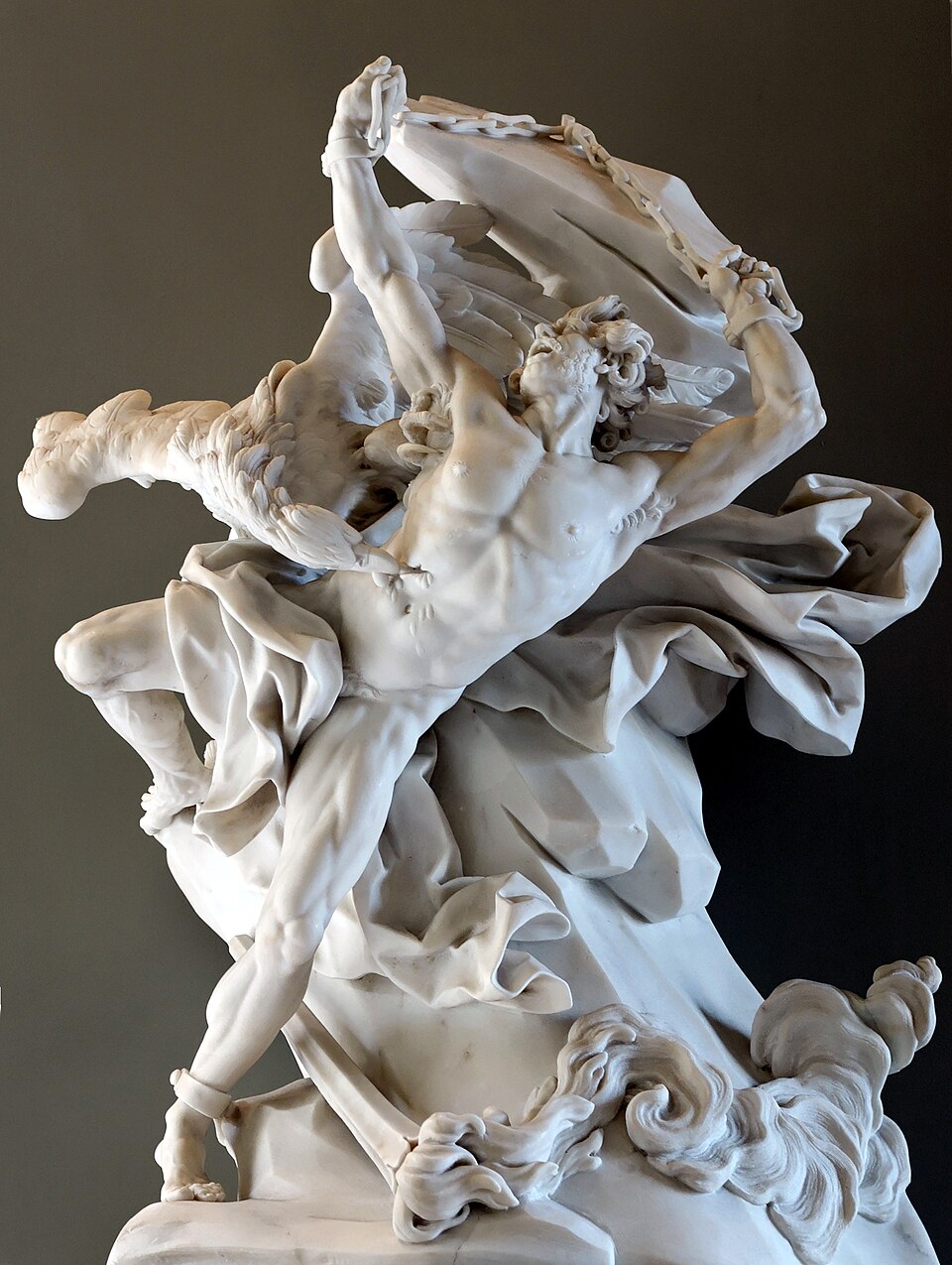 “Prometheus,” 1762, by Nicolas-Sébastien Adam. Louvre, Paris. (Public Domain)
All-Powerful Necessity
The Greek word for Prometheus’s revolutionary gifts is “techne,” often translated as “art,” “skill,” or “technology.” The fire, source of all technology, belonged to Hephaestus, who uses it to chain the thief in the play’s opening. Zeus worried that new technologies might motivate humans to act like gods, hence the harsh sentence he gave them and Prometheus.
When the nymphs ask the Titan about his plans to escape, he dismisses the question, noting that “Skill is much weaker than Necessity”—a strange thing to say for someone whose unusual trademark weapon was skillful cunning, not brute force.
Prometheus can see the future. He knows that someone will free him. That’s why he’s able to accept his condition calmly. He also wants the world to understand that Zeus is unjust. Although he often says he would be ashamed if someone saw him in chains, the Titan recognizes that his blatant agony might spark anger towards his perpetrator.
The Greeks taught by negative examples, stressing the virtue in accepting one’s limitations and the vice of overreaching. Their lessons were frank and occasionally austere, but never cynical.
Whatever one makes of Prometheus’s fatalism, it’s a sober reminder that greater forces govern human life. Like the Titan, humanity might do well to remember its origins as it reckons with exciting new powers.
What arts and culture topics would you like us to cover? Please email ideas or feedback to features@epochtimes.nyc