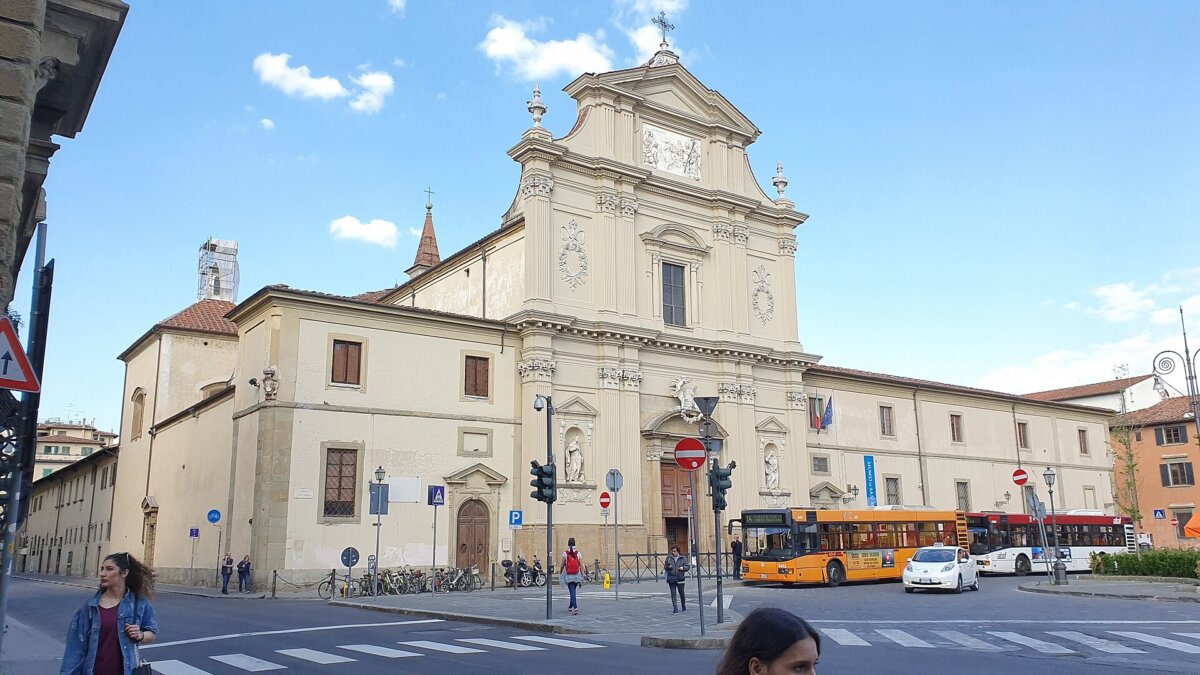
A stroll through Florence’s northern district requires visitors to pass by the Catholic convent of San Marco, an unassuming religious complex that pales before the city’s grand churches.
Behind San Marco’s façade is a cool, quiet columned cloister where monks once paced in pious contemplation. The narrow corridors on the complex’s second floor link a dozen small private rooms adorned by striking frescoes of biblical images. The larger communal areas also feature rich paintings, which colored the regular rhythms of San Marco’s monks until 2014.
In the 1400s, the monastery became an intellectual hub, not least because of its library. Now, visitors can ponder well-preserved medieval manuscripts stored in thick glass cases.
How did a modest convent come to house Florence’s first public book collection? How did it change the world?
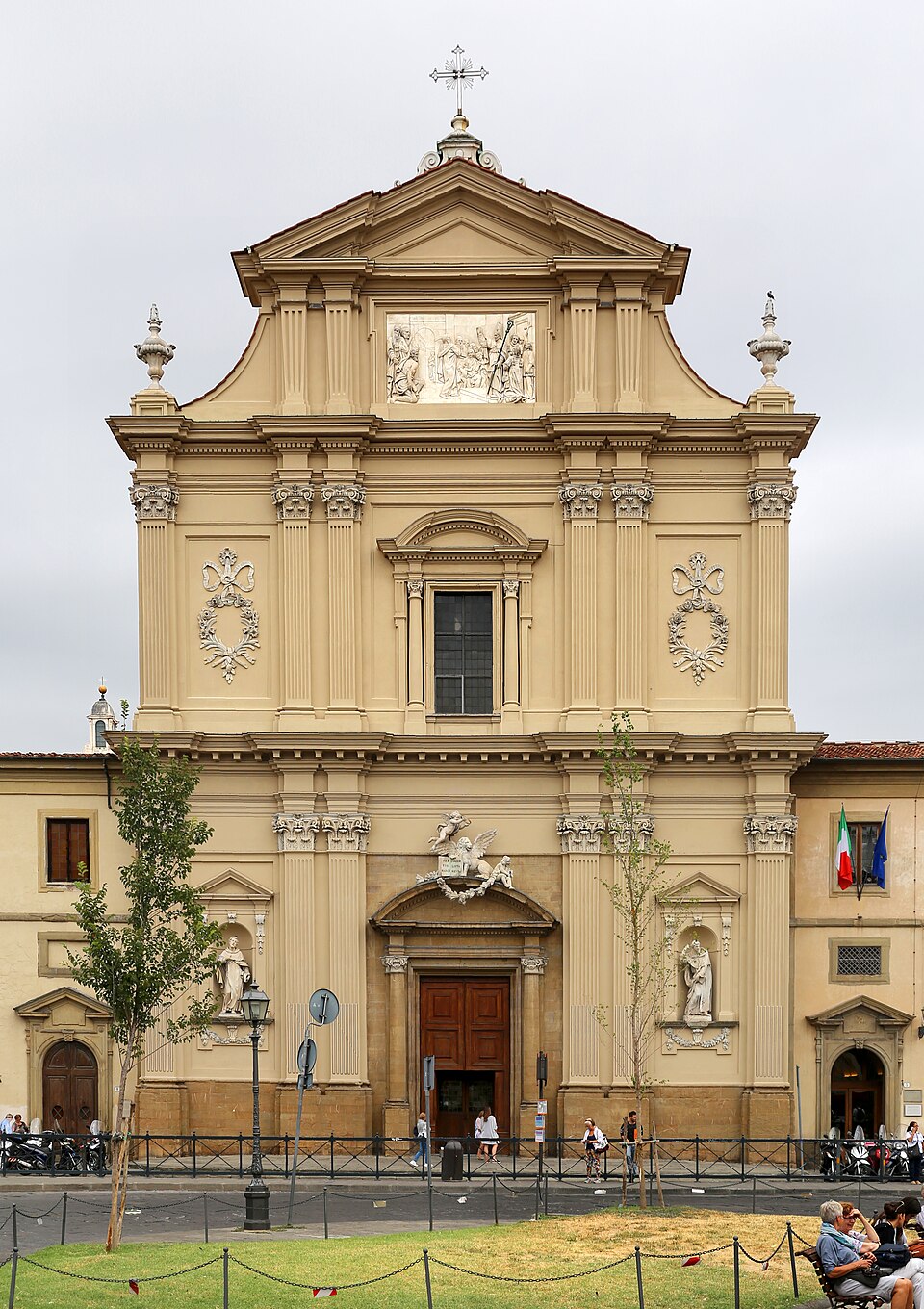 The front facade of the San Marco monastery. (Sailko/CC BY-SA 3.0)
San Marco’s Origins
The first structure on the site dates to the early 13th century. It belonged to the Vallombrosians, a Benedictine community that originated near Florence. Around 1300, ownership of the convent passed to the Sylvestrines, also a part of the Benedictine order. Benedictines lived by the precept “ora et labora” (“pray and work”), articulated in “The Rule of St. Benedict” by their eponymous founder Benedict of Nursia (480–547).
In 1418, the Sylvestrines were accused of laxity for allegedly neglecting their religious duties. Florentine authorities pressured them to leave the convent, which they abandoned the same year.
The site remained vacant for almost two decades, during which time it fell into ruin. The dilapidated structures intrigued local entrepreneurs, who saw an opportunity to leave their mark on burgeoning Florence. Among them was the famed Cosimo de’ Medici (1389–1464), also known as “Cosimo the Elder.”
Cosimo had recently sponsored the renovation of a nearby Franciscan convent. To announce his return to Florence after a year-long political exile, the magnate decided to finance another large-scale restoration, this time at San Marco. The masterplan included a brand-new cloister and a state-of-the-art library.
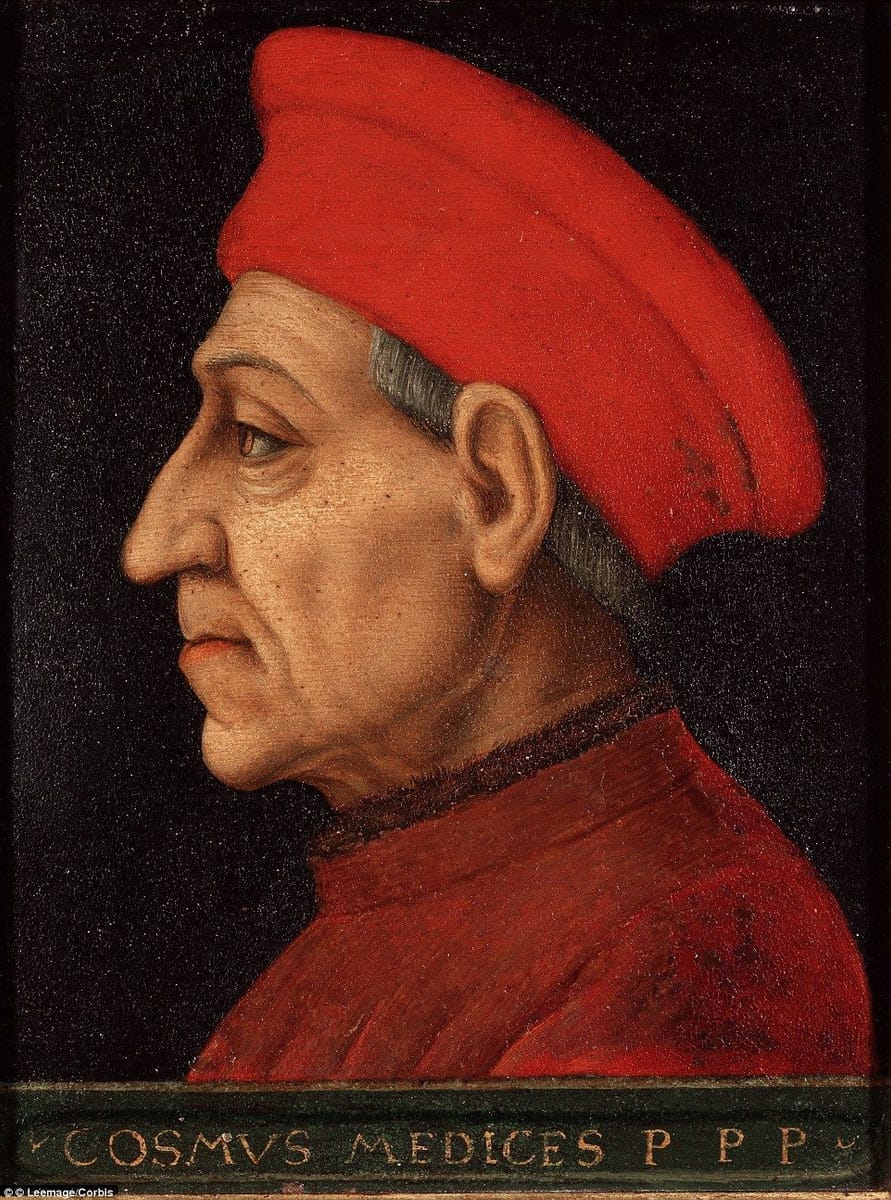 “Cosimo di Medici,” circa 1565 to circa 1569, by Bronzino. (Public Domain)
Cosimo de’ Medici: Patron of the Arts
Cosimo made his fortune as a banker. His success depended largely on double-entry bookkeeping, a simple yet revolutionary accounting method that helped investors avoid miscalculations, prevent fraud, and keep more accurate records of their finances than ever before.
A shrewd socialite with a vast network and an incessant thirst for innovation and control, Cosimo circulated his money widely. He backed pro-Medici political candidates, launched publicity campaigns against his opponents, and traveled extensively to gain allies from prominent cities as far away as London.
In the cultural realm, Cosimo sponsored city-wide festivals, funded academic scholarship in the sciences and the humanities, and commissioned artists to embellish Florence with grand statues, churches, and palaces.
More than other members of the Medici family, Cosimo knew that political influence and cultural prestige went hand in hand. He believed that a magnate with virtually endless resources was morally obliged to provide for the people.
How, then, could he enrich his fellow Florentines? By turning Florence into the European capital of painting, sculpture, and architecture.
Patrons like Cosimo were doubtless self-interested. They could be vicious and power-hungry, often resorting to the arts as a way to spread political propaganda. The Medici’s investments were meant to woo the masses and secure votes. That explains their many diatribes with competing families like the Pazzi, who plotted an infamous conspiracy against Cosimo’s better-known grandson, Lorenzo the Magnificent (1449–1492).
Yet patrons were also genuinely interested in art for art’s sake. Scholars have estimated that, throughout his life, Cosimo invested roughly $500 million on art and architecture alone, far more than he needed for purely political purposes. Although he didn’t hide his ulterior motives, Cosimo delighted in beauty, as shown by his hunger for creation in painting, sculpture, architecture, literature, poetry, and philosophy.
The banker’s patronage remains one of history’s clearest examples of “philanthropy,” a Greek word that translates to “love of humans.” As the influential 18th-century British historian Edward Gibbon (1737–1794) put it, Cosimo “was the father of a line of princes, whose name and age are almost synonymous with the restoration of learning: His credit was ennobled into fame; his riches were dedicated to the service of mankind.”
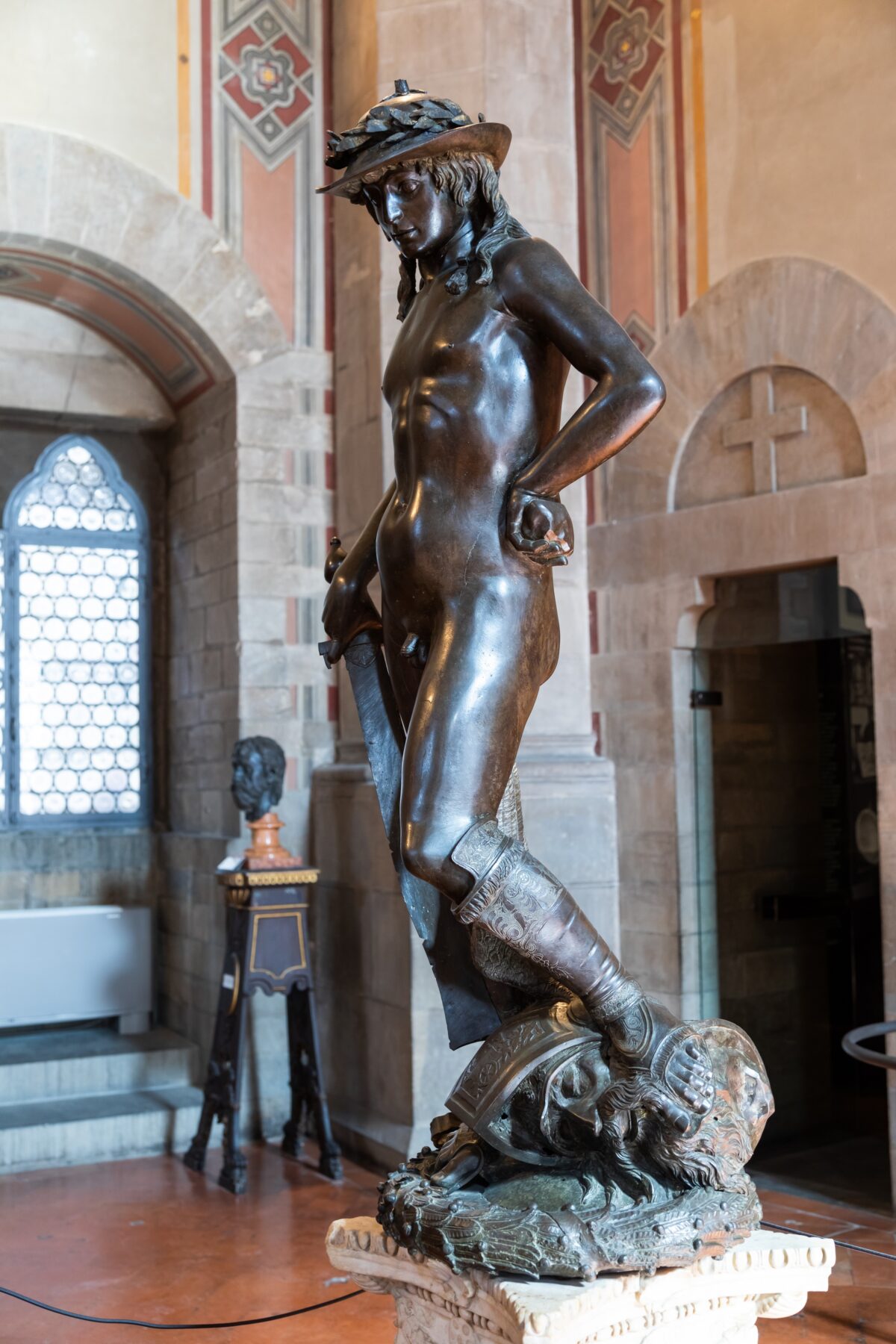
His generous support enabled Donatello (1386–1466), Brunelleschi (1377–1446), and countless others to create Renaissance masterpieces that we continue to admire. Among the most celebrated projects funded by Cosimo’s patronage are Donatello’s bronze “David” and Brunelleschi’s dome of the cathedral Santa Maria del Fiore.
Michelozzo’s Design
There are few better places to appreciate the full extent of Cosimo’s philanthropy than the convent of San Marco.
By 1437, San Marco had become the new home for a group of Dominican friars from nearby Fiesole. The building was in terrible condition. To renovate their abode, the friars appealed to Cosimo, who pledged 40,000 golden florins (approximately $33 million today). This hefty sum far surpassed the Dominicans’ need for a basic structural renovation.
Oversight of the project went to Michelozzo Michelozzi (1396–1472), an architect and long-time friend of the Medici family. Born in Florence shortly after Cosimo, Michelozzo trained extensively with Lorenzo Ghiberti (1378–1455), another accomplished polymath who spent much of his life competing with Brunelleschi for fame during the construction of Florence’s enormous cathedral.
Michelozzo represented a new generation of Renaissance architects. Like Ghiberti and Brunelleschi, he drew inspiration from the Greco-Roman world, which prized the symmetrical use of arches, columns, and related elements.
Michelozzo’s design included a new cloister and a state-of-the-art library. He planned the cloister as a nearly square courtyard enclosed by four straight walks of evenly spaced, slender columns that supported rounded arches. The continuous arcade surrounds an open-air core illuminated by the sun’s natural patterns.
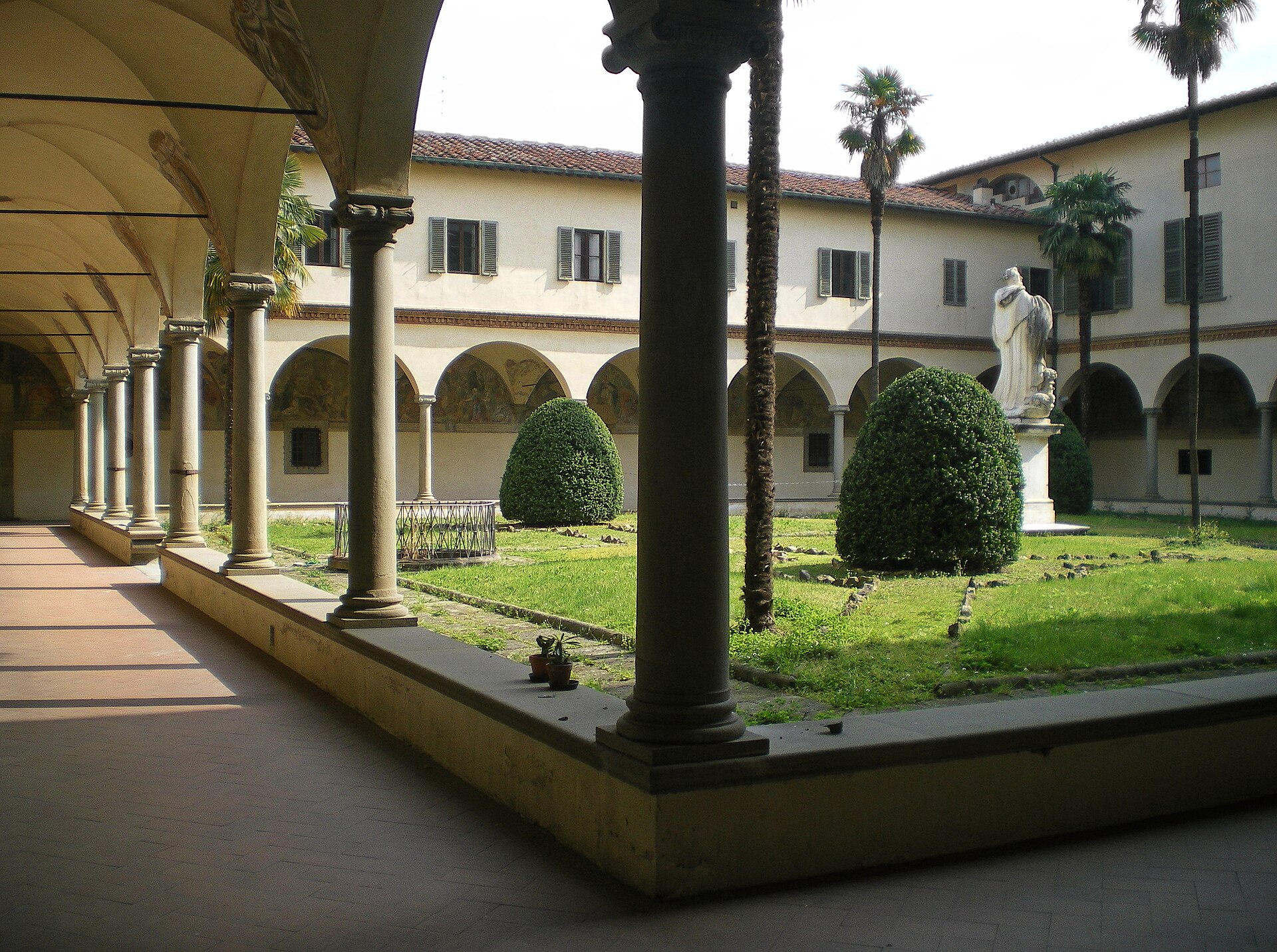 The monastery of San Marco has beautifully appointed arches and columns with a central courtyard. (Srecan/CC BY 3.0)
The architect applied similar Renaissance elements to San Marco’s library, which Cosimo envisioned as a new center of learning for Italy’s most promising minds.
The library consists of a long, rectangular hall divided into three naves by two rows of columns, which are crowned by scroll-like Ionic capitals. Like the cloister’s columns, the library’s support a series of evenly spaced rounded arches. Light trickles in through medium-sized windows on the two lateral walls. This layout would have been most useful for reading on the library’s many neatly arranged wooden desks, which are no longer on display.
Fra Angelico’s Frescoes
Cosimo’s vision also included a series of frescoes, which he commissioned to the revered painter Fra Angelico.
Born Giovanni da Fiesole (1395–1455), Fra Angelico exemplified the harmonious union between artistic brilliance and religious devotion. He decorated the cloister and most of the upper floor with inspiring biblical imagery. Most of his frescoes were never intended for public display. They adorned the friars’ private rooms, where they served as visual aids for prayer and contemplation.
Today, visitors can peek through the cells’ doorways and marvel at Fra Angelico’s masterful depictions of religious scenes and symbols, which remain San Marco’s most recognizable features.
San Marco’s Library
The Dominican order is known for its emphasis on study. Its founder, St. Dominic, is represented with a star upon his head, which symbolizes the light of divine knowledge and the illuminating power of the intellect.
The Dominicans’ intellectual orientation proved especially fruitful in 15th-century Florence, where a new generation of literati emerged. Cosimo purchased hundreds of manuscripts from keen book collectors, most of whom were happy to share their private collections for the greater good. Manuscripts were rare and delicate. They cost a fortune and were usually only available to the aristocracy. Out of gratitude for the patron’s generosity, the Dominicans agreed to house Cosimo’s volumes in the convent.
San Marco’s library opened in 1444, making history as the first public library in Florence. By modern standards, the word “public” is misleading. Although little is known about the library’s daily operations, access to its volumes was limited to select scholars. They could consult books and study for free, but their admission was vetted, by the Medici.
Among the library’s most frequent visitors were Angelo Poliziano (1454–1494) and Pico della Mirandola (1463–1494), two short-lived prodigies who left behind far-reaching contributions.
Poliziano’s major projects included a partial translation of Homer’s “Iliad,” numerous poems in sophisticated Latin, and a series of commentaries on the Greek philosopher Aristotle. These works revived interest in Greek and Roman literature and its historical context, which defined the political trajectory of modern European history.
A close friend of Poliziano’s, Pico della Mirandola was an original, provocative savant most famously admired for his posthumously published treatise “Oration on the Dignity of Man.” A collection of 900 pithy statements, the text eventually became known as the “Manifesto of the Renaissance.”
In keeping with the Renaissance emphasis on human potential and creativity, Pico described intellectual inquiry as the noblest human activity, and the closest to God. Pico believed that when humans fail to think with their unique intellect, they degrade their nature and fall short of their potential. Similar ideas were articulated by ancient philosophers like Plato, Plotinus (circa 204–270), and a plethora of lesser-known figures whose works had just begun to circulate among Florence’s intellectual elites.
Although where they wrote these works is unknown, Pico and Poliziano consulted San Marco’s volumes on a regular basis. Their presence turned the convent into a key site for the many revolutionary ideas that emerged in Renaissance Italy. After their sudden, mysterious, and simultaneous deaths, the young scholars were buried side-by-side in San Marco’s church.
A Cultural Hub with a Religious Foundation
Thanks to its library, San Marco became Renaissance Florence’s intellectual core. It provided a space for eclectic scholars to rediscover the Greco-Roman world, which gradually turned into the preferred social and political paradigm for people like Cosimo to leave their marks.
Though it inspired daring ideas, San Marco never disavowed its religious tenets. Prayer governed the convent’s rhythms and monastic requirements ordered its spaces until 2014, when its last friars were transferred to the bigger Dominican community at Santa Maria Novella.
At once a hub for intellectual experimentation and a cradle of piety, San Marco was both secular academy and secluded monastery. It breathed the same winds of change that swept the streets of medieval Florence, but never strayed from its founding spiritual orientation. Its legacy embodies a fruitful tension between novelty and tradition, which defined one of history’s most remarkable eras.
What arts and culture topics would you like us to cover? Please email ideas or feedback to features@epochtimes.nyc