Stocks tied to artificial intelligence (AI) fell sharply as investors rotated out of the tech trade and into blue-chip companies and government bonds.
The PHLX Semiconductor Index—a capitalization-weighted index comprised of 30 chip companies—sank about 2 percent on Oct. 15.
It has declined almost 10 percent over the past week but remains up 61 percent this year.
Chipmaking titan Nvidia fell about 2 percent, while Advanced Micro Devices (AMD) and Intel declined 4 percent. Micron Technology slipped almost 1 percent.
The tech-heavy Nasdaq Composite Index erased most of its losses after sliding as much as 400 points earlier in the session. It was still down around 100 points, or 0.4 percent.
Foreign markets have also signaled growing concern surrounding the AI trade.
South Korea’s benchmark KOSPI, which is sensitive to the memory industry, has diverged from the Nasdaq 100, says Adam Turnquist, chief cross-asset strategist at LPL Financial.
“While enthusiasm around the broader AI investment cycle remains intact, Korea’s concentrated exposure to memory leaves it more vulnerable to competitive threats, positioning unwinds, and shifts in the memory cycle,” Turnquist said in a note emailed to The Epoch Times.
KOSPI plunged almost 8 percent on Oct. 15 and has declined 18 percent in the past five sessions.
Still, the index is up almost 30 percent year to date.
Conversely, the blue-chip Dow Jones Industrial Average rallied more than 400 points, or nearly 0.9 percent. The broad-market S&P 500 was flat, staying above 7,700.
Many companies posted solid gains, including Nike (5 percent), UnitedHealth Group (4 percent), Sherwin-Williams (3 percent), and Walmart (2 percent).
Fragile Expectations
A key risk to the AI-driven rally is that investors want proof that spending on the revolutionary technology will persist through 2027 and beyond, says Hendi Susanto, portfolio manager at Gabelli Funds.
“The biggest challenge in AI investing right now isn’t the fundamentals,” Susanto said in an emailed note to The Epoch Times. “It is the expectations that are fragile.”
According to Susanto, the AI infrastructure buildout will continue into the new year, as demand remains high for key components: accelerators, chipmaking equipment, memory chips, and networking.
Suppliers are expanding capacity to meet this demand. “Companies don’t commit billions to new fabs unless they see the orders coming,” Susanto stated.
Investors also cashed in their tech profits and fled to safety following red-hot wholesale inflation data.
Fleeing to Safety
September’s Producer Price Index surged 1.3 percent—well above market expectations—from an upwardly adjusted 0.5 percent in August.
Core producer inflation, which strips out volatile energy and food prices, also came in above estimates, rising 0.7 percent.
Consumer inflation rose 0.6 percent last month, lifting the annual rate to 3.7 percent.
Treasury yields were mostly down across the curve, with the benchmark 10-year sliding below 5.1 percent, the lowest in about a month.
The 30-year fell to 5.42 percent, while the Fed-sensitive 2-year yield eased to 4.75 percent.
Despite higher-than-expected inflation, futures markets expect the Federal Reserve to delay another interest rate hike until the December policy meeting.
A growing concern is whether Wall Street can handle a rising-rate environment, says Chris Zaccarelli, CIO of Northlight Asset Management.
“If this market is one thing, it is resilient, and we believe that resilience will last through the end of the year,” Zaccarelli told The Epoch Times in an emailed note.
One economist says that the data center buildout will be instrumental to the ongoing rally.
The Wall Street consensus is that AI investment returns will exceed 10 percent, higher than the federal funds rate—a key policy rate that influences borrowing costs for businesses and consumers, which is currently around 4 percent.
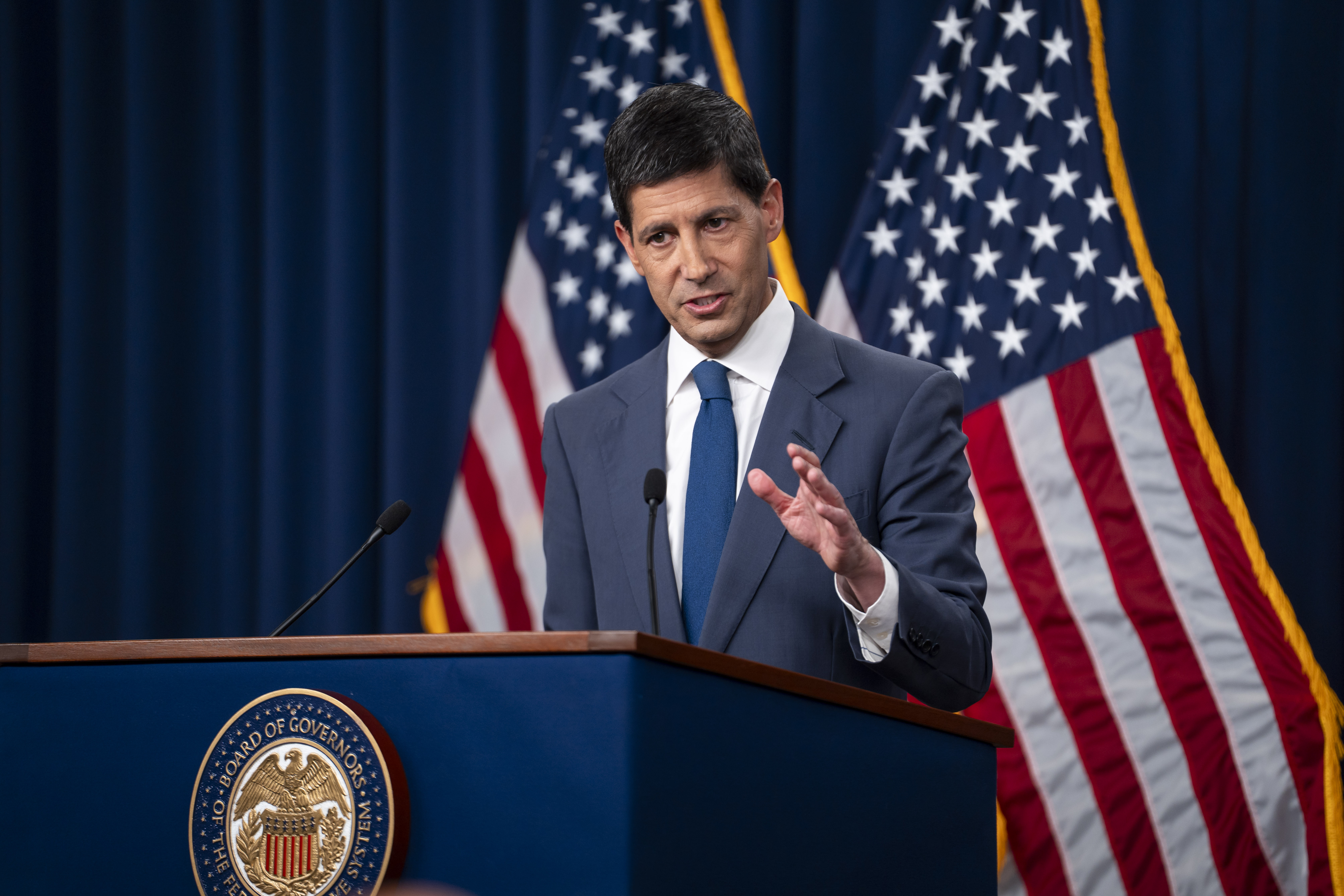 Federal Reserve chairman Kevin Warsh speaks during a press conference in Washington on July 29, 2026. (Madalina Kilroy/The Epoch Times)
The challenge, Slok says, is that upward pressure on interest rates will continue until AI returns fall below the fed funds rate or the Fed keeps raising interest rates to above forecasted AI returns.
But increasing borrowing costs could then weigh on consumer spending, which accounts for about two-thirds of gross domestic product, or GDP.
New Census Bureau data show retail sales advanced at a higher-than-expected pace of 0.8 percent in September, fueled mainly by spending at gasoline stations.
Excluding filling up the tank, retail sales were relatively flat.
A central theme since the other side of the pandemic has been the consumer’s resilience. Despite their deteriorating sentiment amid multiple headwinds in recent years, shoppers keep opening their wallets.
 Friends Read Free
Copy
Facebook
Tweet