
Amazon has purchased Swiss robotics firm Rivr to develop machines for “doorstep delivery,” the company confirmed to The Epoch Times on March 20.
For the past decade, the online retail giant has invested heavily in robotics and other assistive technologies, particularly for its warehouse operations.
The latest acquisition, a spokesperson said, reflects those investments in research and development.
On its website, Rivr states that it uses “physical [artificial intelligence] to revolutionize doorstep delivery.” The firm’s primary technology is a four-legged robot on wheels that could eventually be integrated into Amazon’s delivery operations.
By acquiring the European tech startup, doorstep delivery could have “the potential to further improve safety outcomes and the overall delivery experience for Delivery Service Partners (DSPs) and their Delivery Associates (DAs),” Amazon wrote.
“We are in the early stages of this journey, and as we progress, we will engage you and our teams to help us field test this technology, gathering real-world insights and incorporating your feedback into how we scale this technology in the future,” it said.
This came at about the same time that the company announced that it is offering ultrafast delivery of three hours or less in select U.S. markets for about 90,000 items.
Amazon, meanwhile, has already contributed to Rivr’s growth, backing the startup through its four‑year‑old, $1 billion Amazon Industrial Innovation Fund.
Additionally, Amazon founder Jeff Bezos’s venture capital fund, Bezos Expeditions, contributed to the company’s $22 million seed round last year.
In the past two years, a slate of companies, including DoorDash and Uber, has been testing autonomous sidewalk vehicles—equipped with cameras and sensors—in major urban centers.
Last month, Coco Robotics launched its next-generation autonomous robots for urban deliveries, whether for groceries or pharmaceuticals. The firm demonstrated the endurance of its delivery robots, which ventured through flooded streets in Miami and braved frigid temperatures in Chicago.
“Every mile our robots have driven has made the whole fleet smarter,” said Zach Rash, CEO and cofounder of Coco Robotics. “Human-in-the-loop learnings have helped us improve with every edge case, creating a feedback loop between deployment, data collection, and model advancements.”
Amazon’s Push Into AI
Amazon has been expanding its push into artificial intelligence (AI) and integrating more of the technology—from robotics to generative AI—into its day-to-day operations.
This past summer, Amazon CEO Andy Jassy stated that AI has been implemented in “virtually every corner of the company.”
“In our fulfillment network, we’re using AI to improve inventory placement, demand forecasting, and the efficiency of our robots—all of which have improved cost to serve and delivery speed,” Jassy said in a June 2025 message to employees.
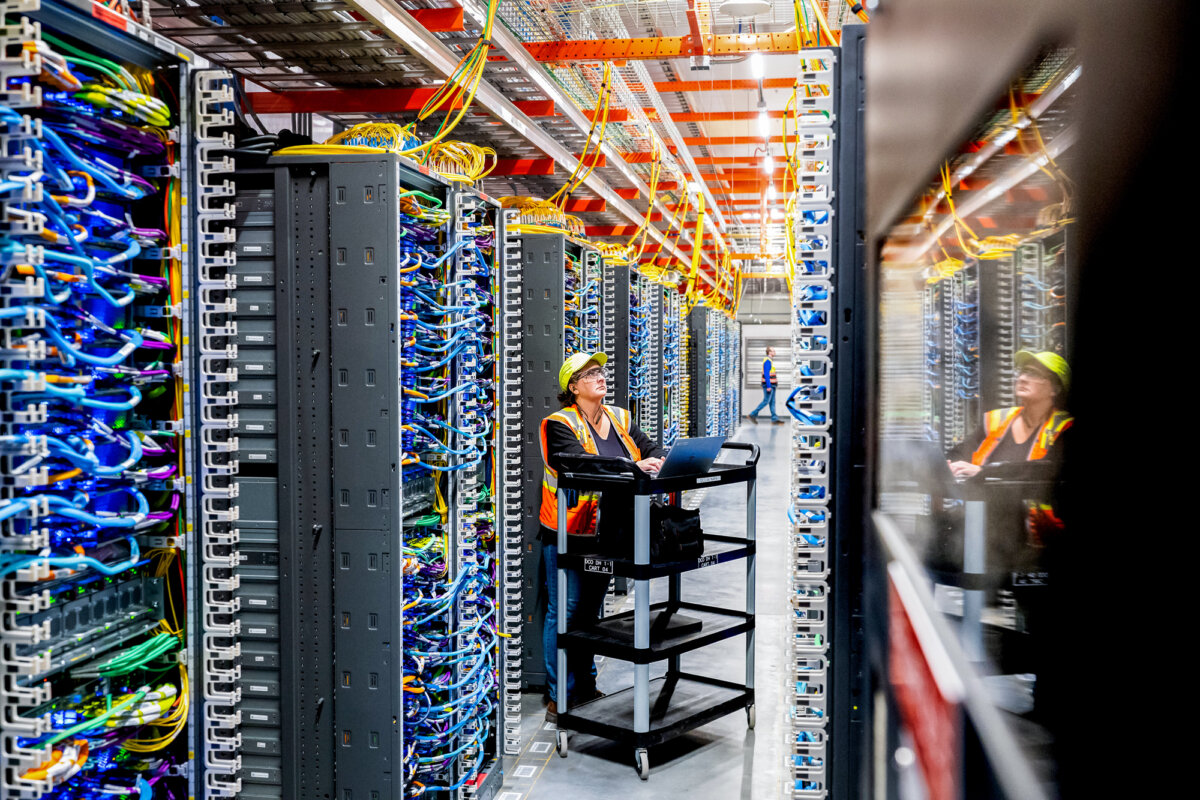
The tech giant has also been one of the several major hyperscalers participating in the buildout of the AI infrastructure.
Investors have expressed concern about Amazon’s increase in capital expenditure (capex), particularly its reliance on corporate debt and loans to finance the development of data centers across the United States.
“There’s sentiment around software companies that are being disrupted by AI as well as around countries that are building AI infrastructure,” John Belton, portfolio manager at Gabelli Funds, said in a note emailed to The Epoch Times.
For AI infrastructure builders—Amazon, Google, Meta, Microsoft, and Nvidia—sentiment will improve only when there is clear proof that their massive investments are paying off, he said. This change will come from the widening range of AI applications, strong real‑world use cases, and the performance of other AI‑native companies.
Although Big Tech companies have depended on their massive cash flows to support the infrastructure buildout, more are taking on debt.
“Looking at the five largest hyperscalers outside of China, Amazon, Microsoft, Alphabet, Meta, and Oracle, their capex is already at a high level,” Belton said. “Simplistically, nearly every dollar of operating cash flow this year is going into capex.”
Share prices of Amazon (AMZN) fell by 1.6 percent to finish the trading week at $205.37. The stock posted a weekly loss of 1.3 percent and is down by more than 9 percent this year.
Bruce Parker contributed to this report.
 Friends Read Free
Copy
Facebook
Tweet
Friends Read Free
Copy
Facebook
Tweet