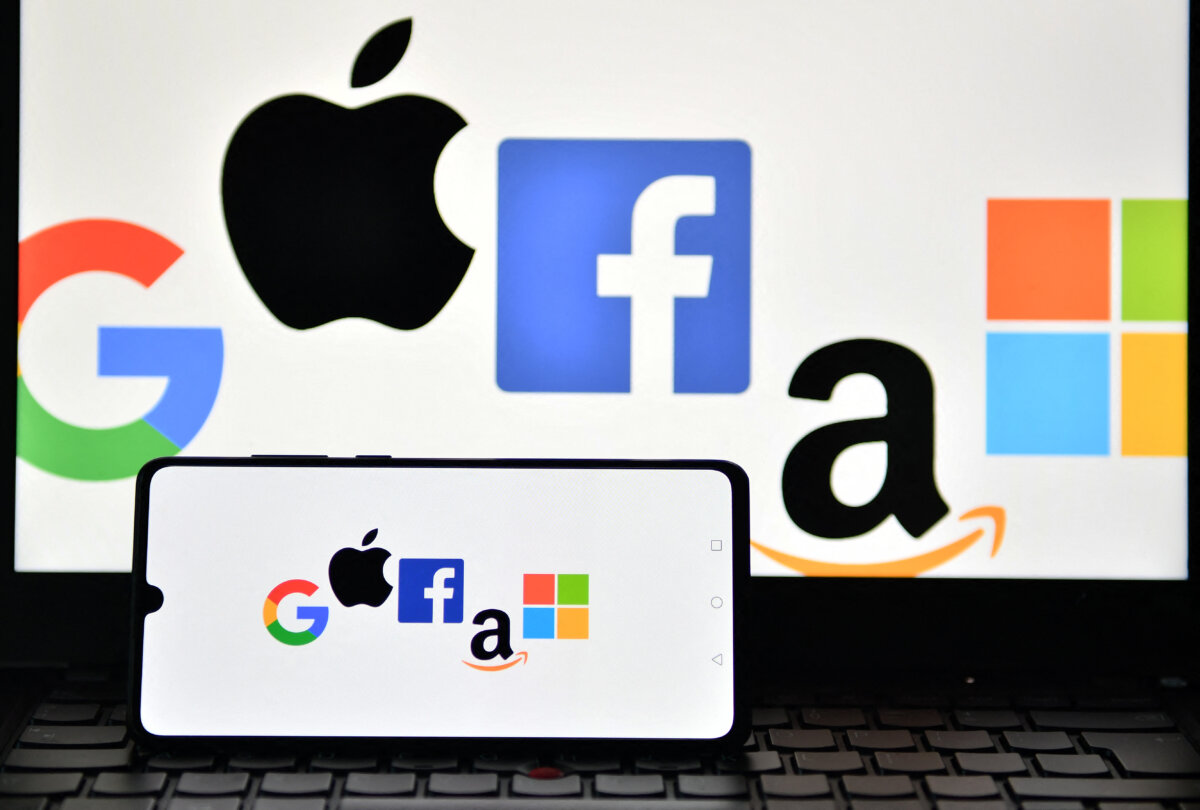

Last week was considered the most important week of this earnings season, as five of the “Magnificent Seven”—Alphabet, Amazon, Meta, Microsoft, and Apple—reported their quarterly results. Although overall performance was solid, market reactions diverged as an AI-spending spree squeezed the free cash flow of some of these companies.
“Magnificent Seven” is a market-coined term for a group of seven large U.S. tech-focused companies that have had an outsized impact on stock market performance in recent years. Aside from the five companies mentioned above, the group also includes Nvidia and Tesla.
Strong Earnings
Alphabet reported $109.9 billion in consolidated revenues for the first quarter on April 29, a 22 percent increase, driven by strength across Google Services and Google Cloud.
Strong revenue growth helped the company lift operating income to $39.7 billion, up by 30 percent, for an operating margin of 36.1 percent. Net income reached $62.6 billion, up by 81 percent, with earnings per share climbing by 82 percent to $5.11.
The rising profit margin was well received by Wall Street. Alphabet shares surged on April 30 following the earnings release and gained 34 percent for the month—the best monthly performance since the company went public.
Apple on April 30 reported $111.2 billion in revenue for the second quarter of fiscal 2026, which ended on March 28, up by 17 percent year over year, with iPhone revenue reaching $57 billion, up by 22 percent—a March record. The iPhone 17 family has been the most popular lineup in company history since its launch through March.
Services revenue came in at $31 billion, up by 16 percent year over year and setting a record, with double-digit growth in both developed and emerging markets and all-time category records across the board. Gross margin reached 49.3 percent, up by 110 basis points sequentially and above the high end of guidance, with services margin up by 20 basis points.
Apple shares gained 3.2 percent on May 1 and 9.59 percent over the prior 30 days.
Amazon, Microsoft, and Meta also posted impressive results.
Amazon reported on April 29 total revenue of $181.5 billion for the first quarter, up by 17 percent year over year, led by Amazon Web Services (AWS), the company’s cloud computing and infrastructure-as-a-service segment, which generated $37.6 billion in sales—up by 28 percent year over year, the fastest growth pace in 15 quarters, Andrew R. Jassy, the company’s president and CEO, said during an earnings call.
Operating income came in at $23.9 billion, producing a 13.1 percent company-wide operating margin—the highest the company has ever reported.
Microsoft posted on April 29 total revenue of $81.3 billion for the first quarter, up by 17 percent in constant currency, driven by growth across core commercial businesses. Its cloud segment generated $51.5 billion, up by 26 percent in constant currency (a measure that removes the impact of foreign exchange rate fluctuations), marking the first time that the cloud business surpassed $50 billion in a single quarter. Operating income rose by 21 percent in constant currency, reflecting both higher revenue and improved operating leverage.
Meta reported daily active people—a metric that tracks unique users across its family of apps—of 3.5 billion in March, with a slight sequential decline attributed to internet disruptions in Iran and WhatsApp access restrictions in Russia. Total revenue reached $56.3 billion, up by 33 percent. Operating income came in at $26.8 billion, translating to a 41 percent operating margin. Net income was $26.8 billion, or $10.44 per share, and would have been $18.7 billion, or $7.31 per share, excluding an $8.03 billion tax benefit.
Despite the strong numbers, Amazon, Microsoft, and Meta failed to win over investors.
Amazon shares gained 1.62 percent last week, although they have climbed by 27 percent over the past 30 days. Microsoft shares fell by 2.4 percent for the week but gained 12.4 percent for the month. Meta shares dropped by 9.82 percent and are up by 5.1 percent over the past 30 days.
Growing Concerns
Analysts point to growing concerns over massive AI-related capital expenditures as the reason for Wall Street’s muted reaction.
Amazon’s capital expenditure reached $43.2 billion in the first quarter, primarily allocated to AWS and generative AI expansion. Jassy cautioned against rapid increases in capital expenditure during periods of high AWS growth, noting the effect on “the early years’ free cash flow” until new infrastructure is monetized.
Microsoft’s capital expenditure came in at $37.5 billion, with roughly two-thirds directed toward short-lived assets such as graphics processing units and central processing units, while finance leases accounted for $6.7 billion, mainly for large data centers.
Meta’s capital expenditure totaled $19.8 billion, largely allocated to servers, data centers, and network infrastructure.
Capital expenditure is a critical component in determining a company’s free cash flow—measured as operating cash flow minus capital expenditures—the money available to be returned to stockholders through share buybacks and dividend increases. The elevated spending levels have weighed heavily on free cash flow across all three companies.
Amazon’s annual free cash flow for 2025 was zero, a 100 percent decline from 2024, compared with $38.219 billion in 2024, which itself represented a 3.82 percent increase from 2023.
Microsoft’s annual free cash flow for 2025 was $71.611 billion, a 3.32 percent decline from 2024.
Meta Platforms’ annual free cash flow for 2025 was $46.109 billion, a 14.73 percent decline from 2024.
A ‘Referendum’
Jason Moser, senior investment analyst and lead adviser at The Motley Fool, said this earnings season is shaping up to be a “referendum” on the massive AI spending underway this year.
“Corporate spending priorities remain centered around AI, so we need to start seeing signs that these investments are paying off. If not, and margins become strained, the markets will respond accordingly, likely taking economic growth with it,” he told The Epoch Times.
“Those companies that can show that revenue growth and margin improvement are keeping up with AI capex will begin to separate themselves from the pack.”
Patrizia Porrini, professor of management at Long Island University, said the industry is witnessing what she described as the most expensive arms race in corporate history.
“By spending $131 billion in just three months, Silicon Valley’s elite are betting that whoever builds the biggest AI brain wins the future,” she told The Epoch Times.
Porrini said this week’s market reaction suggests that investors are growing impatient with the “potential” of AI spending and are now demanding “proof” of real returns.
“They are not rewarding AI hardware infrastructure, but rather rewarding AI-related revenue,” she said.
 Friends Read Free
Copy
Facebook
Tweet
Friends Read Free
Copy
Facebook
Tweet