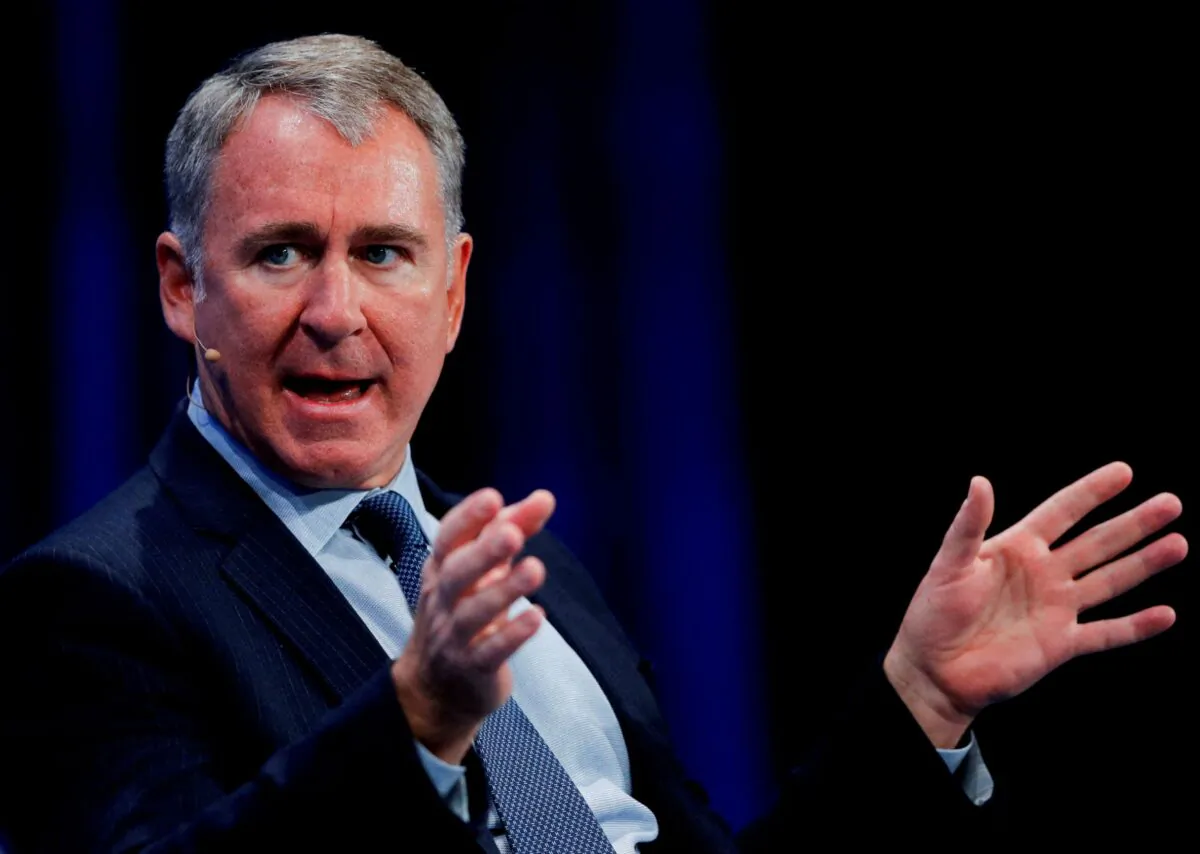

Billionaire investor Ken Griffin, the founder of hedge fund Citadel, said that high inflation could persist for decades in the United States, with negative implications for the cost of making interest payments on America’s massive—and growing—pile of public debt.
While speaking at the Bloomberg New Economy Forum in Singapore on Nov. 9, Mr. Griffin warned that the U.S. government needs to put its fiscal house in order as it has been spending “like a drunken sailor.”
When the government went on a “spending spree that created a $33 trillion deficit,” as Mr. Griffin put it, interest rates were low (or near zero).
Since then, inflation soared and central banks around the world—led by America’s own Federal Reserve—embarked on a rapid cycle of interest-rate hikes, quickly pushing the benchmark federal funds rate to a range of 5.25–5.5 percent.
Higher interest rates have caused the cost of making interest payments on the $33-plus trillion U.S. government debt to surge. The annualized interest payments on America’s public debt stood at an annualized $981.3 billion for the 2023 fiscal year (which ended on Sept. 30). But the latest projections from Bloomberg Intelligence show that, in October, this figure rocketed above $1 trillion.
‘Deep Tailspin’
Mr. Griffin warned that if the Fed were to try to deal with the gargantuan debt pile by printing more money to buy government securities (i.e., monetizing government debt), then “the economic consequences would be devastating.”
“The minute we start to print dollars just to deal with the possibility of default, our economy’s going into a deep tailspin,” he cautioned.
Mr. Griffin warned that continued government spending that keeps adding to the level of public debt, combined with the Russia-Ukraine and Israel-Hamas wars, will drive higher inflation and de-globalization.
“The peace dividend is clearly at the end of the road,” Mr. Griffin said, referring to the idea that in times of geopolitical strife, countries spend more money on defense that could otherwise be used for other purposes, like paying off government debt or putting it back in people’s pockets by lowering taxes.
“We are likely to see higher real rates, and we’re likely to see higher nominal rates,” Mr. Griffin predicted.
He added that one of several trends that are “pushing us toward de-globalization” and are causing higher baseline rates of inflation that may last “for decades” is the loss of cheap energy due to the Russia-Ukraine conflict.
Mr. Griffin also suggested that U.S. federal officials were mostly blindsided by the confluence of factors—including geopolitical shocks like the war in Ukraine and the reorienting of supply chains as part of a broader trend of de-globalization—that put upward pressure on prices.
But he warned that America needs to get its fiscal house in order because persistently higher inflation—and the associated higher interest rates on U.S. government debt—will make the cost of servicing the public debt painfully expensive.
Several Fed officials in recent days have hinted at the problem of persistently high inflation—and the possibility of higher-for-longer interest rates to try and quash it.
Where Do Rates Go From Here?
Fed board member Christopher Waller said at a seminar at the Federal Reserve Bank of St. Louis on Tuesday that a “blowout” third-quarter U.S. economic growth at an annualized 4.9 percent pace warrants watching as the central bank considers its next moves.
Fed board member Michelle Bowman said she took the recent GDP number as evidence the U.S. economy not only “remained strong” but also may have gained speed and so may require a higher Fed policy rate.
Dallas Fed President Lorie Logan said that despite some cooling, the labor market remains “very tight” while inflation is trending at around 3 percent—too high for comfort.
“We’re going to continue to need to see tight financial conditions in order to bring inflation to 2 percent in a timely and sustainable way,” Ms. Logan said, speaking at another event.
When Fed policymakers of the Federal Open Market Committee meet in December, markets currently put the odds of a 25 basis-point rate hike at roughly 10 percent, while the remaining 90 percent think the central bank will continue to hold rates at their current level.
Meanwhile, Americans expects inflation to worsen in the coming months and have lower expectations regarding their personal finances, according to a recent survey from the University of Michigan.
 Friends Read Free
Copy
Facebook
Tweet
Friends Read Free
Copy
Facebook
Tweet