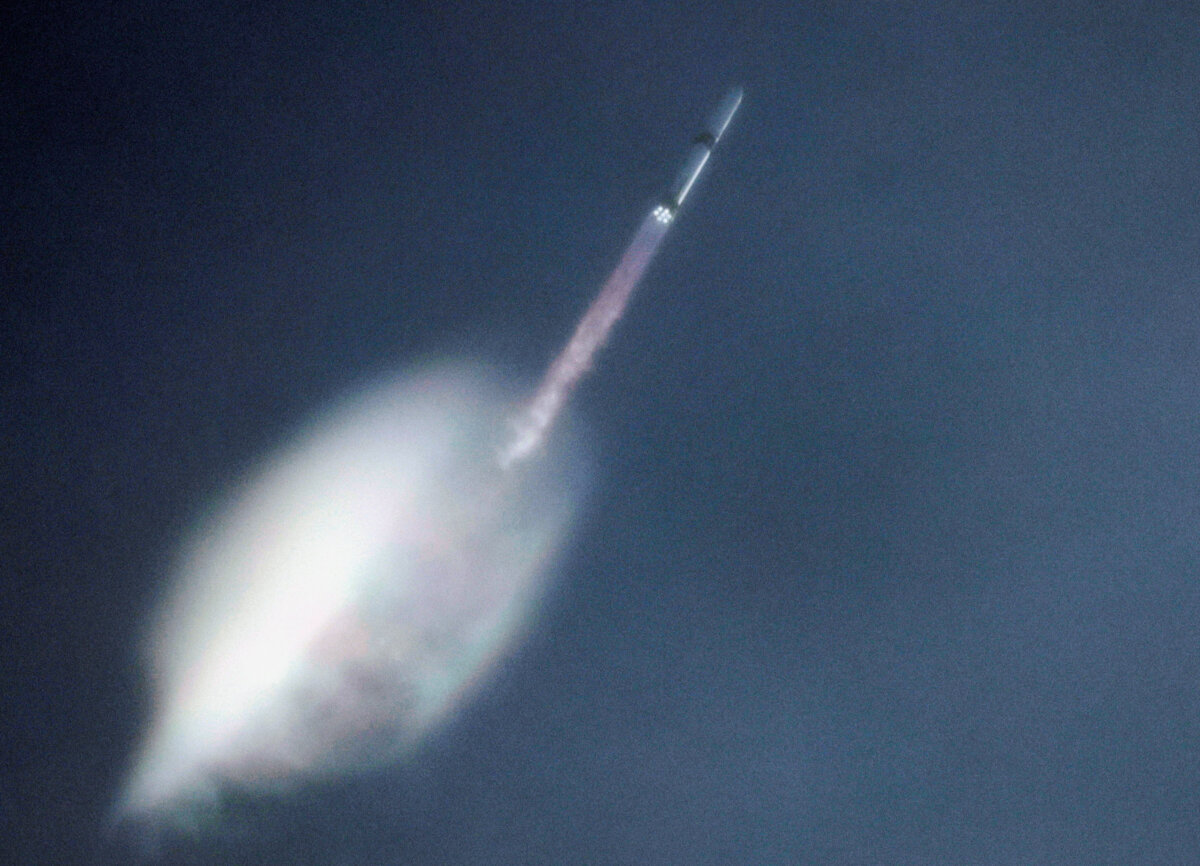

Blue Origin successfully landed a 29-story reusable rocket booster for the first time on April 19, marking a new wave of possibilities for the Jeff Bezos-led company to compete with Elon Musk’s SpaceX.
The New Glenn rocket booster, nicknamed Never Tell Me the Odds, took off from Launch Complex 36 at Cape Canaveral Space Force Station in Florida just before 7:30 a.m. ET and landed on a sea-based platform hundreds of miles downrange nearly 10 minutes later.
Bezos posted a video showing the successful landing on the platform, called Jacklyn, located east of Cape Canaveral in the Atlantic Ocean.
“During the final descent onto Jacklyn, the three middle BE-4 engines on the booster will reignite to slow down the vehicle,” Blue Origin said on X.
“They will burn for about 20 seconds, and then the outer two engines will shut off. The middle engine will help guide the vehicle for a safe landing. After that, we’ll deploy New Glenn’s six landing legs.”
The mission for the spaceflight company, founded by Amazon’s CEO, launched a new AST SpaceMobile BlueBird 7 satellite into low Earth orbit.
The Texas-built satellite was designed to deliver space-based cellular broadband connectivity to everyday smartphones.
AST SpaceMobile plans to roll out direct-to-smartphone broadband network capacity this year, aiming to eliminate coverage gaps for people around the world.
“Every launch brings us closer to fulfilling our mission: connecting billions of people through space-based cellular broadband,” President of AST SpaceMobile Scott Wisniewski said.
“We are grateful to our shareholders and supporters for their continued trust as we reach another milestone in the deployment of our constellation.”
AST SpaceMobile has operation agreements with more than 50 networks such as AT&T, Verizon, and Google.
The April 19 mission was the first time that Blue Origin successfully landed a fully reusable booster after Never Tell Me The Odds was first used in November 2025.
The development on the morning of April 19 in the billionaire space race brought Blue Origin closer to competing with innovations made by Musk’s SpaceX, which has been landing its own rockets since late 2015.
SpaceX has achieved nearly 600 landings over the past decade, according to its website.
The company announced on April 16 that it would assist with the 2028 launch of Rosalind Franklin, the first Mars rover to search for signs of past or present life under the planet’s surface.
 Friends Read Free
Copy
Facebook
Tweet
Friends Read Free
Copy
Facebook
Tweet