
Aerospace and defense giant Boeing’s turnaround continues as fourth-quarter earnings topped Wall Street expectations.
Ahead of the Jan. 27 opening bell, Boeing reported net income of $8.13 billion, a sizable reversal from the company’s $3.92 billion loss a year ago.
Core earnings per share—a measure of a company’s underlying profitability—were $9.92. The market had penciled in a 39-cent loss.
Boeing also posted $23.9 billion in revenue, a 57 percent increase from a year ago and above the market forecast of $22.6 billion. This was due to a more than 37 percent jump in revenue from its defense, security, and space unit, reaching a higher-than-expected $7.42 billion.
Its $400 million cash flow also doubled market forecasts.
Since becoming Boeing’s president and CEO in August 2024, Kelly Ortberg has led an aggressive restructuring aimed at stabilizing production, tightening quality control, and restoring the company’s financial footing.
Ortberg said the company’s efforts are paying off and Boeing has “set the foundation to keep … momentum going in the year ahead.”
“We completed the acquisition of Spirit AeroSystems and the sale of portions of the Digital Aviation Solutions business and remain focused on promoting stable operations, completing our development programs, rebuilding trust with our stakeholders, and fully restoring Boeing to the iconic company we all know it can be,” Ortberg said.
Deliveries, Sales, FAA
Better-than-expected earnings were supported by three factors: stronger deliveries, an asset sale, and federal regulatory approval.
During the final three months of 2025, Boeing deliveries surged by 181 percent, totaling 160 aircraft.
Boeing delivered 600 airplanes last year—almost twice as many as the previous year and the most since 2018. Its backlog exceeds 6,100 aircraft, valued at an all-time high of $682 billion.
The current administration has also played a major role in Boeing’s turnaround.
The aerospace manufacturer has been at the center of U.S. trade negotiations, during which foreign governments and companies have agreed to purchase billions of dollars’ worth of Boeing jets.
New Department of Commerce data suggest that government-assisted civilian aerospace foreign contracts totaled $215 billion, reflecting major transactions, including Qatar’s purchase of Boeing wide-body planes.
In the spring of 2025, as part of its restructuring efforts, Boeing sold portions of its Digital Aviation Solutions business to private equity firm Thoma Bravo for $10.6 billion. The deal included well-known brands such as Jeppesen, AerData, ForeFlight, and OzRunways.
The sale was part of Ortberg’s strategy to reduce Boeing’s debt by shedding businesses that are not central to its core operations.
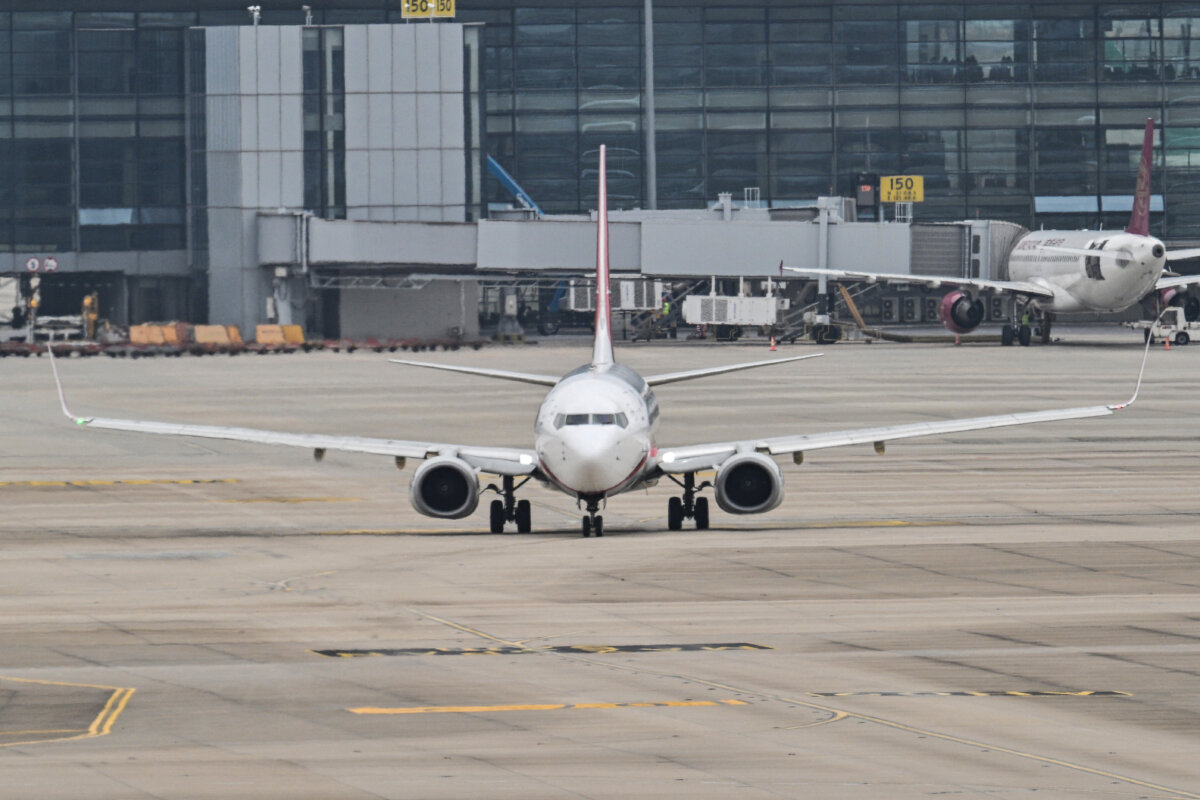
Boeing won Federal Aviation Administration approval in October 2025 to lift 737 MAX production to 42 jets a month. This ended a year-long 38-plane limit implemented after a midair emergency involving an Alaska Airlines 737 MAX 9 in early 2024.
Regulators concluded after an investigation that the incident stemmed from widespread safety and quality‑control failures across Boeing’s production system.
Despite the incident, Alaska Airlines said earlier this month that it had ordered 105 new aircraft, including five 787 wide-body aircraft, from Boeing.
Shrugging Off Earnings
Despite upbeat earnings, investors were unimpressed.
Boeing shares were down at the opening bell, falling by 2 percent to about $244.
Still, the stock is trading at a 52-week high, rallying by 41 percent over the past year “after maneuvering through turbulent times,” according to Jay Woods, chief market strategist at Freedom Capital Markets.
“Yet it is still 48 [percent] below its all-time highs set in 2019,” Woods said in a note emailed to The Epoch Times.
Market watchers, Woods said, need to watch the $260 level for Boeing shares.
“It has failed to close above there on its last two trips to that resistance area. Those attempts occurred in 2021 and 2023,” he said. “Will 2026 be the time it breaks through? If it can, this turnaround stock can soar.”
Analysts maintain a “Moderate Buy” rating with a 12-month downside of 3 percent, according to MarketBeat.
Sustainable Jet Fuel
In a separate announcement, Boeing and Israel’s Technion University said on Jan. 27 that they were starting to develop sustainable aviation fuel. They plan to use feedstocks such as green hydrogen and carbon dioxide to enable long-term growth in the aviation sector.
Sustainable aviation fuel is typically made from used cooking oil or waste and can lower emissions compared with conventional jet fuel. However, it is about five times as expensive as traditional aviation fuel.
Boeing expects the effort to take several years before the technology reaches commercial scale.
The aerospace giant has been working with Technion since 2023, when the two sides started the Boeing–Technion Sustainable Aviation Fuel Innovation Center.
Mary Prenon and Reuters contributed to this report.
 Friends Read Free
Copy
Facebook
Tweet
Friends Read Free
Copy
Facebook
Tweet