
American consumers grew less confident in September, according to a new report from The Conference Board, which showed sentiment deteriorating to its lowest point since April as assessments of job availability fell for the ninth straight month to a multiyear low.
The Conference Board said on Sept. 30 that its consumer confidence index fell to 94.2 in September, down from 97.8 in August, reflecting gloomier views of current and future economic conditions.
“The present situation component registered its largest drop in a year,” Stephanie Guichard, a senior economist at The Conference Board, said in a statement.
The expectations index, which is a forward-looking measure that assesses consumers’ short-term outlook for income, business, and job market conditions, retreated by 1.3 points to a reading of 73.4.
“Expectations have been below the threshold of 80 that typically signals a recession ahead since February 2025,” the report notes, adding that consumers grew more pessimistic about future business conditions and job availability but became more optimistic about future income prospects.
While year-ahead inflation expectations inched down to 5.8 percent from 6.1 percent in August, consumers’ write-in responses showed an increase in references to prices and inflation, which regained their top position as the main topic influencing views about the economy.
Write-in responses also showed a rise in references to jobs and employment to the highest level in more than a year.
“The comments were mostly negative, especially when referring to the current situation,” the report states. “There were a few positive comments which mostly conveyed hopes that things would get better.”
The drop in the Conference Board’s consumer confidence index lines up with a decline in another closely watched sentiment gauge from the University of Michigan. In that measure, consumer sentiment fell for a second straight month, hitting its lowest level since May, driven by increasing concerns about the state of the economy.
The Michigan consumer sentiment index fell by 3.1 points, or about 5 percent, to 55.1 in September. The latest reading was lower than the consensus forecast of 55.4 tracked by Bloomberg. Consumer sentiment has fallen by 15 points, or 21.4 percent, from a year ago.
“Nationally, not only did macroeconomic expectations fall, particularly for labor markets and business conditions, but personal expectations did as well, with a softening outlook for their own incomes and personal finances,” Joanne Hsu, director of the University of Michigan consumer survey, said in a statement.
Inflationary concerns mounted in the University of Michigan survey, aligning with the Conference Board’s data. While year-ahead inflation expectations ticked down from 4.8 percent last month to 4.7 percent in September, long-run expectations moved up for the second straight month to 3.7 percent.
“Consumers continue to express frustration over the persistence of high prices, with 44 percent spontaneously mentioning that high prices are eroding their personal finances, the highest reading in a year,” Hsu said. “Interviews this month highlight the fact that consumers feel pressure both from the prospect of higher inflation as well as the risk of weaker labor markets.”
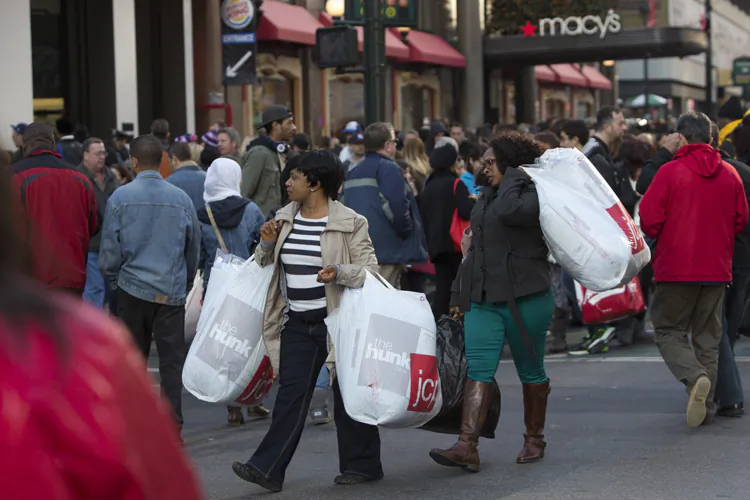
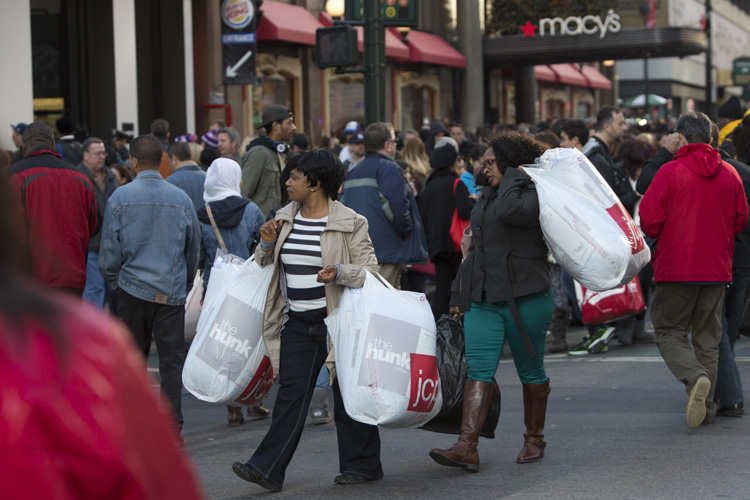
Taken together, the surveys point to growing unease about both inflation and jobs, raising questions about how much longer the labor market can prop up consumer spending.
While retail spending picked up over the summer, weaker consumer spending constrained U.S. economic activity over the first six months of 2025, which saw an average pace of growth of about 1.5 percent.
Slowing Labor Market
In their latest monetary policy statement in mid-September, Federal Reserve officials spoke of elevated uncertainty around the U.S. economic outlook, pointing to indicators that suggest growth moderated in the first half of the year.
“Job gains have slowed, and the unemployment rate has edged up, but remains low,” members of the Federal Open Market Committee (FOMC), the central bank’s interest rate-setting body, said in a Sept. 17 statement, which described inflation as “somewhat elevated.”
At a press briefing on the same day, Fed Chair Jerome Powell said that payroll job gains have slowed “significantly” to a pace of just 29,000 per month over the past three months.
“A good part of the slowing likely reflects a decline in the growth of the labor force due to lower immigration and lower labor force participation. Even so, labor demand has softened, and the recent pace of job creation appears to be running below the ‘breakeven’ rate needed to hold the unemployment rate constant,” he said.
Fed economists expect the unemployment rate to rise from 4.3 percent in August to 4.5 percent by the end of the year, before falling next year, he added.
In more recent comments on the U.S. economic outlook, Fed Vice Chair Philip Jefferson said in a speech at a Sept. 30 central banking conference in Helsinki, Finland, that the downside risks to employment are rising.
“The recent pace of employment growth has been the slowest since the U.S. economy recovered from the COVID-19 pandemic recession, which is largely explained by the slower growth in the labor force,” he said. “There are other measures of the labor market that also bear watching. For example, the ratio of unfilled jobs to unemployed Americans seeking work remains near 1. And measures of job openings and initial jobless claims have been mostly moving sideways.”
A government report on job openings and related metrics released on Sept. 30 showed that the number of vacancies remained flat in August, in line with what some analysts have described as a “low fire, low hire” trend.
Job vacancies edged up by just 19,000 to 7.227 million last month, according to the Bureau of Labor Statistics’ Job Openings and Labor Turnover Survey (JOLTS) report.
Another closely watched data point in the JOLTS report is the number of job quits, which economists track as a reflection of workers’ confidence in the labor market, with a lower quits rate suggesting lower confidence. August’s quits rate fell by 75,000, to an 11-month low of 3.091 million, suggesting a higher level of job market uncertainty.
Mark Hamrick, Bankrate senior economic analyst, told The Epoch Times in an emailed statement that the JOLTS report showed “little meaningful change” in the labor market.
“This remains consistent with a low-hire, low-fire job market, where businesses broadly see no reason to ramp up hiring and many continue to hold onto their workers,” he said.
 Friends Read Free
Copy
Facebook
Tweet
Friends Read Free
Copy
Facebook
Tweet