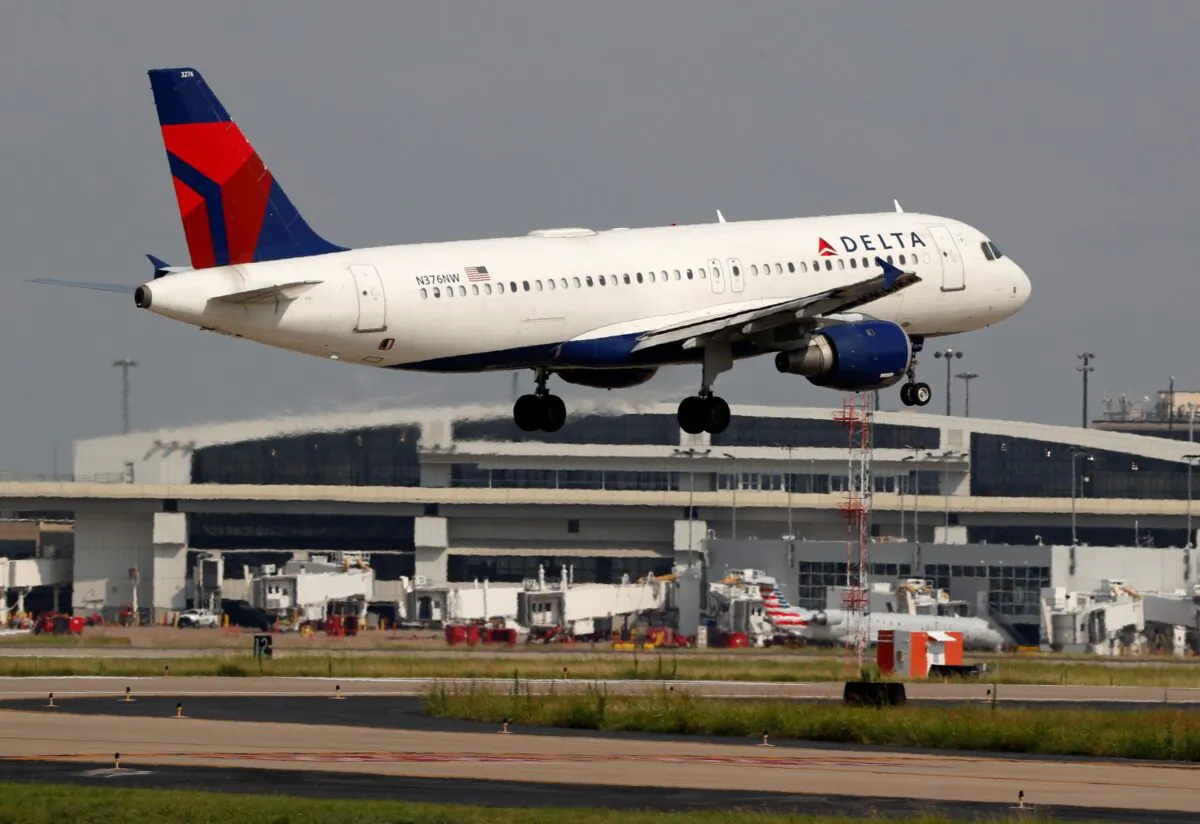

Record quarterly revenue of $15.2 billion in the third quarter, a year-over-year spike of 4.1 percent, helped push Delta Air Line stock up by more than 4 percent by market close.
Delta on Oct. 9 announced that its quarterly earnings topped expectations, with ticket sales from premium, corporate, and loyalty customers increasing in all geographic areas. Those increases give it strong headway heading into the final quarter of the year, the Atlanta-based carrier said.
“For the December quarter, we expect total revenue growth of 2 percent to 4 percent over last year’s record performance, with healthy sequential unit revenue improvement driven by continued domestic strength and meaningful improvement in transatlantic unit revenue,” Glen Hauenstein, president of Delta Air Lines, said.
High-revenue streams such as first-class seating carried 60 percent of the company’s revenue in the quarter, Delta said. Premium revenue was up 9 percent year over year, with Delta announcing multiple efforts to expand its presence in the premium sector. It continues to roll out free in-flight Wi-Fi for SkyMiles members, with the service now available on more than 1,000 planes, the company said.
Delta’s partnership with YouTube provides in-flight access to content on seatback devices and smartphones or tablets, the company said. In addition, more than 1 million SkyMiles members are earning airline miles by linking their accounts with Uber, the airline said. Delta also increased meal options on certain international flights.
The company’s revenue was buoyed by an 8-percent jump in corporate sales versus the same quarter in the prior year, and by a 5-percent year-over-year increase in domestic passenger revenue, the airline said. Recent surveys point to an increase or similar amount of corporate travel in 2026, Delta stated.
Ed Bastian, Delta’s chief executive officer, said the sustained momentum positions the company to deliver strong returns in the fourth quarter and beyond.
“We delivered September quarter results at the top end of our expectations on a combination of strong execution and improving fundamentals,” Bastian said. “Looking to 2026, Delta is well positioned to deliver top-line growth, margin expansion and earnings improvement consistent with our long-term financial framework.”
Delta’s earnings per share of $1.71 surpassed consensus estimates of $1.53 per share. The company ended the quarter with $1.8 billion in operating cash flow, a number that’s expected to significantly increase in future quarters as Delta continues to pay down its debt, Dan Janki, Delta’s chief financial officer, said.
The company had adjusted net debt of $15.6 billion on its books at the end of September, and has paid down $2.4 billion through the first nine months of 2025, including $459 million in the third quarter.
“For the full year, we expect free cash flow of $3.5 to $4 billion,” Janki said. “This outlook is within our long-term target range and enables us to pay down debt while continuing to reinvest in the business and return cash to shareholders.”
Delta earlier this year said it would slow capacity growth in the second half of the year due to slower-than-expected global economic growth and broad economic uncertainty. However, the company has taken delivery of 31 aircraft so far this year, including 12 in the past quarter. It also retired six aircraft in the quarter, bringing its year-to-date total retirements to 20 aircraft.
Other highlights in the quarter include expanded service from Austin to nearly 30 destinations, new routes from Boston’s Logan International Airport to Madrid and Nice, France, and new direct flights starting in 2026 from Seattle-Tacoma International Airport to Rome and Barcelona, Spain.
 Friends Read Free
Copy
Facebook
Tweet
Friends Read Free
Copy
Facebook
Tweet