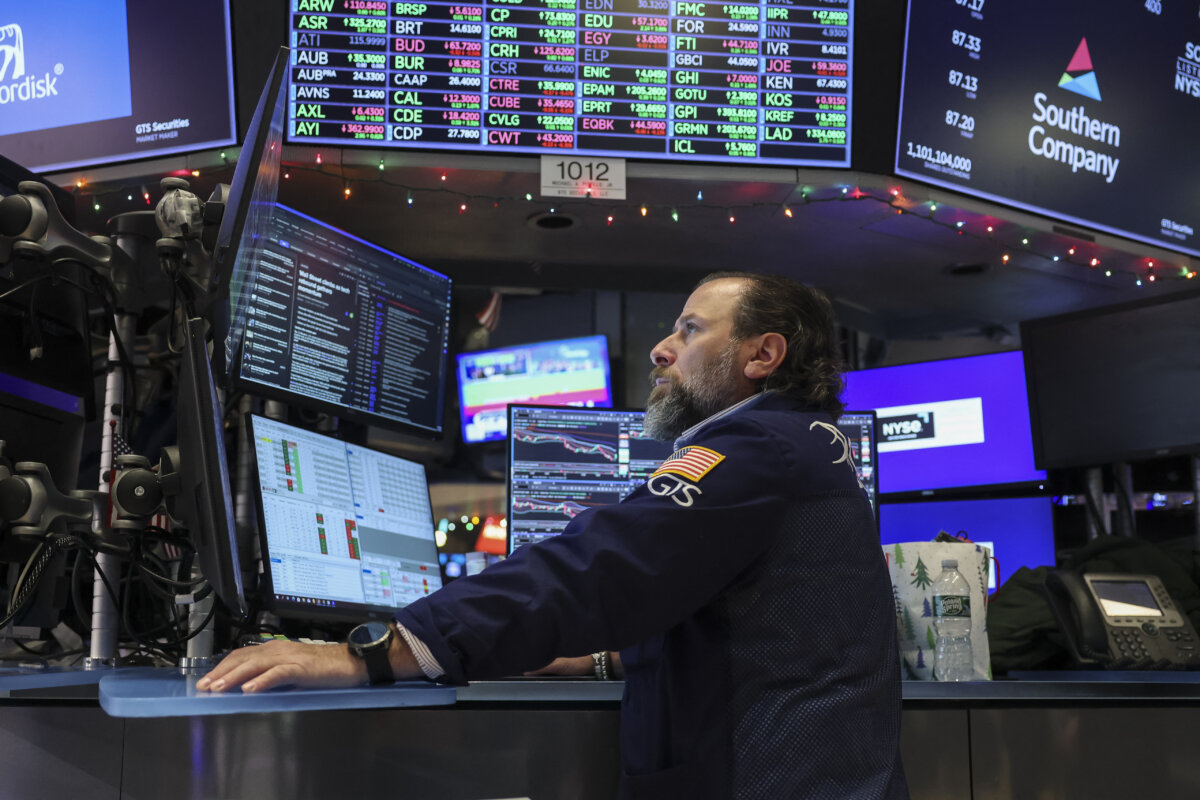

U.S. stocks plunged as investors returned from the Martin Luther King Jr. holiday weekend, with President Donald Trump’s pursuit of a U.S. acquisition of Greenland taking center stage on Wall Street.
The blue-chip Dow Jones Industrial Average fell by about 600 points, or 1.3 percent, at 9:45 a.m. on Jan. 20. The tech-heavy Nasdaq Composite Index declined by about 380 points, or 1.6 percent. The broader S&P 500 Index fell by nearly 100 points, or 1.3 percent.
In a Jan. 17 post on Truth Social, the president announced that eight European NATO members would be subject to 10 percent tariffs beginning Feb. 1, which would rise to 25 percent on June 1.
“We have subsidized Denmark, and all of the Countries of the European Union, and others, for many years by not charging them Tariffs, or any other forms of remuneration,” he said on the social media platform.
“Now, after Centuries, it is time for Denmark to give back—World Peace is at stake! China and Russia want Greenland, and there is not a thing that Denmark can do about it. They currently have two dogsleds as protection, one added recently.”
Greenlandic Prime Minister Jens-Frederik Nielsen said in a social media post on Jan. 19 that the island territory “will not be pressured” over Trump’s tariff threats.
Nielsen also welcomed support from European countries, noting that it is a “clear recognition” that Greenland can choose its own path.
“The latest statements from the U.S., including threats of tariffs, do not change that line,” he said. “We will not be pressured. We stand firm on dialogue, on respect and on international law.”
Trump also threatened to impose 200 percent tariffs on French wines and champagne if France refuses to join the White House’s newly formed Board of Peace. He later lambasted the United Kingdom over its plan to transfer sovereignty of the Chagos Islands to Mauritius, calling it “great stupidity.”
Later on Jan. 20, the president will travel to Davos, Switzerland, for the World Economic Forum.
Dollar Sinks, Yields Rise, Metals Soar
U.S.–European tensions also weighed on the U.S. dollar and lifted global government bond yields, traditional safe-haven assets that investors flee to during economic and political uncertainty.
Long-term yields for U.S. Treasury securities climbed, with the benchmark 10-year increasing more than 5 basis points to nearly 4.29 percent. The 30-year yield topped 4.91 percent.
Treasury Secretary Scott Bessent, speaking to reporters on the sidelines of the World Economic Forum, rebuked speculation that European governments are selling their U.S. Treasury holdings.
“Well, I just want to say this is a false narrative. … There is no talk in European governments,” Bessent said.
Despite the Federal Reserve cutting interest rates, the 10-year yield is now higher than where it was when the U.S. central bank restarted its easing cycle in September.
Elsewhere, the United Kingdom’s 10- and 30-year government bond yields rose to 4.47 percent and 5.23 percent, respectively.
Japanese government bonds have also rocketed, led by the 30-year yield, which increased by almost 27 basis points, to 3.87 percent. The 20-year yield also advanced 20 basis points, to 3.45 percent.
Investors in Tokyo reacted to Prime Minister Sanae Takaichi’s decision to call a snap election—less than half a year into her term—scheduled for Feb. 8.

The U.S. dollar index, a measure of the greenback against a weighted basket of currencies, fell by 0.9 percent.
Investors are seeking shelter in the metals, adding to the market’s meteoric ascent.
Gold prices rose by more than $150, or 3.3 percent, to a new all-time high of $4,750 per ounce. Silver prices spiked $6.70, or 7.57 percent, to above $95 per ounce.
Platinum and palladium prices rallied 4.9 percent and 3.8 percent, respectively. Copper fell by 0.4 percent.
While Greenland has added fuel to the fire, it was not the catalyst behind the metal market’s rally, says Ole Hansen, head of commodity strategy at Saxo Bank.
“The global bid for metals reflects deeper unease about fiscal discipline, monetary credibility, and financial stability, not just short-term geopolitical headlines,” Hansen said in a Jan. 19 note.
“With silver testing levels that risk industrial demand destruction, investors may consider a partial rotation back toward gold.”
Cryptocurrency markets have also failed to attract safe-haven attention. Bitcoin, the largest crypto asset in the world, fell by nearly 3 percent, to below $91,000.
Other Developments on the Way
Financial markets are waiting for the U.S Supreme Court’s decision on whether Trump’s use of tariffs without congressional authorization is legal.
On the data front, traders will learn about the economy’s health when the Bureau of Economic Analysis releases the final estimate for third-quarter gross domestic product (GDP).
Investors will also digest the Federal Reserve’s preferred measure of inflation, the personal consumption expenditures price index, for November, as well as personal income and spending.
Despite the recent selloff, market watchers expect the stock market to respond well to fiscal stimulus from the One Big Beautiful Bill Act, lower interest rates, and spending on artificial intelligence.
“The economy appears to be in good shape,” Thomas Browne, portfolio manager at Gabelli Funds, said in a note emailed to The Epoch Times.
“We haven’t had a truly strong economy for several years, and this looks like another muddle-through environment. From a market standpoint, that should be supportive of corporate earnings. Valuations are somewhat high for large caps, but they remain reasonable for small and mid caps.”
Aldgra Fredly and Tom Ozimek contributed to this report.
 Friends Read Free
Copy
Facebook
Tweet
Friends Read Free
Copy
Facebook
Tweet