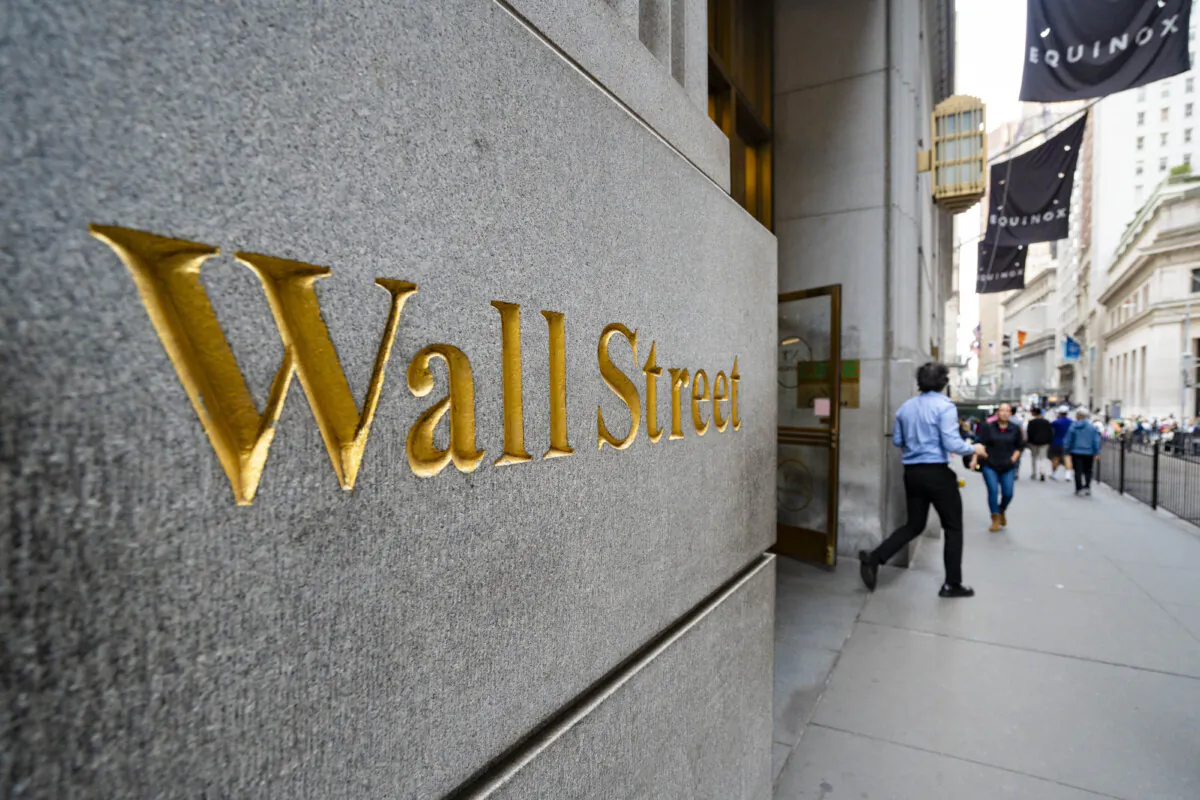

The blue-chip Dow Jones Industrial Average slipped into correction territory at the end of the trading week as the war in Iran continued to weigh on U.S. stocks.
A correction reflects a decline of at least 10 percent from a recent all-time high.
The Dow Jones, a major stock market index composed of 30 large companies, fell by about 600 points, or more than 1 percent, during the March 27 trading session.
Year-to-date, the benchmark average index has slumped by almost 6 percent.
This comes one day after the Nasdaq Composite Index was pushed into correction territory, declining by more than 2 percent on March 26.
The tech-heavy index extended its skid, falling nearly 400 points, or 1.8 percent, at the end of the trading week. It has fallen around 10 percent so far this year.
The broader S&P 500 also fell about 1.3 percent and has slid nearly 7 percent this year.
“The market has continued to methodically take steps lower from one support level to the next without a clear washout. As we enter Friday’s trading session that next step is much further down than previous steps,” Jay Woods, chief market strategist at Freedom Capital Markets, said in a note emailed to The Epoch Times.
“We have yet to see an acceleration to the downside, but it’s coming.”
Uncertainty surrounding the Iranian conflict continues to drive the market lower. Investors fear that Middle East tensions could lead to renewed inflationary pressures and weaker economic growth amid higher energy prices.
Consumer sentiment weakened this month, falling 6 percent to its lowest level since Dec. 25, according to the University of Michigan’s March Consumer Sentiment Index. Additionally, consumers’ one-year inflation outlook rose to 3.8 percent, from 3.4 percent in the previous month.
‘Flush Out’
Deteriorating consumer sentiment has coincided with rising oil and gas prices and financial market volatility.
The conflict in Iran has shut down the Strait of Hormuz, a vital global artery for energy shipments, resulting in an oil price shock.
U.S. crude oil prices surged more than 4 percent on March 27 to above $98 per barrel on the New York Mercantile Exchange.
Brent, a global benchmark that is more sensitive to geopolitical strife, climbed nearly 4 percent to $112 a barrel in overseas markets.
Motorists are feeling the pain at the pump, since oil accounts for about half the price of gas.
The average cost for a gallon of gasoline is around $3.98, according to the American Automobile Association.
The March Consumer Price Index report is expected to show a large increase in the annual inflation rate, with the Cleveland Federal Reserve forecasting a reading of above 3 percent.
Risks of a recession—back-to-back quarters of negative growth—have also risen as of late.
Goldman Sachs raised the odds of a recession to 30 percent over the next 12 months.
All of this could spell more bad news for the stock market, Woods notes.
“This is the extension and acceleration of a flush out—a correction if you will,” he said.
“For those with dry powder, start getting those lists ready. The dominoes are in place for a deeper drawdown over the next week or so—ironically the same time as last year’s Liberation Day sell-off.”
But Torsten Slok, chief economist at Apollo, believes investors are overreacting to the situation in Iran and are failing to think long term.
“Markets are overreacting to what will likely be a 4- to 6-week period of volatility, which will ultimately result in 50 years of stability in oil markets, supply chains and geopolitics,” Slok said in a note emailed to The Epoch Times.
“The Gulf region will become more stable and even more closely integrated with the global economy.”
The Iran war is not vast enough to cancel out the various tailwinds, whether artificial intelligence-related spending or fiscal stimulus in the One Big Beautiful Bill Act, he added.
U.S. Treasury yields were mixed. The benchmark 10-year yield ticked up to 4.3 percent, while the 20- and 30-year yields eyed 5 percent. The 2-year, which tracks Fed policy expectations, fell sharply to below 3.92 percent.
The greenback strengthened further as investors sought shelter from market turbulence.
The U.S. Dollar Index—a gauge of the buck against a weighted basket of currencies like the British pound and euro—rose 0.3 percent to above 100.00. The index posted a weekly gain of 0.5 percent and is up almost 2 percent this year.
 Friends Read Free
Copy
Facebook
Tweet
Friends Read Free
Copy
Facebook
Tweet