
The European Central Bank (ECB) on April 30 left its key interest rates unchanged, saying that the ongoing war in the Middle East has pushed inflation higher and dampened economic sentiment.
The ECB’s Governing Council maintained the deposit rate at 2 percent, the main refinancing operations at 2.15 percent, and the marginal lending facility at 2.4 percent.
The decision comes as inflation in the euro area rose to 3 percent in April, up from 2.6 percent in March and 1.9 percent in February, driven largely by energy costs.
Energy inflation soared to 10.9 percent in April from 5.1 percent the previous month, according to ECB data.
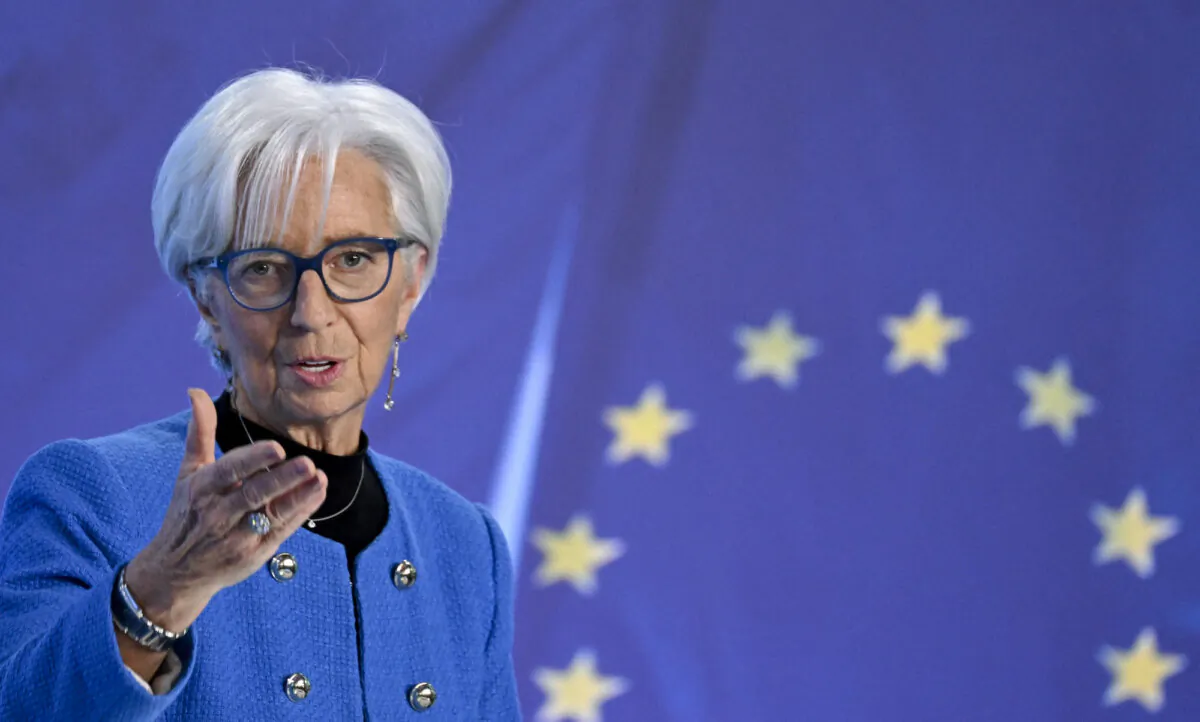
ECB president Christine Lagarde said during a news conference in Frankfurt that the implications of the Iran war for medium-term inflation and economic activity will depend on the intensity and duration of the energy price shock.
“The longer the war continues and the longer energy prices remain high, the stronger is the likely impact on broader inflation and the economy,” Lagarde said.
The announcement came the same day the Bank of England held its key rate at 3.75 percent, projecting further inflationary spikes in the coming months due to higher energy costs.
The Bank of England and the ECB both target an inflation rate of 2 percent. Lagarde said the ECB remains committed to ensuring inflation returns to its medium-term target.
“We stand ready to adjust all of our instruments within our mandate to ensure that inflation stabilises sustainably,” she said.

The U.S. Federal Reserve on April 29 held its benchmark target range at 3.5 to 3.75 percent, while the Bank of Japan kept its short-term policy rate steady at 0.75 percent a day earlier.
Growth Outlook
The ECB also highlighted signs of weakening economic activity.
Euro area GDP grew by 0.1 percent in the first quarter of 2026, according to preliminary data cited by the central bank.
Lagarde said surveys indicate slowing growth and declining confidence among businesses and consumers since the start of the conflict in the Middle East.
Higher energy costs are expected to weigh on household incomes and business investment, while supply chain pressures have reemerged, reflected in longer delivery times and rising input costs.
Despite these headwinds, the labor market has remained relatively resilient, with unemployment in the euro area at 6.2 percent in March. The ECB noted that labor demand has begun to cool.
Financial conditions have tightened since the onset of the conflict, with borrowing costs rising and credit standards tightening. The cost of issuing market-based debt rose to 3.9 percent in March from 3.5 percent in February, ECB data showed.
Bank lending rates for firms edged down slightly before the conflict, but demand for loans has since softened, particularly for investment purposes. Mortgage lending growth also slowed marginally.
The ECB said these developments reflect increased caution among banks and borrowers amid heightened uncertainty.
Lagarde said the ECB will “closely monitor” the size and persistence of the energy price surge and its impact on price and wage-setting, inflation expectations, and overall economic dynamics.
 Friends Read Free
Copy
Facebook
Tweet
Friends Read Free
Copy
Facebook
Tweet