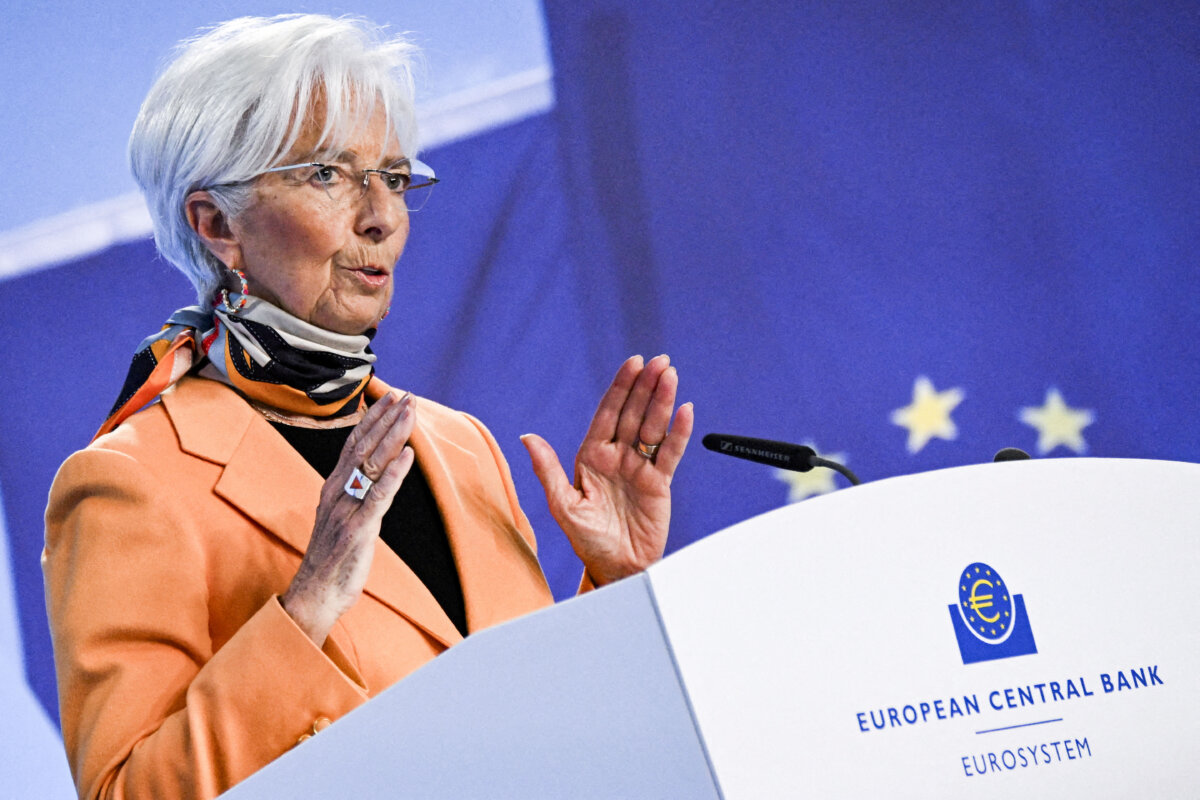

The European Central Bank (ECB) raised interest rates on June 11 for the first time since September 2023, moving to contain an energy-driven inflation shock triggered by the war in the Middle East even as the eurozone economy shows signs of weakening.
The ECB lifted its three key rates by 25 basis points, taking the benchmark deposit rate to 2.25 percent from 2 percent, according to a June 11 policy statement citing inflation pressures driven by an energy price shock stemming from the Iran war.
“The decision to raise rates is robust across a range of scenarios mapping out how the shock might evolve and affect the medium-term outlook,” the ECB’s governing council said in the statement, which described the outlook as “uncertain, with upside risks for inflation and downside risks for economic growth.”
The rate hike also lifts the main refinancing rate to 2.4 percent and the marginal lending facility to 2.65 percent, effective on June 17. The ECB said future rate moves would depend on incoming economic data and policymakers’ assessment of inflation risks.
The move was widely expected by economists and marks the first rate increase by a major G7 central bank in response to the energy crisis driven by the war in the Middle East.
Inflation in the 21-country eurozone accelerated to 3.2 percent in May from 3 percent in April, moving further above the ECB’s 2 percent target. Energy prices remained a key driver, while underlying inflation pressures also strengthened.
Energy Shock Clouds Economic Outlook
The ECB said the conflict in the Middle East is pushing up energy costs and creating broader price pressures throughout the economy. Higher energy bills are weighing on consumer spending, business confidence, and economic growth.
Policymakers revised their inflation outlook higher and cut their growth forecasts, reflecting expectations that elevated energy prices will continue to affect households and businesses for some time.
The ECB’s new baseline projections for inflation put it at 3 percent this year, 2.3 percent in 2027, and 2 percent in 2028, bringing them closer to the “adverse scenario” the bank had mentioned in its March report, when the contours of the war-related energy shock were less clear.
While it still expects inflation to return to its 2 percent target over the medium term, the ECB warned that the process would take longer than previously anticipated and would depend heavily on how the conflict evolves and whether energy prices remain elevated.
“The full implications of the war for medium-term inflation and growth will depend on the intensity and duration of the energy price shock, as well as the scale of its indirect and second-round effects,” the central bank said.
ECB President Christine Lagarde said the rise in energy costs is expected to keep inflation above target well into next year and could increasingly spread into other parts of the economy through higher costs of services, goods, and food.
“We see the energy price inflation—10.9 percent at the moment—broadening throughout the economy, which is why we are making this decision today,” Lagarde said at a press conference following the decision.
When asked by reporters about the risk to growth posed by the decision to raise rates, Lagarde said the bigger worry for policymakers was inaction.
“The main risk would be not to take that kind of decision, because if you let inflation start running out without control, then it becomes a much more difficult situation to bring it back to the level of price stability that we have defined,” she said, describing the rate hike as a “good decision” that delivers on the ECB’s pledge to support the kind of financial stability that helps households and businesses make decisions on investment and employment.
Debate Over Need for Higher Rates
Some economists have characterized the move as an “insurance hike” designed to prevent inflation expectations from becoming unanchored and to protect the ECB’s credibility after criticism that it reacted too slowly to the post-COVID-19 pandemic inflation surge.
“Today’s ECB decision is the expected insurance rate hike and an attempt to stay ahead of the curve, as an inflation wave is clearly hitting the eurozone economy,” ING analysts wrote in a note. “Unofficially, however, we can’t shake the idea that the ECB is actually fighting ghosts from the past.”
ING analysts said policymakers may be influenced by memories of their delayed response to the inflation surge of 2021 and 2022, when a bout of what was widely described as “transitory” inflation proved to be longer lasting.
Price pressures now remain far more contained than during the post-COVID-19 pandemic surge, ING said, noting also that the ECB’s own forecasts do not point to a sustained outbreak of runaway inflation.
Further rate hikes risk repeating what ING analysts described as “another mistake from the past,” namely the 2011 tightening cycle that was later quickly reversed as the eurozone economy weakened.
Other economists were even more critical.
Paul Donovan, chief economist at UBS Global Wealth Management, called the move an error, driven by an “unhelpful 2022 mindset.”
Berenberg Bank economist Holger Schmieding described the hike as “a policy mistake,” arguing that weakening demand and slowing growth are likely to limit the persistence of inflation pressures.
Lagarde was asked at the June 11 press conference whether the rate-hike decision was driven less by inflation dynamics and more by a desire for ECB decision-makers not to be perceived as complacent.
“It’s not an issue of complacency,” Lagarde replied, insisting that the “robustness of the decision” was supported by rigorous analysis and the rate hike is “completely warranted and justified.”
“I don’t need to characterize it as credibility insurance or anything else for that matter,” she said. “It’s a monetary policy decision that stands, and that is … robust across all scenarios.”
Despite the increase, Lagarde dismissed suggestions that this was the start of a broader tightening cycle, vowing “data-dependent” decisions based on where prices go from here.
 Friends Read Free
Copy
Facebook
Tweet
Friends Read Free
Copy
Facebook
Tweet