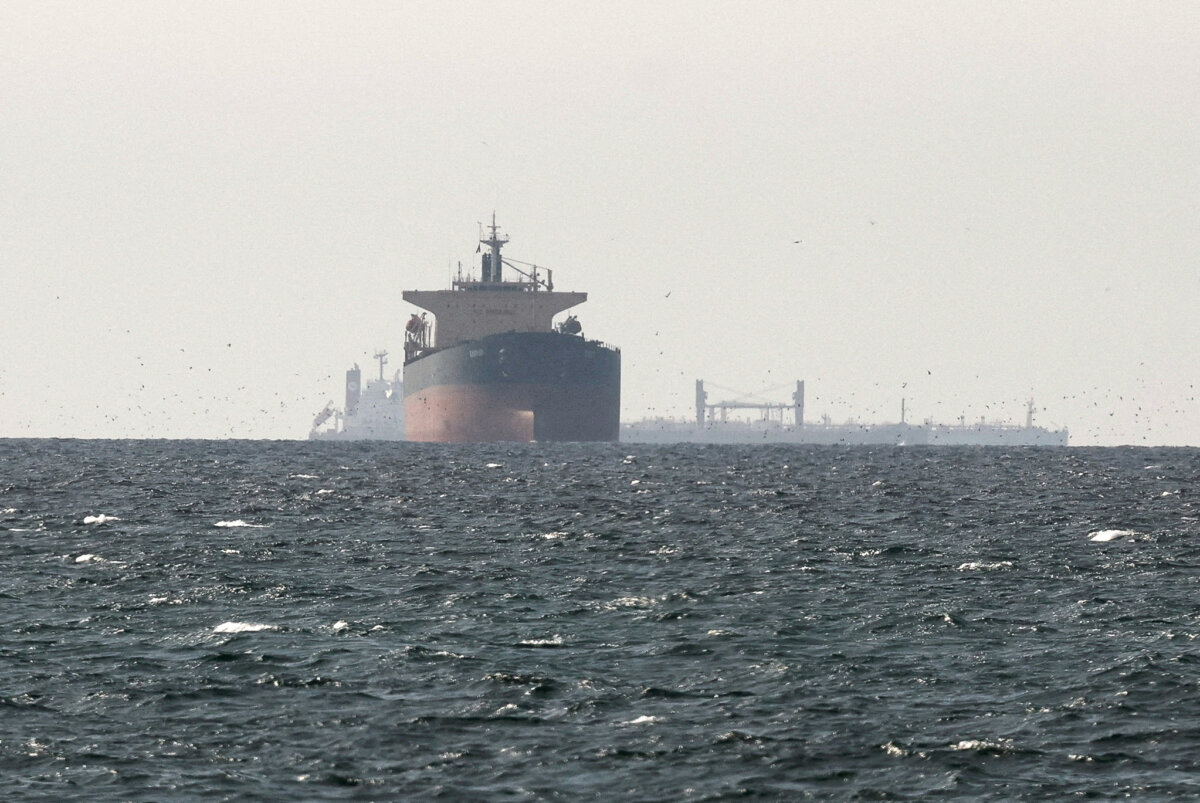

Liquefied natural gas prices in Europe and Asia have surged amid the closure of the Strait of Hormuz waterway, diverging from U.S. prices, the U.S. Energy Information Administration (EIA) said in an April 28 statement.
“Futures prices for liquified natural gas (LNG) delivery to the Title Transfer Facility (TTF), the European benchmark price, increased to $14.80 per million British thermal units (MMBtu) for the week ending April 24, 35 percent higher than before the closure” of the Strait, the EIA stated.
“In East Asia, the front-month futures price for the benchmark Japan-Korea Marker (JKM), rose 51 percent over the same period to $16.02/MMBtu.
“In contrast, natural gas prices at the U.S. benchmark Henry Hub have decreased 9 percent since February 28 due to limited opportunities for increasing LNG exports in the near term and ample domestic seasonal natural gas storage and supply.”
Gas prices have increased following the U.S.–Israeli war with Iran, which began on Feb. 28 and has disrupted the shipment of fuel via the Strait of Hormuz, a waterway connecting the Persian Gulf with the larger Indian Ocean. Closure of the strait “would strand LNG exports from Qatar and the UAE,” which combined account for a sizable share of global LNG exports, according to the International Energy Agency.
Since the war began, Iran’s military has fired on commercial shipping vessels transiting the Strait, disrupting shipments and pushing up energy prices.
Meanwhile, the U.S. military has imposed a naval blockade of Iranian ports to exert pressure on Tehran. A ceasefire announced earlier this month is ongoing, but there has been no indication of any deal.
In its statement, EIA said that the Hormuz closure has affected more than 10 billion cubic feet per day of LNG supplies, which represents roughly 20 percent of total worldwide supplies. This is mainly due to a lack of shipments from Qatar’s Ras Laffan export facility.
“No laden LNG vessels are known to have crossed the strait between March 1 and April 24,” the agency stated. “QatarEnergy declared force majeure on March 4, which has forced Asian buyers who import over 80 percent of Qatari gas to compete for spot cargoes on global markets to replace lost contract volumes.”
Force majeure is a contractual provision that allows parties to avoid fulfilling their obligations when circumstances are beyond their control.
However, even if shipments through Hormuz were to normalize, the global LNG market remains set to see persisting supply disruptions, as it will take time to restart Qatari capacity, ING Bank said in an April 16 post.
“There is little in the way of supply alternatives for the market to offset the sizeable volumes we are seeing disrupted from the Persian Gulf. The ramp-up of new US LNG capacity is simply not enough,” the bank stated.
The EIA said in its recent statement that it expects U.S. LNG exports to increase, but only by a “small portion of the missing volumes.”
U.S. LNG terminals are already being run at high utilization rates, which limits any additional natural gas export growth and also restricts the potential for any price increases in the U.S. market, the EIA stated.
Hormuz Oil Impact
In addition to natural gas prices, the Hormuz crisis has also sent crude oil prices surging, with U.S. gasoline prices also rising.
Brent crude oil futures ended Feb. 27, the day before the war began, at around $72 per barrel. Oil was trading at $109.67 as of 11:20 a.m. EDT on April 29.
On April 28, the average nationwide price for a gallon of gasoline hit $4.17 in the United States, the highest in four years, Patrick de Haan, head of petroleum analysis at GasBuddy, said in an April 28 post on X.
According to data from the American Automobile Association, a gallon of regular gas averaged $4.23 nationwide on April 29, up from $3.98 a month back. Gas prices exceeded $5 per gallon in five states—Nevada, Oregon, Washington, Hawaii, and California.
During a press conference at the Oval Office on April 23, President Donald Trump said that Americans may have to deal with higher gasoline prices “for a little while” amid the Iran conflict.
A day earlier, Treasury Secretary Scott Bessent told the Senate Appropriations Committee that high gas prices won’t last long.
“I think the conflict will end; I think gasoline prices will come back to where they were or perhaps lower,” Bessent said.
 Friends Read Free
Copy
Facebook
Tweet
Friends Read Free
Copy
Facebook
Tweet