
Long-term interest rates hit their highest level in almost 20 years to start the trading week, signaling investors’ growing concerns surrounding persistent inflation and the government’s fiscal health.
The 30-year Treasury yield climbed by more than 4 basis points to about 5.31 percent—its highest since June 2007—during the Aug. 17 trading session.
The benchmark 10-year yield also ticked up to above 4.72 percent. The two-year yield, which generally tracks Federal Reserve policy expectations, was little changed at 4.18 percent.
Higher yields can have financial consequences for companies and consumers because they influence mortgages, auto financing, business loans, and more.
Here’s what to know as long-run rates surge to a 19-year high.
War in Iran
In the month before the Iranian conflict, Treasury yields were decelerating sharply. Once the war in the Middle East began, interest rates steadily climbed amid inflation fears.
With both sides at a stalemate, there does not appear to be an imminent resolution that could curb inflation-related worries.
Still, global energy markets were upended in the wake of the joint U.S.–Israel operation in Iran, as oil prices topped $100 per barrel. Crude futures have stabilized, but energy costs remain firmly higher than where they were this past winter.
The price of a barrel of West Texas Intermediate—the U.S. benchmark for oil prices—is above $84 on the New York Mercantile Exchange. The global benchmark Brent oil reached $90 in overseas trading.
As a result, bond markets are signaling persistent inflation, which could lead the Federal Reserve to eventually hike interest rates or keep policy tighter for longer.
The U.S. economy got a break last month when the annual inflation rate eased for the second consecutive month to 3.4 percent. Additionally, excluding oil and gas, core inflation is much more subdued and only slightly above the central bank’s 2 percent target.
The Cleveland Fed’s Inflation Nowcasting model suggests August’s 12-month core inflation rate could come in at 2.4 percent.
Futures markets pared their September rate hike bets, and traders are now anticipating the Fed to hold steady at next month’s Federal Open Market Committee policy meeting. Investors are split on whether the central bank will hike rates or hold steady this year.
Treasury Issuance
The U.S. government has aggressively expanded its debt issuance, flooding global capital markets with a fresh supply of Treasury securities.
In the first seven months of 2026, U.S. Treasury market issuance—bills, notes, bonds, and TIPS—has ballooned by more than 10 percent year over year to almost $19 trillion, according to the Securities Industry and Financial Markets Association. The focus has been on the short term (30 days to one year).
From 2007 to 2020, traders accepted interest rates of less than 5 percent for long-term bonds. Over the past five years, investors have increasingly demanded higher compensation to finance the federal government’s growing debt.
An example of this occurred on Aug. 13 when the Treasury completed a $25 billion sale of 30-year bonds at a rate of 5.216 percent—the highest since 2001.
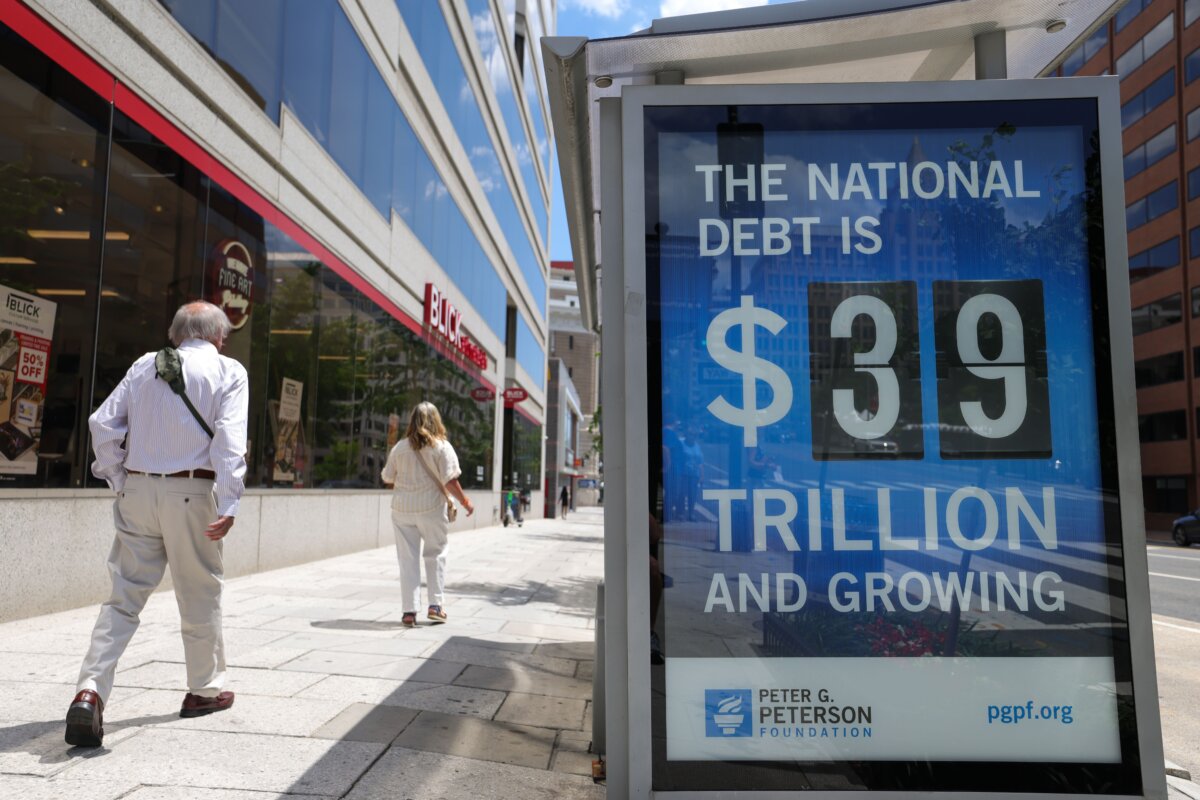
America’s national debt is set to reach $40 trillion soon.
This will come shortly after the federal government recorded a $432 billion deficit in July and is poised to register a $2 trillion shortfall for the fiscal year.
Interest payments continue to represent one of the largest budgetary items, on par with Social Security. In the first 10 months of the fiscal year, interest on the public debt sits at $1.17 trillion, up by 15 percent year over year.
But rising yields could be a return to normal rather than a sign of panic, ING strategists say.
“It’s real yields moving back to more sensible levels; to the type of levels that we saw before the craziness of the great financial crisis and pandemic years that trampled real yields to the floor,” they said in an Aug. 17 research note.
“Real yields where they are now are no more than a reversion to more normal rates.”
Long-term inflation expectations are well-anchored, and the 10-year break-even rate is hovering at 2.3 percent.
AI Competition
A concern moving forward is that corporate debt could crowd out government bonds, forcing the Treasury to compete with the artificial intelligence hyperscalers for capital.
Big Tech—Alphabet, Amazon, Nvidia, Oracle, and SpaceX, for example—has been executing multi-billion-dollar bond sales to fund this year’s trillion-dollar capital expenditures amid the ongoing AI infrastructure buildout.
AI-related issuance currently accounts for 40 percent of long-duration investment-grade corporate bond supply, says Torsten Slok, chief economist at Apollo.
“And the financing needs are only getting larger,” he said in an Aug. 14 note.
“We estimate the AI ecosystem could fundamentally support more than $2 trillion of additional [investment-grade] debt, while public IG markets may be able to absorb less than $1 trillion of that amount through 2030 because of concentration and ratings constraints.”
So far, the Treasury Department has not altered its issuance strategies, and the latest quarterly refunding estimates suggest that the government plans to borrow almost $1.4 trillion over the next six months.
Foreign Holdings
Foreign holdings of U.S. debt fell modestly in June, new government data show.
Major foreign holders of Treasury securities fell by $72 billion, or about 0.8 percent, to $9.299 trillion—the lowest since January.
Japan, China, and the UK—the three largest holders worldwide—were net sellers. Conversely, Belgium, Canada, and Switzerland were net buyers.
There is no direct trend forming, as the numbers have been volatile in 2026, the ING strategists noted.
“Overall net foreign inflows into the U.S. when equities are included remain strong though, at $173 [billion] for June. And at $134 [billion] when banking and short-term flows are included (meaning these saw moderate outflows),” they said.
Economists and policymakers have expressed concern since early last year that the world might be growing tired of U.S. debt, especially as the current administration attempts to rebalance international trade. But global portfolios of U.S. bonds have steadily risen.
 Friends Read Free
Copy
Facebook
Tweet
Friends Read Free
Copy
Facebook
Tweet