
The U.S. government sold 30‑year bonds at their highest interest rate in a generation, reflecting investors’ mounting demand for greater compensation to shoulder America’s persistent budget deficits and increasing debt levels.
On Aug. 13, the Treasury completed a $25 billion sale of 30-year bonds at a rate of 5.216 percent, the most since 2001.
Demand was robust, with big banks, institutions, and foreign investors purchasing a sizable share of the issuance, according to Treasury data.
This comes one day after the Treasury’s 10-year auction yielded 4.683 percent, the highest since 2007.
Movements in U.S. bond markets and the latest auction results suggest higher financing costs are here to stay.
“The ratchet higher in longer-dated real yields since February is a feature that we’re not expecting to see unwound any time soon,” Padhraic Garvey, regional head of research at ING, said in an Aug. 13 note.
“Real yields are higher and will likely remain so. The fiscal numbers are slipping.”
Treasury yields have risen across the board since the Iranian conflict began in late February—and it is not only consternation surrounding the government’s fiscal health fueling the upward trajectory.
The benchmark 10-year yield is close to 4.7 percent, and the 20- and 30-year yields have blown past 5 percent amid growing concerns that elevated inflation will force the Federal Reserve to keep interest rates higher for longer.
“The 10-year yield has remained uncomfortably high as sporadic flare-ups in kinetic activity and unanswered questions around energy production and shipping disruptions in the Middle East have led markets to increase their expectations of a Federal Reserve (Fed) rate hike,” Jeff Buchbinder, chief equity strategist at LPL Financial, told The Epoch Times in an emailed note.
While the 10‑year yield is widely watched because it anchors everything from economic sentiment to borrowing costs and the standard “risk‑free” rate in financial models, the entire Treasury curve has been climbing, drawing attention to a broader shift higher across maturities, Buchbinder added.
Treasury Staying the Course
Despite rising interest rates, the Treasury Department is not adjusting its debt strategies, with long-dated securities remaining at current levels over the next several quarters.
In its latest quarterly refunding estimates, the federal government projects privately held net marketable borrowing of $739 billion for the July–September period. Additionally, it estimates $628 billion during the October–December quarter.
Officials also plan to offer a $125 billion package of securities to refund more than $96 billion in maturing debt and provide almost $29 billion in new cash. This will be driven by $58 billion in 3-year notes, $42 billion in 10-year notes, and $25 billion in 30-year bonds.
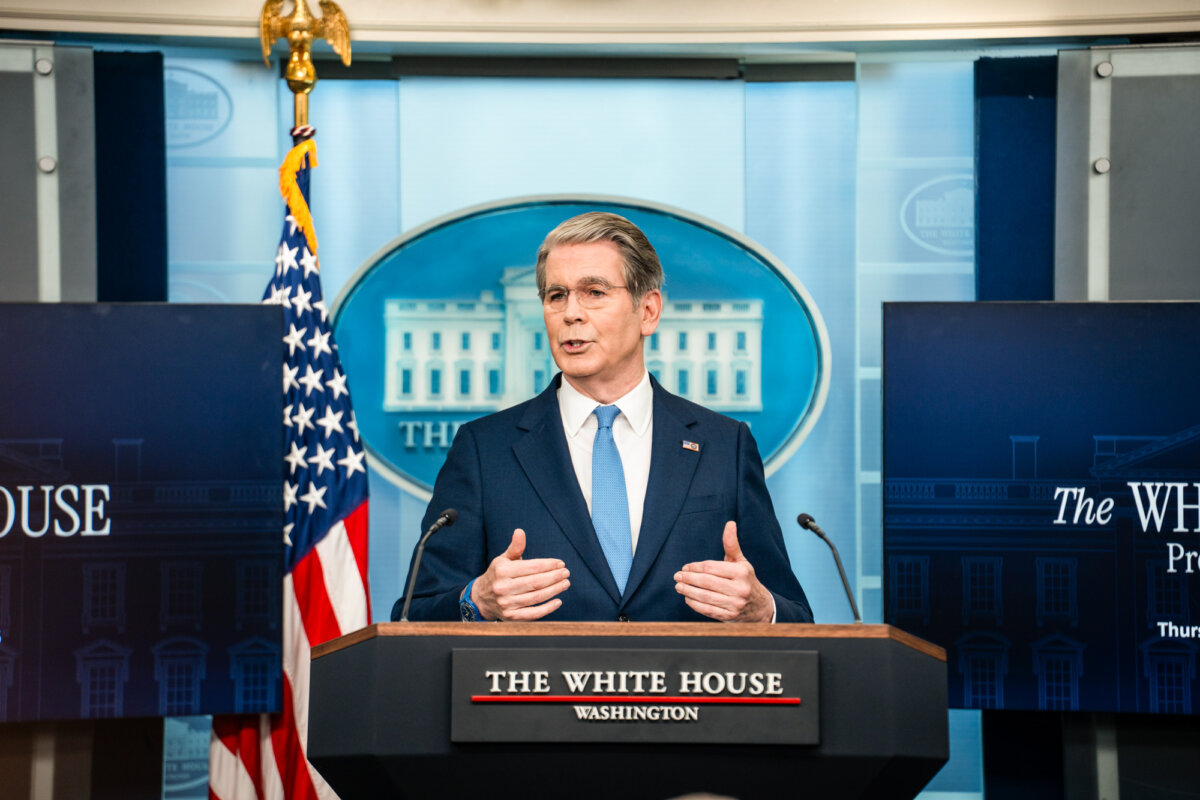
Treasury Secretary Scott Bessent has been employing various strategies to reduce Washington’s debt-servicing costs, relying on a mix of short-term notes and debt buybacks.
An Epoch Times review of Treasury data last month found that the U.S. government bought back almost $200 billion in debt this year to smooth maturity profiles and avoid future refinancing spikes, as well as to bolster liquidity in the bond market.
Earlier this year, the White House had encouraged the Federal Reserve to lower the federal funds rate—a key policy rate that influences borrowing costs for businesses and consumers—to no avail. But nudging the central bank toward a dovish stance might not stabilize bond markets either.
When the Fed started lowering interest rates in 2024, a divergence emerged as Treasury yields began to climb.
Still, the U.S. bond market is facing various pressures that are driving up borrowing costs, including the buildout of artificial intelligence (AI) infrastructure.
This year, scores of AI hyperscalers—Alphabet, Amazon, Microsoft, Nvidia, SpaceX, and others—have tapped capital markets to help fund the AI boom. As a result, the federal government, which has been flooding financial markets with fresh debt, is competing with the private sector for capital.
Enormous deficits and higher borrowing costs are impacting America’s fiscal health.
Fiscal year-to-date interest on the public debt is up 15 percent year-over-year to around $1.17 trillion, fueled in large part by higher yields on Treasury securities. Gross interest payments are the second-largest budgetary item, just behind Social Security’s $1.384 trillion price tag.
The national debt is poised to cross the $40 trillion milestone soon.
The U.S. government registered a $432 billion deficit in July. With two months left in fiscal year 2026, the budget shortfall is nearly $1.8 trillion.
“We are already feeling the consequences of this extreme borrowing – high interest rates, trillion-dollar interest payments, and looming trust fund insolvency that threatens benefits for Social Security and Medicare,” Maya MacGuineas, president of the Committee for a Responsible Federal Budget, said in an Aug. 12 statement.
Consumers are indeed feeling the pain of rising interest costs, particularly in the housing market.
Thirty-year fixed mortgage rates were 6.67 percent for the week ending Aug. 13, according to Freddie Mac’s Primary Mortgage Market Survey. While this is slightly down from the previous year, it is firmly above the 52-week average of 5.98 percent.
 Friends Read Free
Copy
Facebook
Tweet
Friends Read Free
Copy
Facebook
Tweet