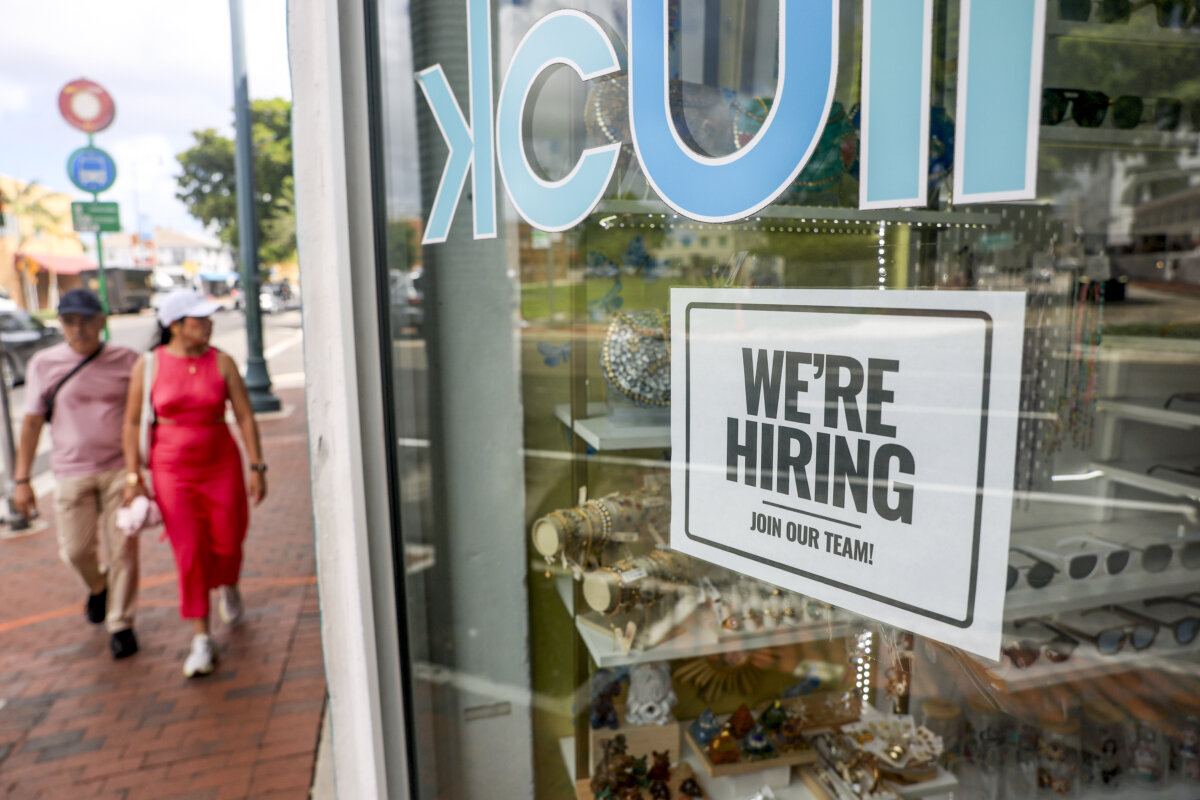

The number of Americans filing for unemployment benefits remained below 200,000 for the fifth straight week, signaling sturdy labor market conditions.
Initial jobless claims rose 1,000 to 199,000 for the week ending Oct. 10, according to the Department of Labor.
This came in slightly below economists’ expectations.
Excluding week-to-week volatility, the four-week average was little changed at 198,500.
Weekly claims data have supported the oft-described “low-fire, low-hire” labor market.
Employment conditions have remained consistent this year, staying within a historically tight range of 189,000 to 230,000.
The Federal Reserve’s Beige Book—a summary of economic conditions across the central bank’s 12 districts—suggests little movement in overall labor market conditions.
Labor supply was “generally adequate to meet demand,” though shortages of skilled trade and technical workers continued, the Oct. 14 report stated.
“The labor market continues to look more frozen than broken,” Chris Osmond, CIO of Fifth Third Wealth Advisers, told The Epoch Times in an emailed note.
While job growth has fluctuated, few layoffs have been a key theme in 2026, keeping the unemployment rate near 4 percent.
Hiring momentum has ebbed and flowed this year, and economists attribute lackluster growth to tariffs, renewed inflation pressures, and artificial intelligence (AI).
“September payrolls suggested a sharp deterioration in hiring, while sub-200,000 claims suggest layoffs remain remarkably contained,” Osmond added.
But lower continuing jobless claims could suggest workers are finding jobs more easily.
Recurring unemployment claims—a measure of the number of people currently receiving benefits—were little changed, at 1.71 million, the department said.
The reading aligned with market estimates.
Economists also suggest it could show more people exhausting their benefits since many states cap eligibility at 26 weeks.
Holiday Hiring
Heading into the holiday shopping season, market watchers will look to see whether seasonal employment demand is picking up.
ADP data show private-sector employment growing by 24,750 per week in the four weeks ending Sept. 26.
As of Sept. 30, seasonal job postings were up about 10 percent from a year ago—the best start in several years—according to new Indeed Hiring Lab data.
While retail still accounts for about two-thirds of seasonal work, demand for stocking and loading roles has steadily risen. These positions now make up about 9 percent of seasonal job postings, up from 3.5 percent in 2019.
The U.S. hiring outlook venturing into the holiday season is evolving as firms balance budgetary caution and long-term employment needs with economic uncertainty and high applicant volumes, says Christie Brodbeck, vice president of customer service at Hirevue.
“The holiday season brings a surge in demand as companies prepare to move, store and deliver goods ahead of peak holiday shopping,” Brodbeck said in a statement to The Epoch Times.
“Companies are still ramping up their seasonal holiday hiring this year to meet this demand, despite a flat/slowing hiring market more broadly.”
Based on recent economic data, it is unclear whether U.S. consumers will have an appetite for Christmas shopping.
Retail sales popped 0.8 percent in September, easily beating economists’ expectations. Excluding automotive services and gas stations, retail sales only edged up 0.2 percent.
Real (inflation-adjusted) wages have also weakened this year. Real average hourly and weekly earnings fell 0.5 percent in September, according to the Bureau of Labor Statistics.
Consumer sentiment has steadily deteriorated since the start of the war in Iran in late February as households wrestle with rising price pressures.
Despite these numbers, many expect shoppers to head to malls or use computers and smartphones for their Christmas needs.
In its annual U.S. forecast, the Mastercard Economics Institute projects 5.5 percent spending growth, marking the strongest holiday season in four years.
 Friends Read Free
Copy
Facebook
Tweet
Friends Read Free
Copy
Facebook
Tweet