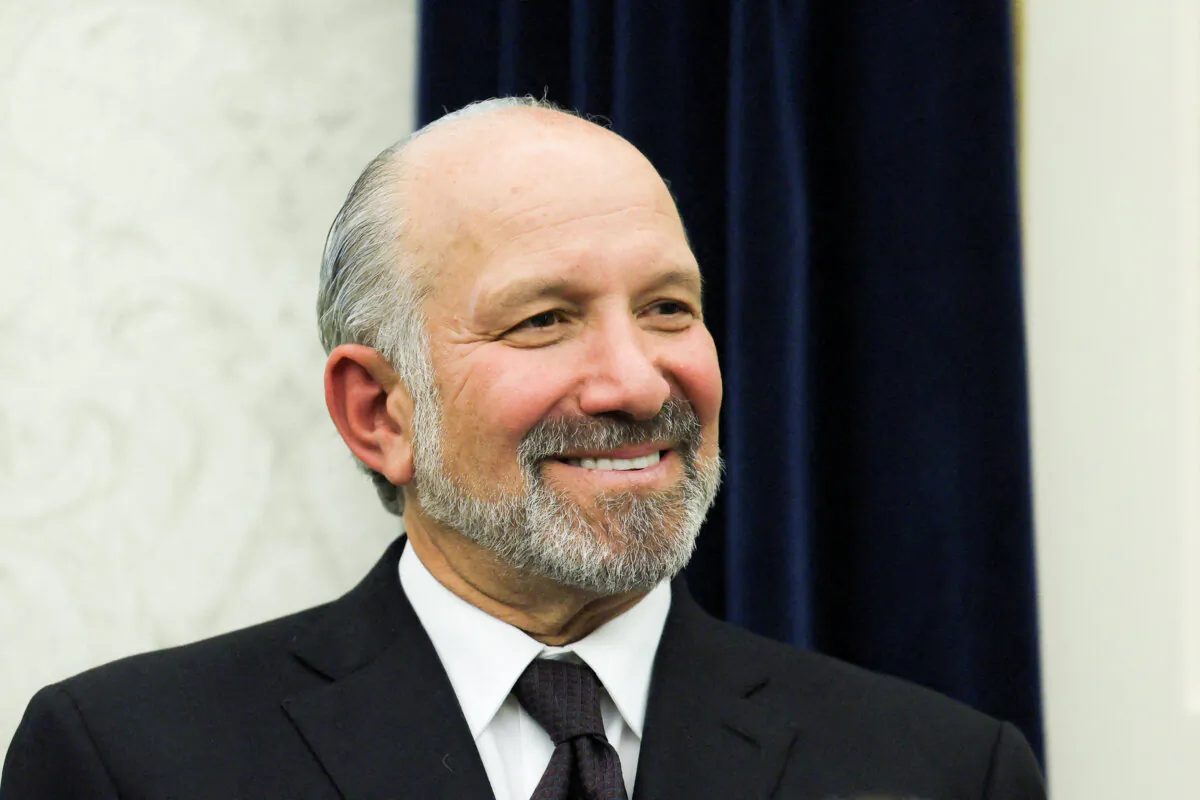

Commerce Secretary Howard Lutnick on June 1 defended President Donald Trump’s tariffs amid legal challenges, saying the government’s plan to impose those tariffs will not be derailed by court rulings.
The U.S. Court of International Trade ruled against Trump’s tariffs on May 28, with the judges determining that the president exceeded his authority by issuing sweeping levies on trade partners. A federal appeals court later stayed the decision, allowing the tariffs to take effect while it “considers the motions papers.”
During an interview with Fox News on June 1, Lutnick was adamant that the tariffs would remain in place despite the legal woes, noting that Trump was given the authority by Congress to enforce them.
“Rest assured, tariffs are not going away,” he said. “He has so many other authorities that even in the weird and unusual circumstance where this was taken away, we just bring on another or another or another. Congress has given this authority to the president, and he’s going to use it.”
Lutnick said that Trump has invoked the International Emergency Economic Powers Act, which gives him the authority to regulate international trade during a national emergency.
He noted that the “$1.2 trillion trade deficit” in goods with other nations and “all the underlying implications” of those deficits constitute such an emergency.
When asked whether the legal setbacks affected trade talks, Lutnick stated that the court rulings cost the administration a week, “but then everybody came right back to the table” as trade partners continued to pursue a trade deal with the United States to avoid tariff hikes before the 90-day pause ends.
“All of the countries that are negotiating with us understand the power of Donald Trump and his ability to protect the American worker,” Lutnick said. “And so what they’re doing is they’re negotiating with us.”
Trump said on June 1 that if the courts rule against the administration on tariffs, it would allow other countries to hold the United States “hostage with their anti-American Tariffs.”
“This would mean the Economic ruination of the United States of America,” he wrote on social media platform Truth Social.
Trump announced a minimum 10 percent tariff on nearly all imports on April 2, with higher levies on roughly 60 nations labeled as the “worst offenders” in trade imbalances with the United States as part of an effort to reduce trade deficits.
Before imposing the sweeping tariffs, Trump placed levies on imports from Canada, China, and Mexico to combat the flow of illegal immigrants and synthetic opioids across the U.S. border. He subsequently granted a 90-day pause to most countries to allow time for negotiations, while maintaining a baseline 10 percent tariff.
The move faced legal challenges from small businesses and a coalition of states led by Oregon, which alleged that Trump engaged in an unprecedented expansion of executive authority by imposing the tariffs.
Government lawyers have argued that the tariffs “are central to the President’s foreign-policy and economic agendas” and that the lower court order would block efforts to eliminate the United States’ “exploding trade deficit” and to “reorient the global economy on an equal footing.”
Jack Phillips contributed to this report.
 Friends Read Free
Copy
Facebook
Tweet
Friends Read Free
Copy
Facebook
Tweet