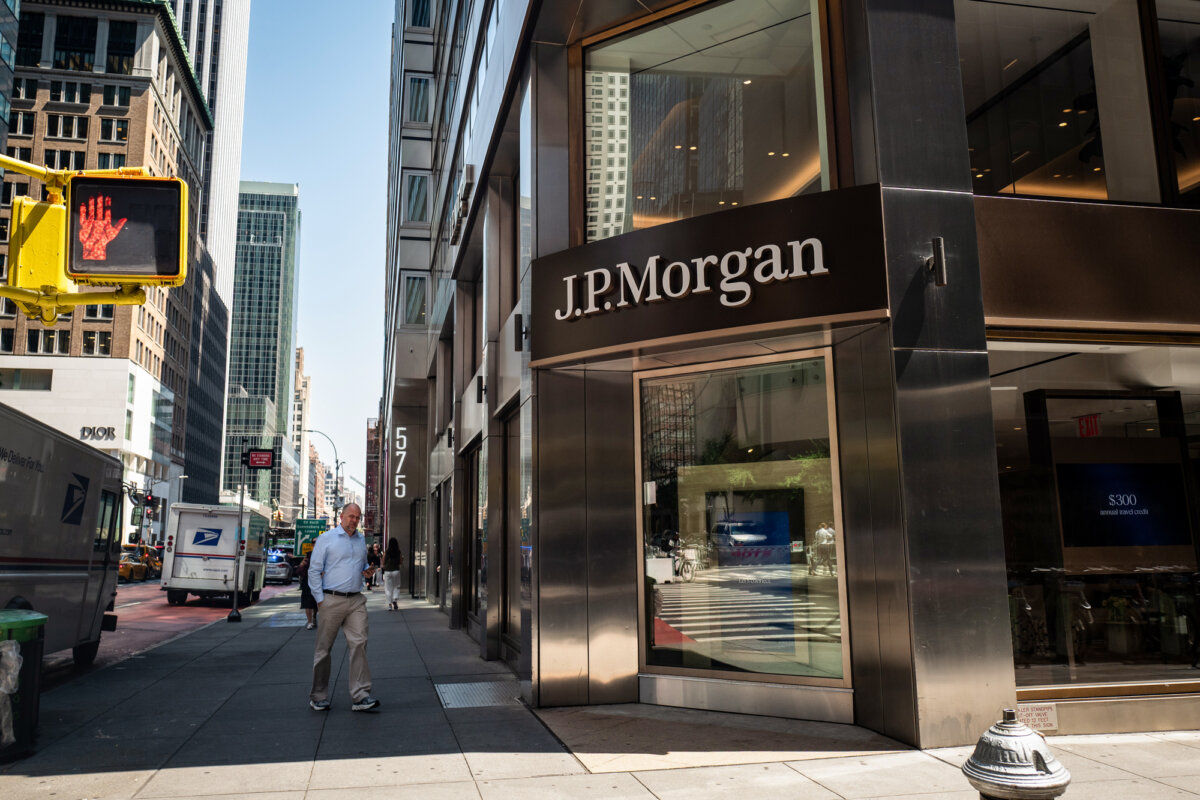

Four of the six major banks kicked off the third-quarter earnings reporting season before the opening bell, providing clues about the health of the U.S. economy.
Shares of JPMorgan Chase slipped despite the largest U.S. bank posting year-over-year increases in profits and net revenues.
Traders were spooked by the company’s miss of Wall Street expectations. The bank’s rare slip came from disappointing fixed income trading of $5.4 billion—about $550 million below the consensus estimate—and $27.3 billion in expenses that outpaced revenue.
JPMorgan Chase was also hit by the third-quarter global bond market rout that has sent interest rates to their highest levels since the 2008–2009 global financial crisis.
The bank logged $658 million in securities losses. Earnings per share came in at $5.57—below the market forecast of $5.90—but would have been $5.75 per share if the securities loss were stripped out.
Goldman Sachs shares rose 3 percent as the bank blew past market expectations in the previous quarter.
It reported earnings of $17.01 per share, up from $12.25 a year ago and well above analysts’ expectations of $12.86.
Net revenues were $18.68 billion, about $2 billion above the consensus estimate. Equities revenue rose 72 percent year over year, and investment banking fees rose 21 percent.
“Against the backdrop of a complicated operating environment, our clients continued to turn to Goldman Sachs for our world-class advice, execution and financing capabilities, resulting in our second-highest quarterly net revenues and record year-to-date net revenues,” CEO David Solomon said in a statement.
“Notwithstanding the current complexity and uncertainty in the world, we remain very well positioned to continue to deliver for our clients.”
Citigroup posted its best third-quarter revenue in a decade, with CEO Jane Fraser attributing it to “continued discipline and consistent execution of our strategy.”
Earnings per share rose to $2.85, with profits and revenues ballooning to $5.25 billion and $23.85 billion, respectively. All these numbers exceeded expectations.
Rising investment banking revenues, transactions with foreign firms, and higher wealth management earnings fueled the strong quarter.
Fraser said she is optimistic about the year ahead.
“We returned over $4 billion to common shareholders while continuing to invest in growth and prepare for an AI-driven future,” she said in a statement. “We expect to exceed this year’s return target, even as we pull forward investments toward our 11-13% near-term goal—the next waypoints on our path to sustainable returns of 14-15%.”
Citigroup stock jumped 0.4 percent after the results.
Wells Fargo was the final big bank to post earnings on Oct. 13, and the numbers were mixed.
Earnings per share slightly beat expectations at $1.87, compared with the $1.85 estimate. Revenues came in at $21.87 billion, slightly below the market forecast of $22.3 billion.
Still, Wells Fargo reported strength across multiple segment revenues, including wealth and investment management, consumer banking and lending, and corporate banking. Investors were disappointed as its shares fell about 3 percent.
Bank of America and Morgan Stanley will post earnings on Oct. 14.
Previewing Q3 Earnings
Now that earnings season has officially started, Wall Street expects another stellar quarter.
The S&P 500’s third-quarter earnings growth rate is hovering near 30 percent, potentially marking the third consecutive quarter in which companies post year-over-year gains above 25 percent, according to John Butters, senior earnings analyst at FactSet Insights.
Given how earnings growth typically improves as the reporting season unfolds, the S&P 500 is poised to post growth above 35 percent for the quarter, he added.
The broad-market S&P 500 was little changed after earnings. The tech-heavy Nasdaq Composite Index was also flat, while the blue-chip Dow Jones Industrial Average rose about 0.2 percent.
Some pockets of weakness may emerge during earnings, particularly in commercial real estate and credit conditions, but the overall outlook remains resilient, said Macrae Sykes, portfolio manager at Gabelli Funds.
“I still think the backdrop for earnings growth at these major companies is good,” Sykes told The Epoch Times in an emailed note.
“We have nominal growth, low unemployment, healthy credit, and a strong wealth effect. Given that the consumer accounts for roughly 70 percent of the overall economy, that’s an important positive.”
The U.S. economy was also under the spotlight at the big banks.
‘Under the Surface’
JPMorgan Chase CEO Jamie Dimon said solid business investment and consumer spending are supporting current economic conditions.
Looking ahead, he warned that persistent budget deficits, growing borrowing costs, elevated asset prices, stubborn inflation, and geopolitics “will continue to shift under the surface.”
“These forces may be manageable, but we remain prepared for a wide range of outcomes,” Dimon said.
Despite various risks—higher interest rates, elevated energy prices, and sticky inflation—Wells Fargo CEO Charlie Scharf touted “strong positive forces” that “outweigh the risks.”
“Consumers are spending more, loan delinquencies are low, and deposit and investment balances have grown,” Scharf said in a statement.
 Shoppers at the Mall of America in Bloomington, Minn., on Aug. 29, 2025. (Madalina Kilroy/The Epoch Times)
According to the Atlanta Fed, third-quarter GDP growth is expected to be 3.6 percent, driven by consumer spending, changes in private inventories, and business investment.
A deeper look at shoppers’ buying habits shows broad-based gains across multiple categories, Bank of America economists say.
“Spending shows considerable breadth: The vast majority of discretionary retail and services categories are showing growth,” they said in last week’s Consumer Checkpoint analysis. “Moreover, this strength extends across income cohorts, with the ongoing recovery of lower- and middle-income households’ spending growth.”
Holiday spending is already climbing at a steady pace as well, the bank’s economists added.
 Friends Read Free
Copy
Facebook
Tweet
Friends Read Free
Copy
Facebook
Tweet