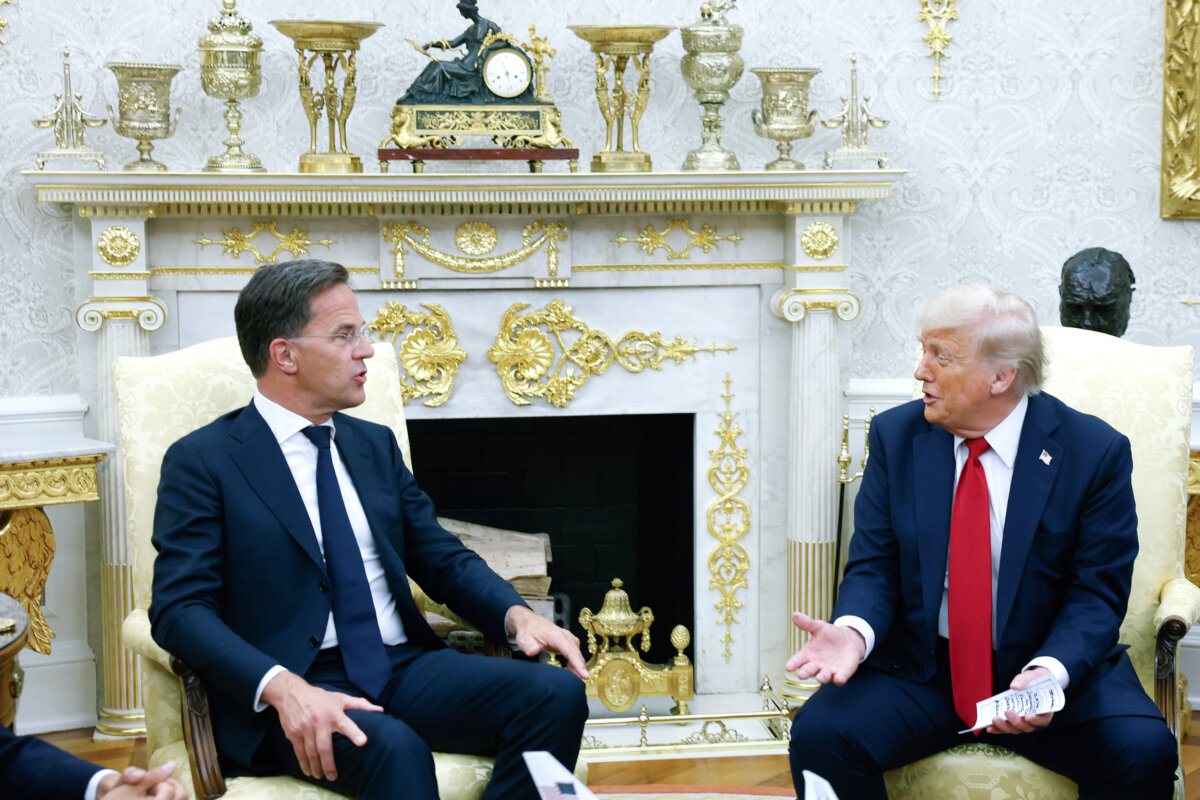

Buyers of Russian oil—including China, India, and Brazil—could be hit by secondary sanctions “in a massive way,” NATO Secretary General Mark Rutte said on Tuesday, urging leaders of the countries to pressure Russian President Vladimir Putin.
Rutte made remarks during a visit to Washington, after U.S. President Donald Trump said on July 14 that he would impose 100 percent tariffs on countries that import Russian oil unless the Kremlin agreed to a peace deal within 50 days to end its war with Ukraine.
Speaking from Capitol Hill, the NATO chief said Trump’s announcement was “very smartly, wisely designed.”
“If you live now in Beijing or in Delhi, or you are the president of Brazil, you might want to take a look into this, because this might hit you very hard. So please make the phone call to Vladimir Putin and tell him that he has to get serious about peace talks, because otherwise, this will slam back on Brazil, on India, and on China in a massive way,” he said, adding that NATO will “find the money in Europe to make sure that Ukraine has what it needs to be in the best possible position during these peace talks as soon as they start.”
Responding to Rutte’s remark in Beijing, Chinese Foreign Ministry spokesperson Lin Jian said Beijing “firmly opposes any illicit unilateral sanctions and long-arm jurisdiction.”
The Epoch Times has reached out to the Indian and Brazilian foreign ministries for comment.
According to a White House official, Trump’s warning involves 100 percent tariffs on Russian goods and secondary sanctions on countries that import from Russia.
Meanwhile, 85 senators, led by Sen. Lindsey Graham (R-S.C.), backed a bill that would give Trump the power to impose 500 percent tariffs on any country that aids Russia in its war against Ukraine.
China and India bought 47 percent and 38 percent of Russia’s crude exports, respectively, between the start of the embargo in December 2022 and the end of June 2025.
During the same period, Turkey and China purchased 26 percent and 13 percent, respectively, of Russia’s refined oil product exports, the paper says.
Brazil was not a big buyer of Russia’s crude oil, gas, or coal, but it purchases 12 percent of Russian oil products—making it the third largest buyer after Turkey and China.
After Trump’s tariff announcement on Monday, Ukrainian President Volodymyr Zelenskyy said he had thanked Trump “for his readiness to support Ukraine and to continue working together to stop the killings and establish a lasting and just peace.”
Russian Foreign Minister Sergei Lavrov said the next day that Moscow wanted to understand why Trump gave a 50-day deadline. He added that Russia has been coping with “an unprecedented number of sanctions” and “will cope” with new sanctions.
Meeting Lavrov in Beijing ahead of the 25th Shanghai Cooperation Organization Foreign Ministers’ Meeting in the nearby city of Tianjin, Chinese leader Xi Jinping reaffirmed on July 15 the comprehensive strategic cooperative partnership between Beijing and Moscow and vowed to strengthen mutual support on multilateral platforms.
 Friends Read Free
Copy
Facebook
Tweet
Friends Read Free
Copy
Facebook
Tweet