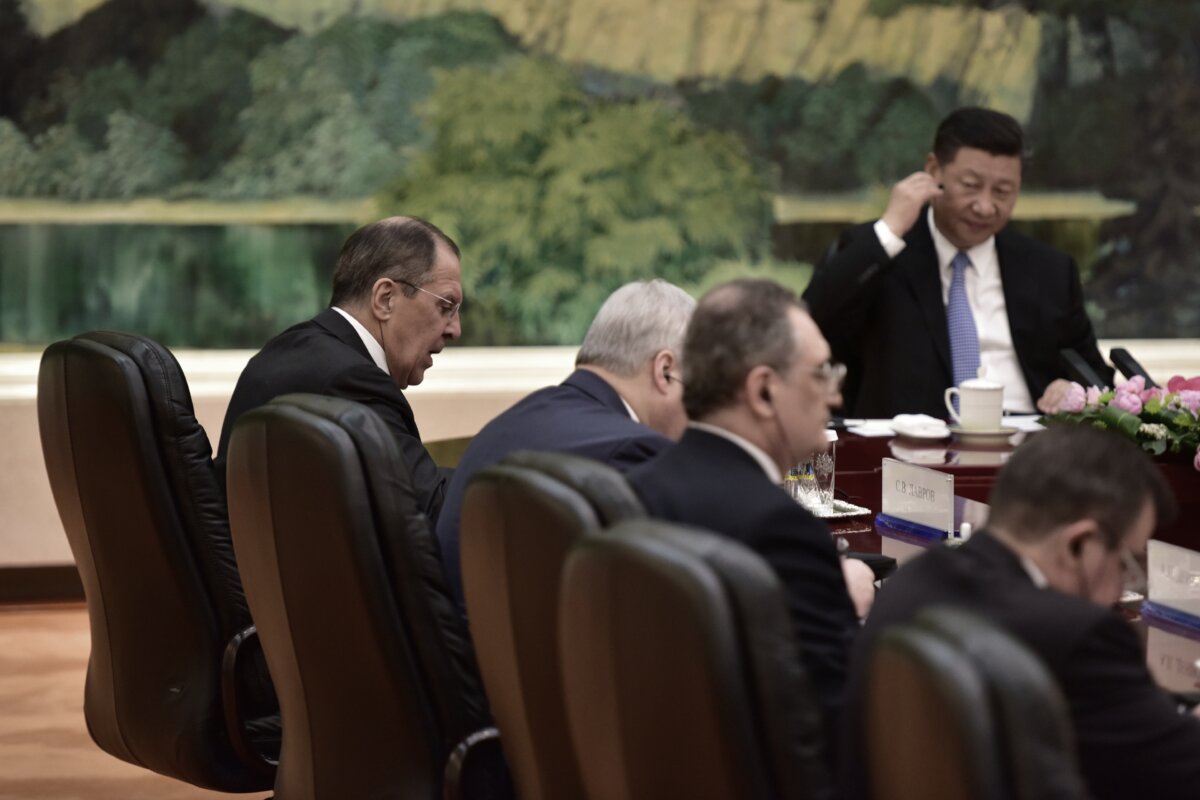

Chinese leader Xi Jinping said Beijing will strengthen ties with Moscow in a meeting on July 15 with Russian Foreign Minister Sergei Lavrov.
Xi reaffirmed the comprehensive strategic cooperative partnership between Beijing and Moscow and vowed to strengthen mutual support on multilateral platforms, according to statements by the Chinese and Russian foreign ministries.
That came after U.S. President Donald Trump warned on July 14 that he would impose 100 percent tariffs on countries that import Russian oil unless the Kremlin agreed to a peace deal within 50 days to end its war with Ukraine.
Lavrov is in China for the 25th Shanghai Cooperation Organization Foreign Ministers’ Meeting in Tianjin, where he also spoke on the sidelines with counterparts from India, Pakistan, and the Iranian regime.
The Russian Foreign Ministry said Lavrov and Indian Foreign Minister Subrahmanyam Jaishankar “reiterated their unwavering commitment to further strengthening the multifaceted Russia-India special and privileged strategic partnership at all levels.”
The Indian Foreign Ministry did not publicize the meeting on its website.
Since the European Union embargoed Russian oil products after Russia invaded Ukraine, the top buyers of Russian energy have been China, India, and Turkey, according to an analysis published on July 11 by the Finland-based Centre for Research on Energy and Clean Air.
China and India bought 47 percent and 38 percent of Russia’s crude exports, respectively, between the start of the embargo in December 2022 and the end of June 2025. During the same period, Turkey and China purchased 26 percent and 13 percent, respectively, of Russia’s refined oil products exports, the paper says.
The EU on July 15 failed to approve the 18th Russia sanctions package. The bloc’s foreign affairs chief, Kaja Kallas, said that the ball is in Slovakia’s court and that a deal could be reached on July 16.
Secondary Sanctions
Speaking at the Oval Office during a meeting with NATO Secretary-General Mark Rutte on July 14, Trump issued a 50-day deadline for the Kremlin to agree to a peace deal and warned of secondary tariffs.
A White House official said Trump was referring to 100 percent tariffs on Russian goods as well as secondary sanctions on other countries that buy its exports. Eighty-five of the 100 U.S. senators are cosponsoring a bill that would give Trump the authority to impose 500 percent tariffs on any country that helps Russia, but the chamber’s Republican leaders have been waiting for Trump to give them the go-ahead for a vote.
Ukrainian President Volodymyr Zelenskyy said on Telegram he had spoken to Trump and “thanked him for his readiness to support Ukraine and to continue working together to stop the killings and establish a lasting and just peace.”
Oil prices fell by less than 1 percent on July 15 as the announcement of the 50-day grace period eased concerns about any immediate supply disruption.
Reacting to Trump’s warning, Lavrov said Russia wants to understand why Trump gave a 50-day deadline.
“It used to be 24 hours, and it was 100 days. We’ve all been through this. And we really want to know what motivates the President of the United States,” he said.
Lavrov added that Russia has been coping with “an unprecedented number of sanctions” and “will cope” with new sanctions.
Chinese Foreign Ministry spokesperson Lin Jian said Beijing believes that “dialogue and negotiations are the only viable way to resolve the Ukrainian crisis.”
Earlier in July, Chinese Foreign Minister Wang Yi reportedly told Kallas that Beijing does not want Russia to lose its war against Ukraine over fears that the United States would increase its focus on China, and he denied the EU’s accusation that the Chinese regime provided material support that sustains Russia’s military industrial complex.
U.S. and European intelligence communities have long accused the Chinese regime of allowing private companies to smuggle weapons components to Russia.
In February, Kallas called the Chinese regime “a key enabler of Russia’s war of aggression against Ukraine,” and said the support “negatively affects EU–China relations.”
She said the bloc had sanctioned 33 entities in China and Hong Kong because they had been “found to export to Russia sanctioned dual-use and advanced tech components, including those of EU origin, which are used by the Russian army to wage war against Ukraine.”
In October 2024, the United States sanctioned two Chinese companies, saying they were responsible for the development and manufacture of entire weapons systems in partnership with Russian firms.
In May, Ukraine said it had confirmed intelligence that China was supplying machine tools, specialty chemicals, gunpowder, and drone electronics to at least 20 Russian arms factories.
Reuters contributed to this report.
 Friends Read Free
Copy
Facebook
Tweet
Friends Read Free
Copy
Facebook
Tweet