
Chipmaker Nvidia is acquiring open-source platform Hugging Face, signaling ambitions beyond chip manufacturing to expand its artificial intelligence (AI) ecosystem.
Hugging Face is an open-source community where more than 18 million developers, creators, and researchers build, share, and collaborate on millions of AI models, datasets, and applications. The platform has become a central hub for open-source AI, hosting millions of datasets and models.
Under the $12.9 billion acquisition, Hugging Face will remain an open platform, according to Nvidia CEO Jensen Huang.
“Developers will choose the models they want, the frameworks they want, the clouds and inference service providers they want and the computing platforms they want. NVIDIA compute will not be required to build on or deploy through Hugging Face,” Huang said in a blog post on Sept. 3.
The graphics processing unit maker is currently the biggest contributor of open models and data to Hugging Face and has released about 500 models and 250 open datasets on the platform.
“We build our own models, libraries and tools in the open so developers everywhere can use them, modify them and build on top of them,” Huang added.
Hugging Face was thrust into the spotlight recently after a hacking incident, raising fresh concerns about the rapid advancement of AI and cybersecurity tools.
CEO Clément Delangue attributed the breach to engineering flaws, noting that the company ultimately relied on an Nvidia‑adapted Chinese open-source model to patch its security vulnerabilities.
In recent weeks, several cyberattacks were carried out using models developed by Anthropic and OpenAI, prompting a warning from Andrew Bailey, the Bank of England governor and head of the Financial Stability Board.
In a letter prior to the start of the G20 Finance Ministers and Central Bank Governors meeting, Bailey warned that advancing AI could pose a significant risk to the global financial system.
“Recent developments have also highlighted to me that many jurisdictions do not have the protocols in place to manage the development, release, and deployment of advanced frontier AI models, heightening risks for the financial sector and beyond,” Bailey wrote in the Aug. 28 letter.
Still, looking ahead, Delangue is excited about what the next 10 years will bring to the AI industry.
“Together, we think we can make open source the default way to build AI, with the goal of empowering 100 million AI builders to own their intelligence rather than rent it,” he said on X on Sept 3.
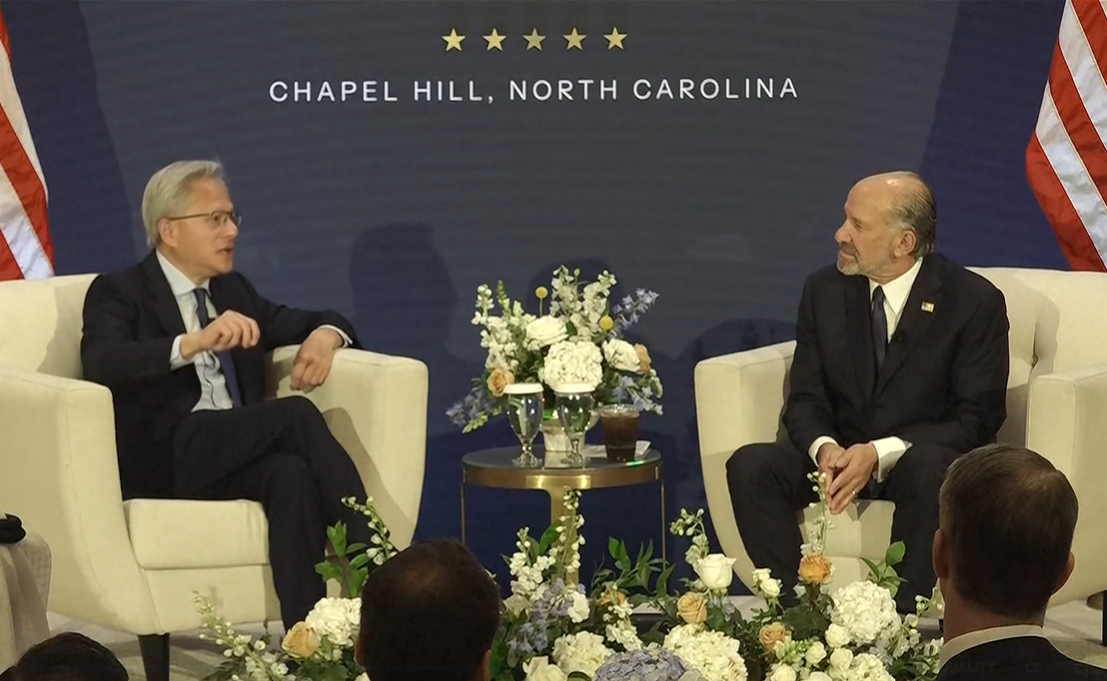 Elon Musk, OpenAI CEO Sam Altman, and Nvidia CEO Jensen Huang are among the attendees at the G20 Innovation Ministerial hosted by Commerce Secretary Howard Lutnick in Chapel Hill, North Carolina, on Sept. 2, 2026. (Screenshot via Reuters)
“In the end, what every single country will have to do is you need to recognize that this is infrastructure, just as is water, roads, electricity, the internet,” Huang said in remarks on Sept. 1.
“Every single country needs to build infrastructure so that you can support your own local economy.”
Boost Its Influence
Shares of the $5 trillion Nvidia were little changed on Sept. 3, rising about 0.5 percent to above $225. The stock is up almost 20 percent year to date.
Nvidia has made multiple purchases and investments over the last year to expand its AI footprint.
The company purchased chipmaker Groq in December 2025 for $20 billion.
Last week, it invested $3.5 billion in the global semiconductor company MediaTek.
These efforts are about bolstering its overall position, says Paul Meeks, head of technology research at Freedom Capital Markets.
“I see this as NVIDIA just continuing to boost its influence in the AI infrastructure ecosystem even beyond GPUs,” Paul Meeks said in an emailed note to The Epoch Times.
“It doesn’t really need MediaTek. NVIDIA is just covering all its bases here and abroad. NVIDIA will give up some GPU share, but it’ll gain it elsewhere in data centers.”
In its fiscal second-quarter earnings report last week, Nvidia beat expectations, recording strong AI chip demand.
Bill Pan contributed to this report.
 Friends Read Free
Copy
Facebook
Tweet
Friends Read Free
Copy
Facebook
Tweet