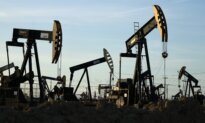

Oil prices jumped on May 18 after a drone strike near the United Arab Emirates’ nuclear power plant, as President Donald Trump warned Iran that “the clock is ticking” for progress in U.S.–Iran peace.
The global benchmark for Brent crude rose 1.85 percent on May 18 to $111.29 a barrel, its highest since May 5, when it traded above $109 per barrel in intraday trading.
Meanwhile, U.S. West Texas Intermediate crude rose above $107 a barrel, gaining 2.19 percent.
The surge in oil prices came amid a May 17 drone attack on the UAE, which struck a generator at its nuclear power plant and caused a fire. No country has taken responsibility.
UAE officials called the drone strikes “terrorist attacks” and said they are investigating the source.
The Gulf Arab country’s ministry of defense reported that three drones on May 17 entered the country from its western border area. Two of the drones were successfully intercepted by its defense systems, while the third drone hit an electrical generator outside the inner perimeter of the Barakah Nuclear Power Plant in the UAE’s Al Dhafra region.
In a May 19 update on X, the UAE Defense Ministry said its investigation found the drones were launched from Iraqi territory, adding that it will take all necessary measures to protect the country’s sovereignty.
Saudi Arabia also said in a May 17 post on X that it intercepted three drones that entered its airspace from Iraqi airspace. It did not attribute the attack to any party.
Saudi Arabia’s Ministry of Defense said it reserves the right to respond at an appropriate time and will take “all necessary operational measures” against any attempt to infringe its sovereignty and the security of its citizens.
In a post on X, the UAE condemned “in the strongest terms” the attacks on Saudi Arabia, saying they constituted a violation of the nation’s sovereignty and affirming its solidarity with Saudi Arabia.
Concerns over the Iran war also pushed oil prices higher as negotiations between the United States and Iran stalled. U.S. President Donald Trump on May 17 warned Iran to move quickly.
“For Iran, the Clock is Ticking, and they better get moving, FAST, or there won’t be anything left of them. TIME IS OF THE ESSENCE,” Trump wrote in a May 17 post on Truth Social.
Iranian military official Abolfazl Shekarchi warned on May 17 that future U.S. strikes on Iran would be met with “crushing and severe blows for that country” and said it would trigger a “self-created quagmire” for the Trump administration, according to the semi-official IRNA news agency.
The escalating conflict in the Middle East has disrupted shipping in the Strait of Hormuz, a critical waterway through which a significant share of global oil and gas shipments pass.
To keep oil prices down, members of the International Energy Agency agreed on March 11 to release 400 million barrels of oil from reserves, the largest withdrawal on record, with the United States contributing 172 million barrels of oil from the U.S. Strategic Petroleum Reserve.
Jack Phillips and Reuters contributed to this report.
 Friends Read Free
Copy
Facebook
Tweet
Friends Read Free
Copy
Facebook
Tweet