

Shares of Oracle surged by more than 8 percent in after-hours trading as the technology giant beat expectations and raised its revenue outlook for 2027.
Following the March 10 closing bell, Oracle reported that revenues surged by 22 percent year over year to a higher-than-expected $17.19 billion in the fiscal third quarter, which ended on Feb. 28.
Earnings per share—how much profit the company earns for each share—reached $1.79, also topping market estimates.
Before the latest earnings release, market watchers had anticipated Oracle to report $16.2 billion in sales and $1.70 in earnings per share.
Investors cheered as Oracle raised its 2027 revenue outlook to $90 billion.
Total cloud revenue ballooned by 44 percent to $8.9 billion, coming in higher than the consensus of $8.85 billion.
Cloud infrastructure revenues also climbed by 68 percent from the previous quarter to $5.9 billion.
“The demand for cloud computing for [artificial intelligence] training and inferencing continues to grow faster than supply,” Oracle said in its earnings release.
“Some of the largest consumers of [artificial intelligence] Cloud capacity have recently strengthened their financial positions quite substantially,” the company said.
“These market dynamics enable Oracle to comfortably meet and likely exceed our revenue growth rate forecast for [fiscal year 2027] and beyond.”
All eyes were on the remaining performance obligation, which swelled by more than 400 percent to $523 billion in the second quarter.
In the last quarter, it reached $553 billion, representing a more than 300 percent increase from the same time a year ago.
The remaining performance obligation has become a critical financial benchmark for Oracle, as it reflects a type of backlog—money clients have committed to pay in the future for cloud and tech support.
AI Payoff
The tech trade has slumped so far this year amid growing bubble concerns and investors seeking an artificial intelligence (AI) payoff.
From the “software scare” to the hyperscalers tapping into credit markets to fund the infrastructure buildout, tech giants have been firmly down from their peak.
The tech-driven Nasdaq composite index has tumbled by about 4 percent year-to-date.
Oracle (ORCL) share prices have had a rough start to 2026, falling by more than 23 percent.
Share prices have also slumped by about 55 percent since reaching a high in September, when the company released its earnings report and announced plans to establish data centers in Texas with OpenAI.
The site was reportedly canceled on March 6 amid financing challenges.
“Since that news and September peak, shares have been stuck in reverse,” Jay Woods, chief market strategist at Freedom Capital Markets, said in a note emailed to The Epoch Times.
However, Oracle stated on X that the news reports are “false and incorrect.”
“First, Crusoe and Oracle are operating in lockstep to deliver one of the world’s largest AI Data centers in [Abilene, Texas,] at record-breaking pace,” Oracle said in a March 8 statement.
“Two buildings are completely operational, and the rest of the campus is on track. Second, Oracle has completed leasing for the additional 4.5 [gigawatts] to deliver on our commitments to OpenAI.”
Moving forward, Oracle’s borrowing strategy could be at the forefront for traders, according to Woods.
The tech behemoth unveiled a $50 billion capital expenditure funding strategy in December: $18 billion in bonds and $38 billion in large syndicated loans.
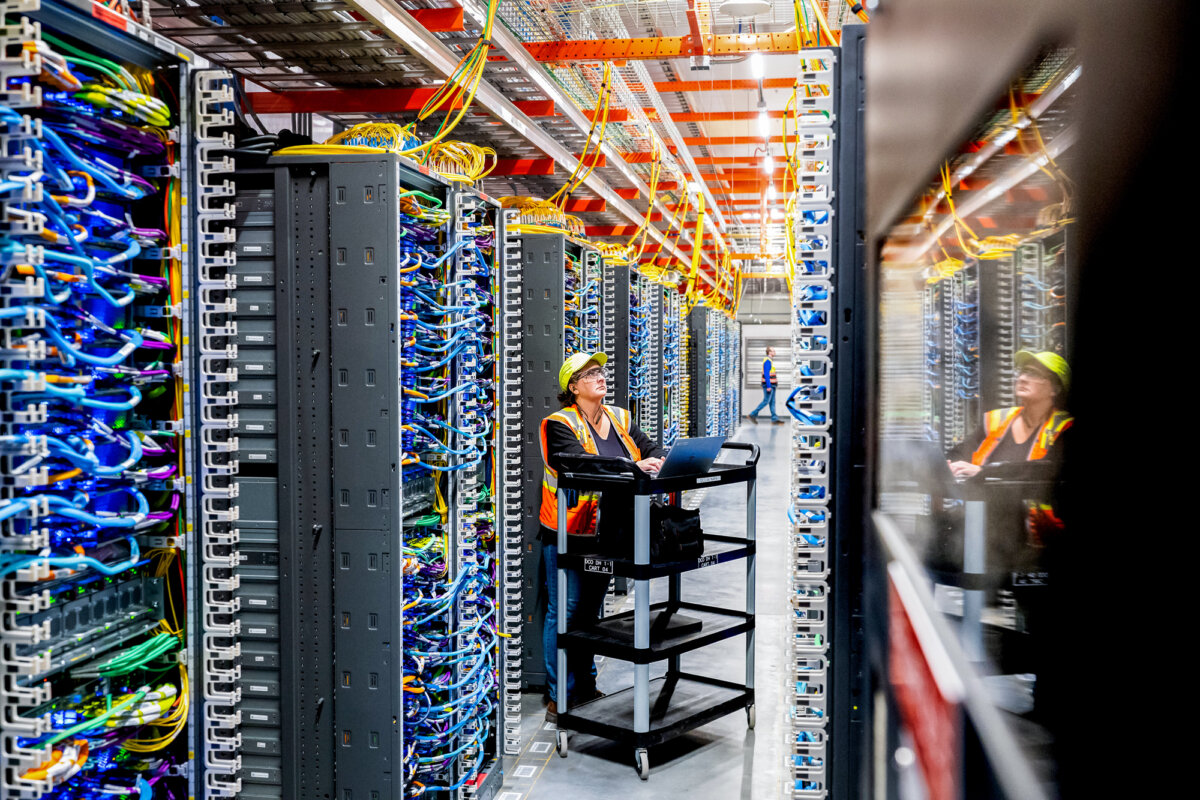
The objective is to finance the buildout of its AI and cloud infrastructure and ensure that it can meet contracted demand from AI customers.
According to the latest quarterly earnings report, the company attracted significant investor demand.
“Within days of the announcement, Oracle raised $30 billion through a combination of investment-grade bonds and mandatory convertible preferred stock, with a record order book that was substantially oversubscribed,” the company said in a March 10 statement.
A growing chorus of companies, including Alphabet and Amazon, has also begun issuing bonds as they raise their capital expenditure spending plans for the year ahead.
The search engine giant, for example, issued a century bond to much fanfare overseas.
Analysts are starting to get worried, though. In the past week, seven brokerage firms lowered their target ratings for Oracle’s stock.
Still, despite these latest downgrades, Oracle maintains a “Moderate Buy” rating and a 12-month consensus price target of 86 percent, according to MarketBeat.
“As we enter this earnings report, it appears that the risk/reward metrics favor an upside bounce,” Woods said.
“This report may be able to shed light on whether or not the sell-off is warranted. Overall, it may take a quarter or two to reverse the trend.”
 Friends Read Free
Copy
Facebook
Tweet
Friends Read Free
Copy
Facebook
Tweet