The dim tunnel passage hugs narrow, winding concrete steps that lead 55 feet down, with a ceiling no higher than 4 1/2 feet, making it a claustrophobe’s nightmare.
The underground passage stretching from Tijuana, Mexico, to a warehouse in California near the Otay Mesa Port of Entry known as “Buy 4 Less” is about 2,000 feet long and features reinforced walls, rail, ventilation, and electrical systems.
The U.S. Attorney’s Office for the Southern District of California said on June 1 that the tunnel had been discovered during a Homeland Security investigation involving a suspected drug smuggling operation.
Four people were charged with conspiring to distribute more than a ton of cocaine worth $45 million. Authorities said the discovery dealt a blow to the Jalisco New Generation cartel.
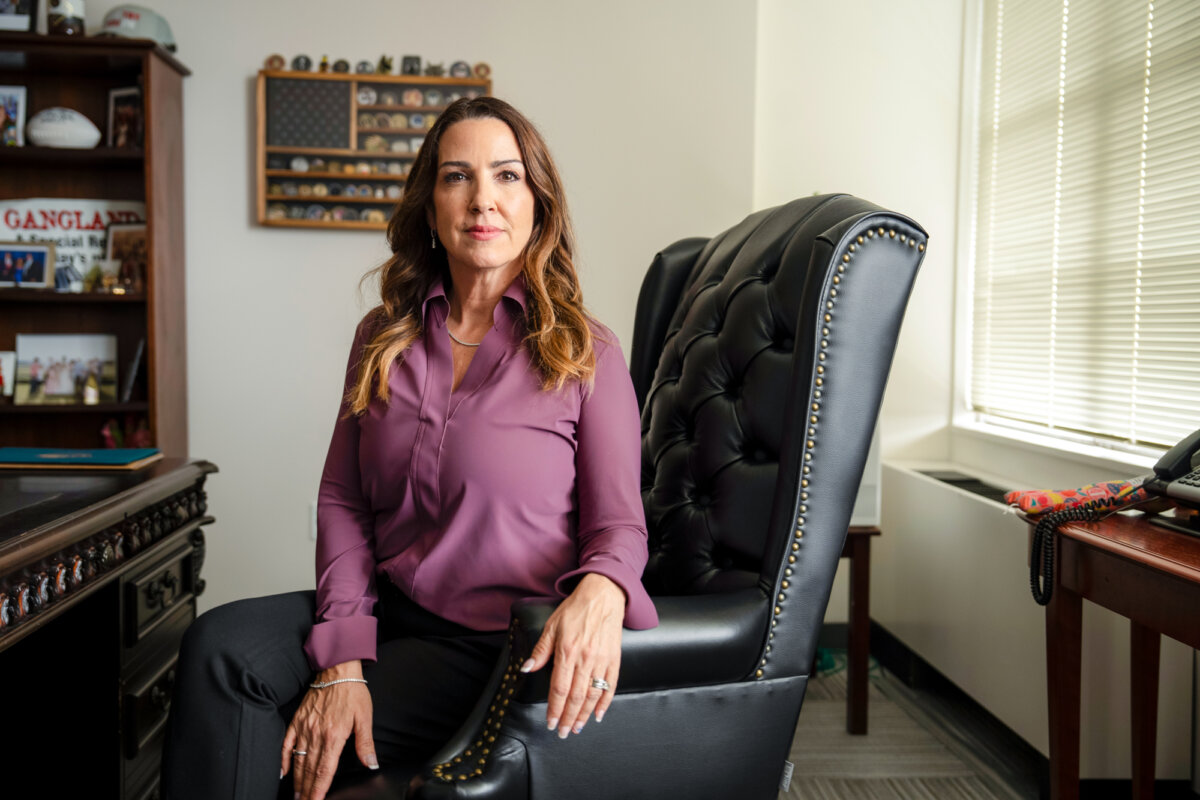
“Hundreds of millions of dollars of narcotics have probably made their way through this tunnel. Imagine the national security implications of that,” drug czar Sara Carter told host Jan Jekielek on a recent episode of EpochTV’s “American Thought Leaders.”
Power Play
Carter said federal agencies have been turning to technology to help combat cartels, although she couldn’t disclose details. She said the cartels’ use of tunnels to transport illicit drugs shows that they are feeling U.S. pressure along the border.
“They’re having a much harder time getting their product across the border because we’ve shut it down,” she said.
Carter attributes it to the Trump administration’s whole-of-government approach to stop the flow of illicit drugs into the country, at the border and beyond.
Carter was sworn in this January as the director of the Office of National Drug Control Policy, which coordinates anti-narcotics policy for 19 federal agencies. The office leads the Trump administration’s effort to reduce illicit drug manufacturing, trafficking, drug use, and overdose deaths.
“Our Homeland Security task forces, now under President Trump, have the capability … to do what’s needed to cut off the heads of the snake,” she said.
Carter attributed President Donald Trump’s efforts to close the border to illegal immigrants and designate cartels as foreign terrorist organizations as significant factors in reducing the flow of drugs across the border, and ultimately driving overdose deaths.
Yet Carter said the cartels aren’t the only problem fueling drug use in the United States—adversarial nationals are also part of the problem.
“We have adversaries that have contaminated our supply chain. We have cartels that couldn’t care less,” she said.
Carter acknowledged the Chinese Communist Party’s involvement in the precursor chemicals to make fentanyl distributed by the cartels.
“It is unrestricted warfare,” she said.
“I have already spoken with Chinese counterparts about this. I have made it very clear that we understand, and we know where these precursor chemicals are coming from, and that it will not be tolerated.”
Carter said China has been put on notice to disclose such chemicals in shipments coming into the United States. Likewise, she has been talking to Mexican officials about safeguarding their own ports against the importation of illicit drugs.
At U.S. ports, the government is also working to hold private industry accountable. If cargo ships are caught with precursor chemicals, then the federal government will hold them accountable, she said.
“We’re looking at all kinds of new technology, technology that was unheard of in the past,” she said. “How can we implement this technology to ensure that the cargo that is coming in is clean?”
Cooperation Through Strength
Carter said that countries understand that Trump is willing to wield U.S. power to stop the drug trade, putting nations on notice around the world.
Trump’s military operation in Venezuela resulted in the arrest of former Venezuelan leader Nicolás Maduro, who had a $50 million bounty on his head as the alleged leader of the De Los Soles cartel, which was designated as a foreign terrorist organization.
“One of the best operations I’ve ever seen conducted,” Carter said. “We have done what we said we were going to do. There were no more games.”
She also said that the amount of cocaine and other drugs flowing from Venezuela has dropped since Maduro’s capture.
Trump’s projection of strength has led to unprecedented cooperation from both Mexico and China, she said.
One example is a February operation in which the United States provided Mexico with intelligence that they used to take down the Jalisco New Generation cartel’s kingpin, Nemesio Oseguera Cervantes, known as “El Mencho.”
Mexican officials cooperated with the United States, sending in the Mexican National Guard and special forces to confront the cartel’s leader, Carter said.
“We said, ‘Look, here’s the information, go get them,’ and they did, and we’d never seen that before, not like that, not in that same way, not with that cooperation,” she said.
Likewise, China’s Ministry of Public Security has been uncharacteristically cooperative, she said. FBI Director Kash Patel traveled to China in November 2025 to meet with his counterpart to discuss stopping the flow of fentanyl precursor chemicals.
During Patel’s visit, the Chinese regime agreed on a plan to stop fentanyl-related chemicals as part of its deal with the Trump administration to crack down on the lethal synthetic opioid.
Two milligrams of fentanyl—the size of a few grains of salt—can be fatal. The drug has killed hundreds of thousands of Americans.
‘Don’t Give Up’
Overdose deaths have been decreasing, but Carter said there are still far too many.
She said 68,000 people died from drug overdoses in 2025, down from a high of 112,000 in 2023. Some have attributed that decrease to a reduction in the amount of fentanyl found in street drugs.
Carter said she does not consider it an overdose when a person orders what he believes to be Adderall online and then dies because the pills are laced with fentanyl.
“This is unacceptable. This is the United States of America,” she said.
But the battle against overdose deaths can’t be solved by government alone. Parents and family members need to communicate with their children and fight for their communities, she said.
Protecting Americans from illicit drugs is part of national security, she said, and the federal government wants to help citizens and teach children principles for a drug-free America.
Carter said she’s investigating how faith and spirituality can help those struggling with drug addiction as part of the government’s drug control strategy, noting that 83 percent of Americans believe in a higher power.
“I have a deep faith in God,” she said. “Sometimes it is the one place you can turn to.”
Carter said she does not believe in the “harm reduction” approach, which enables drug addicts to shoot up or take drugs in designated areas. Saving lives is the goal, which includes making drugs such as Narcan, which can reverse synthetic opioid overdoses, readily available.
Her advice to families dealing with drug addiction is to continue supporting friends and loved ones. No one sets out to become a drug addict, she said.
“Don’t give up on them. There is always hope,” she said. “They are all human beings. They were all once somebody’s baby.”
Jan Jekielek contributed to this report.
 Friends Read Free
Copy
Facebook
Tweet
Friends Read Free
Copy
Facebook
Tweet