
Commentary
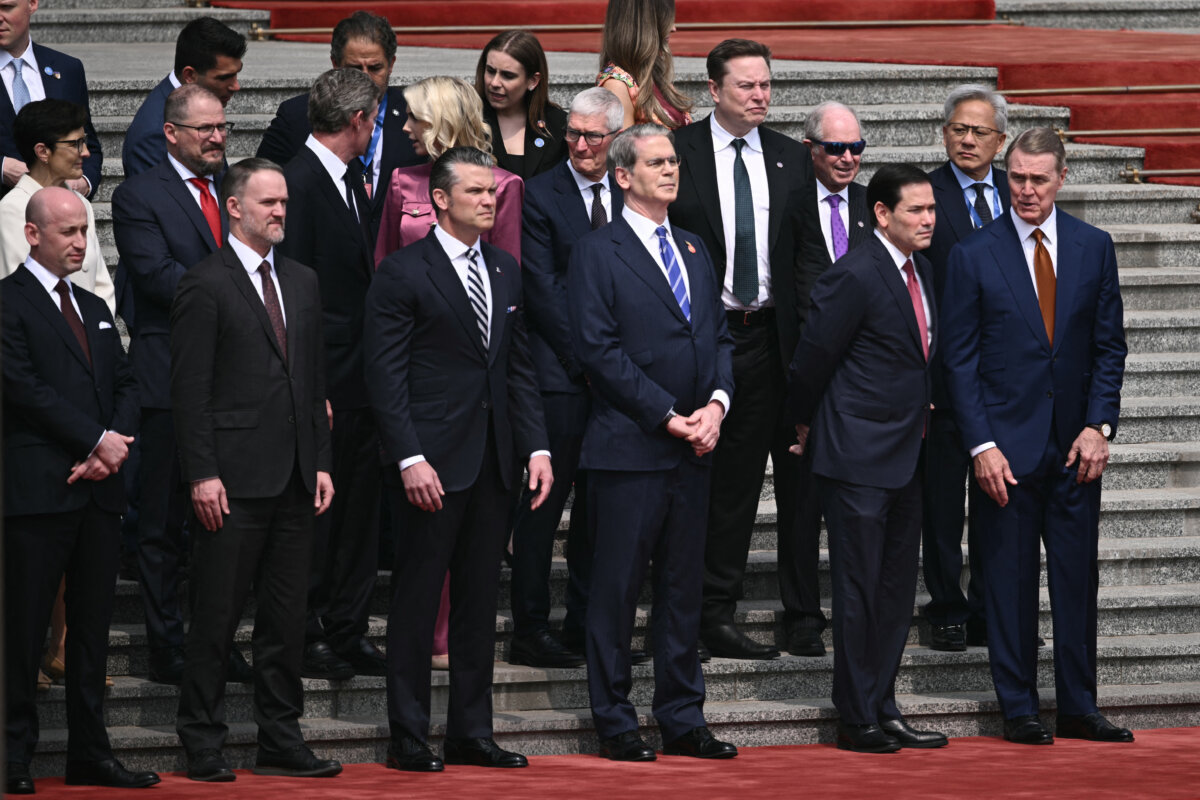
President Trump’s trip to China last week was essentially a super “Chamber of Commerce” summit. In addition to cabinet members like Treasury Secretary Scott Bessent, President Trump invited key business leaders like Apple’s Tim Cook, Tesla’s Elon Musk, Nvidia’s Jensen Huang, and CEOs of a dozen more firms, including Cristiano Amon (Qualcomm), Sanjay Mehrotra (Micron), and Kelly Ortberg (Boeing). They didn’t go to China just for photo-ops or PR, but primarily to cut some business deals with China.
There is undoubtedly a new world order emerging now, with the U.S. dominating world energy markets. Meanwhile, China’s military influence is waning after their equipment proved to be ineffective in Iran. At last week’s summit, China agreed with President Trump – Iran cannot be allowed to have nuclear weapons, and the Strait of Hormuz must be reopened soon – two positive developments.
Iran officially rejected President Trump’s proposed peace deal, with President Trump calling Iran’s response “totally unacceptable,” but investors are increasingly losing interest in the details of this protracted conflict, since the U.S. Naval blockade is disabling sanctioned tankers and other ships in the Strait. Traffic through the Strait is slow but steadily improving, thanks to U.S. escorts, while Iran’s deployment of speedboats to disrupt shipping is largely ineffective, since these tiny speedboats are easily obliterated or quick to retreat.
Here are the most important developments recently and what they mean:
– The recent disclosure that President Trump owns a lot of AI and data center-related stocks means that we are in the midst of a big TACO trade and that he will do everything in his power to boost these stocks. President Trump is now asserting American dominance. Now that the U.S. controls much of the world’s energy supply and has exerted its military dominance, even China has to hitch itself to the U.S. to grow and prosper.
– The chaos around the world is expected to make the U.S. dollar stronger, which in turn is deflationary. In the meantime, any Fed key interest rate cuts will be postponed until the recent surge in energy inflation dissipates. I was on Fox Business when the Labor Department reported that the Producer Price Index (PPI) rose 1.4% in April and 6% in the past 12 months. The core PPI, excluding food, energy and trade services, rose 0.6% in April and 4.4% in the past 12 months. Wholesale food costs rose 0.2% in April, while wholesale energy costs surged 7.8%. The big problem with the PPI was that the wholesale goods costs rose 2%, while wholesale service costs rose 1.1%, so the inflation on the wholesale level is embedded and will likely persist. This means our new Fed Chairman, Kevin Warsh, has his hands full and it will take some time to convince other members of the Federal Open Market Committee (FOMC) that key interest rate cuts might be necessary in the upcoming months.
– I am not ruling out coordinated action by Treasury Secretary Scott Bessent and Kevin Warsh to shove Treasury yields lower later this year. However, the best thing that Bessent and Warsh can do is to argue that the AI productivity gains the U.S. is experiencing are naturally deflationary and to try to coax Treasury yields lower. The other event that could cause Treasury yields to migrate lower will be any kind of currency panic that may ensue if Britain, China, Japan, or other countries experience capital flight from political or economic duress. The bond vigilantes are demanding higher yields from Britain, France, Japan, and other countries with demographic problems (i.e., shrinking households) and budget problems. The big difference between the U.S. and the rest of the world is that we can grow our way out of many of these problems, plus we have better demographics, we better assimilate immigrants, and we have 50 states competing with each other to ensure economic success.
– NextEra Energy (NEE), which is a big utility in Northern Florida, is buying Dominion Energy, which provides electricity in Virginia. Due to the data center boom in Virginia, NextEra Energy plans to steadily grow by selling electricity to data centers. Virginia sits inside PJM Interconnection, which biggest electricity grid in the U.S. Interestingly, battery storage facilities are being increasingly added in Virginia, since they can be deployed faster than new natural gas-fired electric plants. Since most new data centers are utilizing direct natural gas lines to generate their own electricity via Bloom Energy’s fuel cells or GE Vernova’s turbines, it will be fascinating to see if NextEra Energy can effectively compete with data centers in other states that generate their own electricity via natural gas.
– Nvidia’s (NVDA) quarterly results on Wednesday after the close will set the stage for an extended AI rally. The analyst community is expecting its quarterly sales to surge 79.7% to $79.17 billion and its earnings to soar 119.8% to $1.78 per share. As always, Nvidia has to surprise and guide the analyst community higher, which should not be a problem, since the production of the Vera Rubin GPU is ramping up. I should add that Nvidia now represents almost 16% of U.S. GDP and many rise to over 20% as the AI-revolution continues. There are a lot of great technology monopolies that we can invest in, like Google and Nvidia, that ensure that we continue to have tremendous investment success.
– Interestingly, the shortage of memory chips may get worse, since Samsung and its largest labor union are locked in talks to avert a strike. Samsung is the largest manufacturer of memory chips. Unlike many other large Korean conglomerates, Samsung operates with limited union influence, leaving both its management and labor representatives relatively inexperienced in handling large-scale collective bargaining. The South Korean government is mediating these negotiations, where labor leaders are demanding that 15% of operating profits be allocated to employee bonuses. Samsung stock has surged due to robust profits, so it will be interesting if this strike can be averted. A work slowdown is also possible if the negotiations stall.
Overall, the underlying sales and earnings remain so strong for AI and data center-related stocks. Furthermore, due to the fact that it will take up to three years to fulfill current data center order backlogs, I am anticipating that the spectacular sales and earnings momentum will persist well into 2027. I want investors to remain fully invested and enjoy the ride. The similarities between the Internet boom and the AI boom are real, and this year is unfolding like 1999.
 Friends Read Free
Copy
Facebook
Tweet
Friends Read Free
Copy
Facebook
Tweet