
OxyContin manufacturer Purdue Pharma permanently ceased operations on May 1 after a federal judge sentenced the company to $5.5 billion in fines and penalties tied to its 2020 guilty plea to charges of deceiving government regulators and paying kickbacks to doctors to boost opioid sales. The ruling cleared the way for a broader $7.4 billion bankruptcy settlement resolving thousands of opioid lawsuits.
The company will transfer its assets to Knoa Pharma LLC, a newly-formed company that will take over the distribution of medicines previously handled by Purdue, according to its website.
Knoa Pharma is owned by an independent foundation, according to a Purdue statement issued in November 2025. The new company will provide lifesaving opioid use disorder treatments and overdose reversal medicines “with no obligation to maximize profits,” it said.
Purdue said at the time that Knoa Pharma will be subject to “a strict operating injunction with oversight by a monitor to ensure that it provides its medicines in a safe manner that limits the risk of diversion.” Members of the Sackler family who own Purdue will have no role in the new company, it added.
A federal judge on April 28 imposed a criminal sentence on the company to resolve a U.S. Department of Justice probe following its 2020 guilty plea to three felony offenses, including conspiracies to defraud federal regulators and to violate the anti-kickback statute. Only the company was charged, not individual employees or owners.
According to court documents, Purdue was accused of illegally marketing its opioid products to hundreds of prescribers, defrauding the Drug Enforcement Administration about the effectiveness of its programs designed to prevent illegal diversion, and paying kickbacks to doctors through a speakers program to encourage more opioid prescriptions from 2007 to 2017.
The Stamford, Connecticut-based company admitted it did not have an effective program to keep its powerful prescription painkillers from being diverted to the black market, even though it told the U.S. Drug Enforcement Administration that it did.
It also admitted it paid doctors through a speakers program to prescribe the drugs and paid an electronic medical records company to send doctors information on patients that encouraged more opioid prescriptions.
The sentence requires Purdue to pay a $3.54 billion criminal fine, which will be handled through its bankruptcy proceedings, and another $2 billion in criminal forfeiture, according to the Department of Justice.
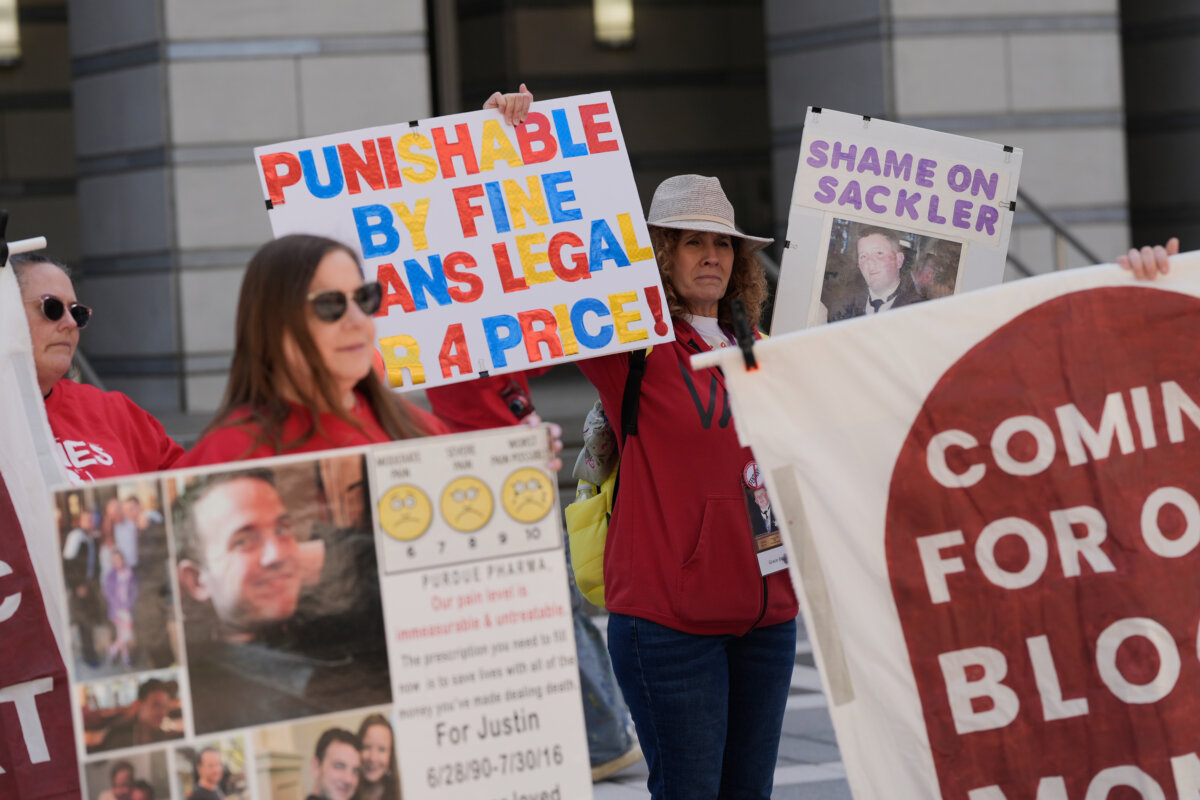
U.S. District Judge Madeline Cox Arleo handed down the sentence on April 28 after listening to hours of impact statements from people who lost loved ones or struggled with addiction themselves. The judge said she sympathized with people who bore the brunt of an epidemic linked to more than 900,000 deaths in the United States since 1999.
Arleo directed Steve Miller, who became chairman of Purdue’s board to guide the company through the bankruptcy process and will cease to have that position when the company is dissolved, to apologize directly to victims in the courthouse, which he did, saying the company “deeply regrets and accepts responsibility” for past misconduct.
“We are deeply apologetic for all of the things that happened that were described in colorful detail by all the victims here today,” Miller said.
Arleo noted that she has sentenced convicted drug dealers to prison for selling OxyContin, and in those cases, federal prosecutors routinely bring up that it was part of an epidemic.
“It is not lost on me that those who started the epidemic will not serve a sentence,” the judge said.
Acting U.S. Attorney General Todd Blanche said in an April 28 statement that Purdue Pharma “put profits over patient health and safety.”
“The company willfully rejected the law and ignored the diversion of their highly addictive prescription drugs,” Blanche said. “Their actions contributed to the opioid crisis that claimed countless lives and destroyed entire families and communities.”
The Epoch Times reached out to Purdue Pharma and Knoa Pharma for comment, but did not receive a response by publication time.
Reuters and The Associated Press contributed to this report.
 Friends Read Free
Copy
Facebook
Tweet
Friends Read Free
Copy
Facebook
Tweet