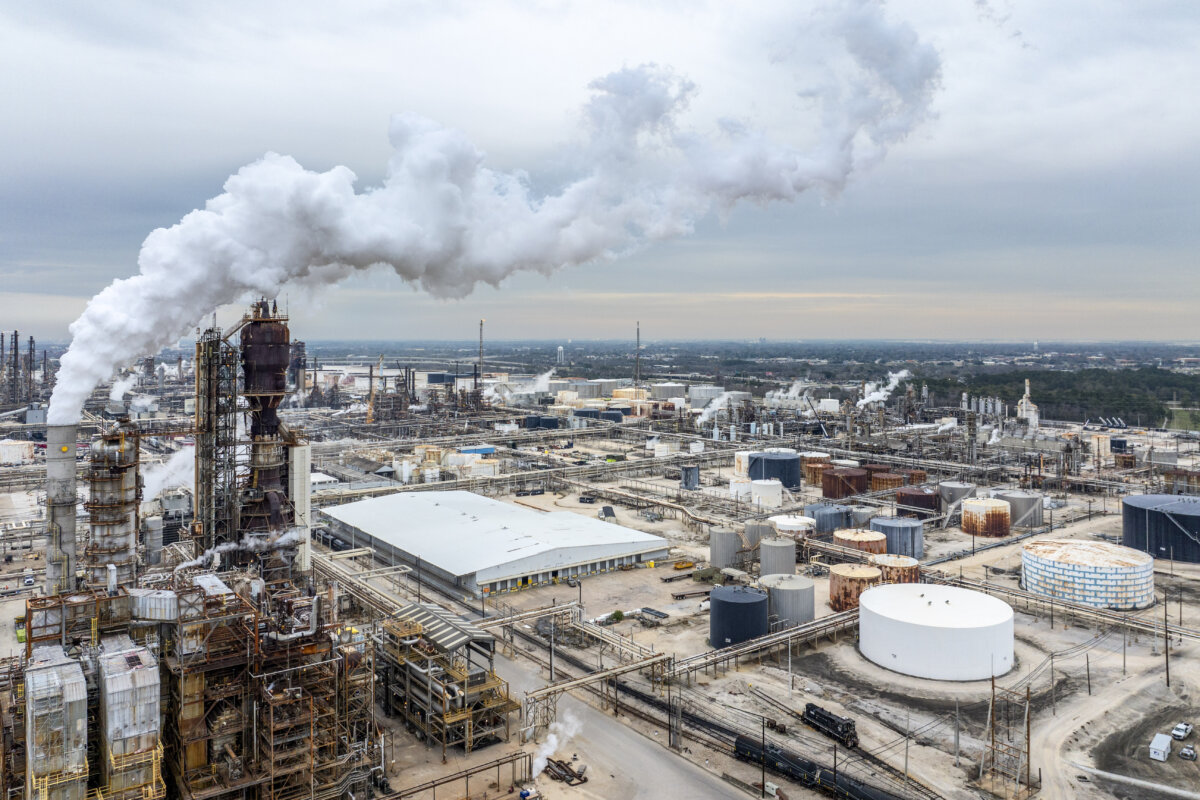

Disruptions to global oil refining are pushing fuel prices up beyond what higher crude costs alone would explain, according to a Dallas Federal Reserve report.
The report warns pressure at the pump could persist even after shipping through the Strait of Hormuz returns to normal.
Refinery damage, shipping constraints, and export restrictions have sidelined as much as 10 percent of global refining capacity, Dallas Fed analysts Jesse Thompson and Garrett Golding wrote in an Oct. 8 report.
The disruptions have widened the gap between crude oil prices and wholesale prices for gasoline, diesel, and jet fuel “well beyond normal,” the analysts said.
Those gaps, known as crack spreads, have exceeded levels reached after Russia’s 2022 invasion of Ukraine, which roiled energy markets.
“These pricing dynamics reflect acute, multifaceted supply constraints in the global market for refined fuels rather than retailer or distributor markup,” the analysts wrote.
“The global economy is wrestling with a refining shock in addition to an oil price shock.”
The findings come as U.S. gasoline prices remain at record highs for autumn.
The national average stood at about $4.36 a gallon on Oct. 8, down roughly 5 cents over the week but up from about $3.12 a year earlier, according to the American Automobile Association.
This is the first year the national average has exceeded $4 a gallon in October, the motorists’ group said.
The price of Brent crude, the global benchmark, was hovering around the $103 mark in early morning trading on Friday, after jumping about 4 percent the day before, as threats to U.S. offshore production from Hurricane Isaias added to supply concerns.
Wars, Export Curbs Squeeze Supply
Fuel markets were already tight before the Iran War began in February, following years of uneven investment in refining capacity.
China and the Middle East added 4.4 million barrels a day of capacity between 2019 and 2025, while Europe and North America lost 2.1 million barrels a day as older plants closed amid thin margins, regulatory costs, and aging equipment, according to the report.
The outbreak of war in the Middle East compounded those pressures.
Iranian strikes and disrupted tanker movements reduced Gulf refinery processing by 2 million barrels a day from February levels, according to preliminary International Energy Agency data cited by the Dallas Fed.
Meanwhile, Ukrainian attacks on Russian refineries intensified, and Moscow restricted fuel exports to ease domestic shortages.
China also reduced refinery processing and temporarily curtailed refined fuel exports.
Ukrainian President Volodymyr Zelenskyy said in an Oct. 9 post that Ukrainian drones had struck refineries in Omsk and Ukhta, describing the attacks as retaliation for Russian strikes on Ukraine.
Russia has extended its ban on diesel and marine fuel exports by producers through October, citing the need to stabilize domestic supplies during the harvest season.
Thin Inventories Prolong Pressure
Releasing emergency stockpiles of crude has helped offset the disruption, but those supplies cannot fully compensate for damaged refineries or shipping bottlenecks, the Dallas Fed analysts said.
Exports of U.S. crude oil have reached record highs, helped by releases from the U.S. Strategic Petroleum Reserve, which in September held 284 million barrels of oil, its lowest level since 1982.
Yet such releases are temporary measures that cannot be sustained unless crude shipments from the Middle East return to normal.
“Drawing further on these inventories will not only pressure prices higher but will leave the global oil market in a much tighter fundamental position when—and if—the Strait of Hormuz becomes reliably passable,” the analysts wrote.
Meanwhile, Saudi Aramco CEO Amin Nasser recently warned that rebuilding depleted inventories demand could take up to two years after shipping through Hormuz fully resumes and confidence returns.
“Existing buffers have cushioned the blow and bought time, but they are finite,” Nasser told an Oct. 5 energy conference in London. “Emergency reserves might buy us a winter. They cannot fix long-term supply.”
The Dallas Fed report said that damaged Middle Eastern refineries could take months to recover, while Russian outages could persist, keeping fuel prices unusually high relative to crude even after Hormuz shipments normalize.
“In the meantime, as inventory buffers dwindle, consumers will be increasingly forced to balance the market through reduced consumption, greater price volatility and potentially higher prices,” the Fed analysts wrote.
In an effort to relieve price pressures on some refined products in the United States, the Trump administration has approved the use of red-dyed diesel, typically reserved for off-road use, on U.S. highways through year-end.
The White House estimates that the move will lead to savings of about $100 per truck refill.
 Friends Read Free
Copy
Facebook
Tweet
Friends Read Free
Copy
Facebook
Tweet