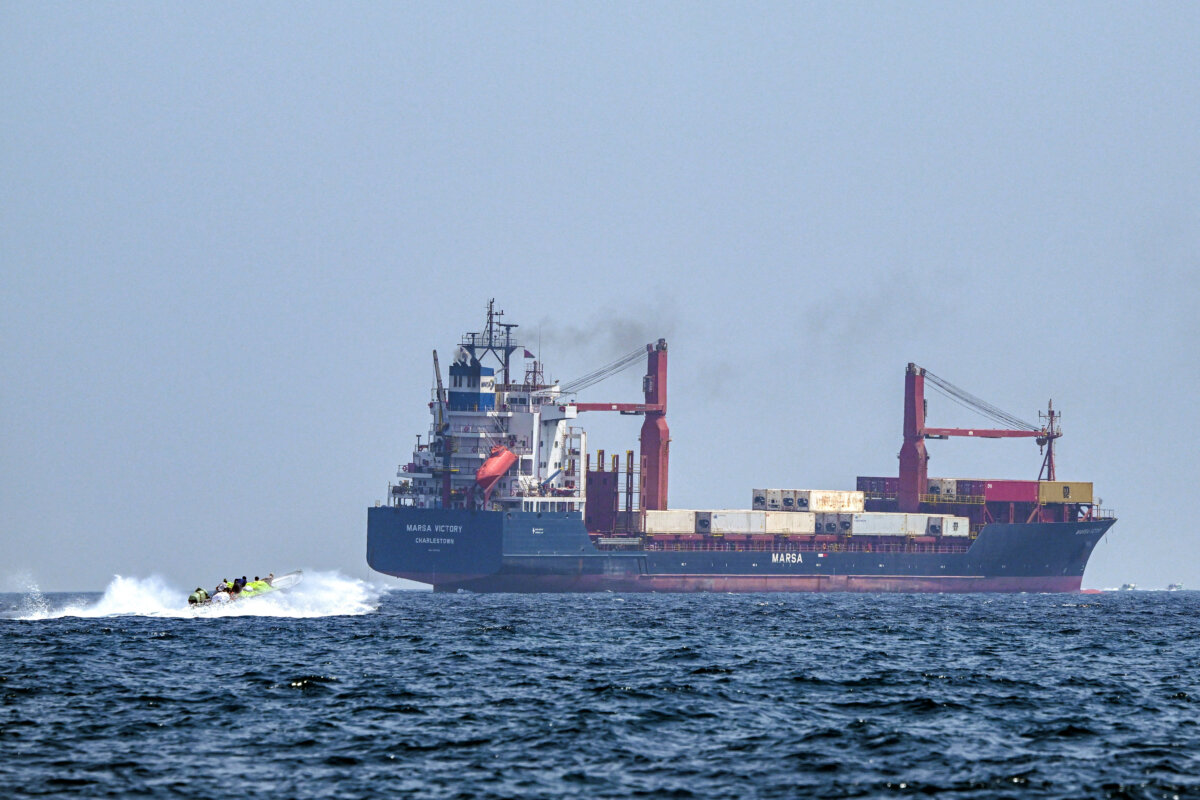

One sunken oil tanker in a six-mile-wide shipping channel in the Strait of Hormuz, less than 21 miles west of Iran’s mountainous coast, could shut down commercial sea traffic in the strait for months, analysts say.
And it would be relatively easy to do if Iran’s Islamic Revolutionary Guard Corps (IRGC)—which has trained for decades in small-craft operations in these waters and has artillery hidden in reinforced bunkers looming above—were to opt to do so, especially with mines.
Only Iran’s self-interest as a Persian Gulf oil exporter has shielded the strait from the heaviest of drone and missile attacks since Operation Epic Fury began on Feb. 28, but that could change immediately if the United States and Israel were to destroy Tehran’s energy infrastructure, said maritime industry analyst and historian Salvatore Mercogliano.
“If [Iran does not] have a means to export oil, [it is] going to have nothing to lose,” he told The Epoch Times, referring to speculation that U.S. special forces could be deployed to “seize” the seven Iranian islands in the 104-mile strait, the Sirri and Farsi islands in the mid-gulf, and, most critically, Kharg Island in the northern gulf.
“To me, that is a terrible idea for a variety of reasons,” said Mercogliano, a professor at Campbell University and a former merchant marine who has transited the strait a dozen times and seen IRGC speedboats.
There are allegedly more than 3,000 speedboats prowling the waterway.
“It’s not even just the speedboats,” he said. “It’s the dhows [trading vessels] that are just everywhere [that are difficult to track].”
“As long as Iran has the ability to launch drones and lay mines, nothing could stop them from shutting down the strait,” Mercogliano said.
That daunting concession was acknowledged by President Donald Trump during a March 9 news conference at his golf resort in Doral, Florida, at which he said that U.S.–Israeli forces had struck “over 5,000 targets to date” and sunk 51 Iranian navy ships.
“We’ve left some of the most important targets for later, in case we need to do it,” he said.
If the IRGC attacks Hormuz Strait shipping, the president said, the U.S.–Israeli assault will intensify “20 times harder,” and whatever restraints are in place to leave Iran’s energy infrastructure relatively unscathed will be removed.
“If we hit [oil terminals on the gulf], it’s going to take many years for them to be rebuilt,” Trump said. “So we’re not looking to do that if we don’t have to. We are waiting to see what happens before we hit them.”
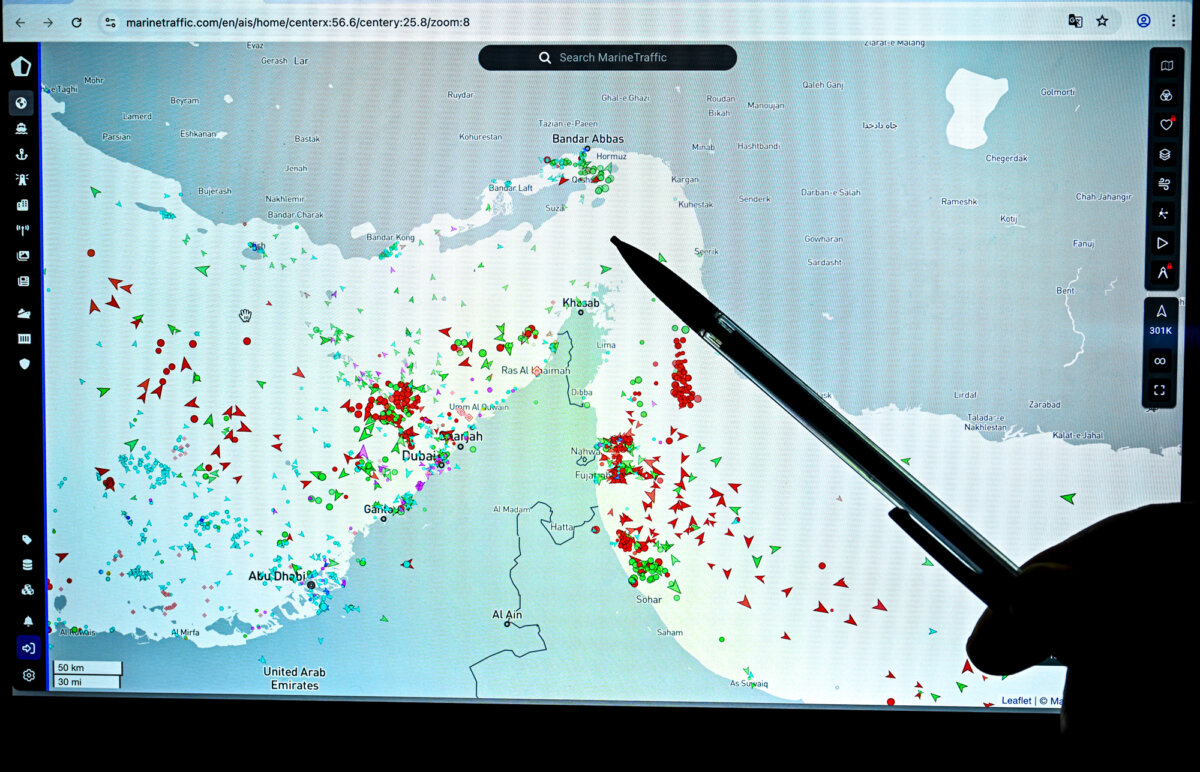
As this standoff extends into its second week, traffic through the strait—where 20 percent of the world’s oil is exported—has come to a near-standstill, with up to 250 ships, including about 150 oil tankers, stacked in the Arabian Sea.
According to UK Maritime Trade Operations, as of March 10, as many as 14 drone attacks on commercial shipping in the strait and Gulf of Oman have been reported, a count that would likely be far higher if the threat of attack had not paralyzed global shipping.
In response, the seven largest global shipping insurers that cover up to 90 percent of the world’s ocean-going cargoes, citing war risks, have canceled policies, leaving ships unwilling to transit the strait under IRGC guns and anchor in Persian Gulf State and Saudi Arabian ports that Iran is targeting.
As a result, global oil prices increased by more than 30 percent, from $72.48 per barrel on Feb. 27 to about $100 per barrel by March 9 after briefly nearing $120 per barrel earlier that day.
Prices for Brent crude dropped to $89 per barrel by 2 p.m. ET on March 10.
Analysts project that oil prices will continue to skyrocket until traffic in the Hormuz Strait is restored.
The Trump administration, which has pledged to use, but has not yet committed, combat ships to escort tankers through the strait, has established a $20 billion U.S. International Development Finance Corp. reinsurance program for tankers in an effort to spur ships to run the strait.
Risk Avoidance Rules
Capt. John Konrad, founder and CEO of the global maritime blog gCaptain, said he doubts that the U.S.-sponsored reinsurance program will spur global ocean shippers such as Denmark-based Maersk and French-owned CMA CGM to make the run without assurances that the Iranian threat has been diminished.
But many ships that ply the strait and Persian Gulf are already under-insured “mom-and-pop Greek companies that own five, maybe 10, tankers” and that could be induced to make the transit to make “a ton of money,” he told The Epoch Times, calling stymied strait traffic “an actuarial shutdown.”
Mercogliano agreed that the reinsurance program could entice “some movement” and see “some Greek tankers come through, maybe some Chinese ships squeak through,” but he said that they will be exceptions.
“Commercial shipping is going to do what is best for commercial shipping—risk avoidance,” he said. “That $20 bullion backstop should have been declared day one.”
He called this a misstep that illustrates that “the United States doesn’t understand the shipping industry.”
Referring to the Iran-backed Houthi terrorist group’s attacks on Red Sea and Gulf of Aden shipping traffic from Yemen, Mercogliano said, “One of the things the U.S. Navy demonstrated is the ability to shoot down drones but not understand ‘sea control.’”
This means that there is no risk of attacks on commercial shipping, he said.
Between November 2023 and October 2025, Houthis targeted more than 178 ocean shippers in the Red Sea and Aden Gulf with missiles and drones, sinking at least four ships, according to Reuters.
A multinational coalition led by the navies of the United States and the UK has been escorting commercial ships and attacking suspected launch sites.
That effort was dramatically scaled up within days of Trump’s January 2025 inauguration with “the largest carrier bombing offensive in naval history against the Houthis in Yemen and pirates in Somalia,” Konrad said.
On Feb. 1, 2025, allied forces spearheaded by the USS Harry S. Truman aircraft carrier strike group dropped 125,000 pounds of munitions on Houthis in Yemen and on the ISIS terrorist group in Somalia.
Although attacks continued intermittently afterward, the last documented Houthi attack on Red Sea shipping was in September 2025.
Konrad said that although Houthi leader Abdul-Malik al-Houthi has given “fiery speeches” in support of the Houthis’ fellow fundamentalist Shiite regime, as of March 9, the group has not reacted.
“They have not been shooting all those rockets and things that were being supplied by Iran,” he said.
The Houthis remain a threat because it is unclear whether they retain hidden missiles and drones and are, in a worst-case scenario, waiting for an ideal opportunity to inflict damage on commercial shipping on Iran’s behalf, analysts say.
“How much ‘warehousing’ capability they have, I don’t know,” Konrad said.
He also said that he does not think that they like to “warehouse” munitions, because they have little air-defense capacity.
“I think they like to smuggle them in from Iran on boats and use them quickly,” he said. “And that’s clearly not happening. So I don’t know if they have rockets left.”
Despite all this, the naval effort “didn’t eliminate the risk,” Mercogliano said, noting that traffic through the Bab-el-Mandeb Strait, the chokepoint between the Gulf of Aden and the Red Sea, remains dramatically scaled back.
“You’ve eliminated 99 percent of the risk,” he said. “But even at 1 percent risk, it is more cost-effective for [commercial shippers] to sail around Africa” rather than tempt a Houthi attack.
Correction: A previous version of this article misspelled the name of Capt. John Konrad. The Epoch Times regrets the error.
 Friends Read Free
Copy
Facebook
Tweet
Friends Read Free
Copy
Facebook
Tweet