
Commentary
Last week’s big news included powerful earnings from many big tech stocks, plus President Trump’s Asia trip and Wednesday’s Federal Open Market Committee (FOMC) meeting, where they cut key interest rates 0.25% after a fairly contentious debate, ending in a 10-2 vote.
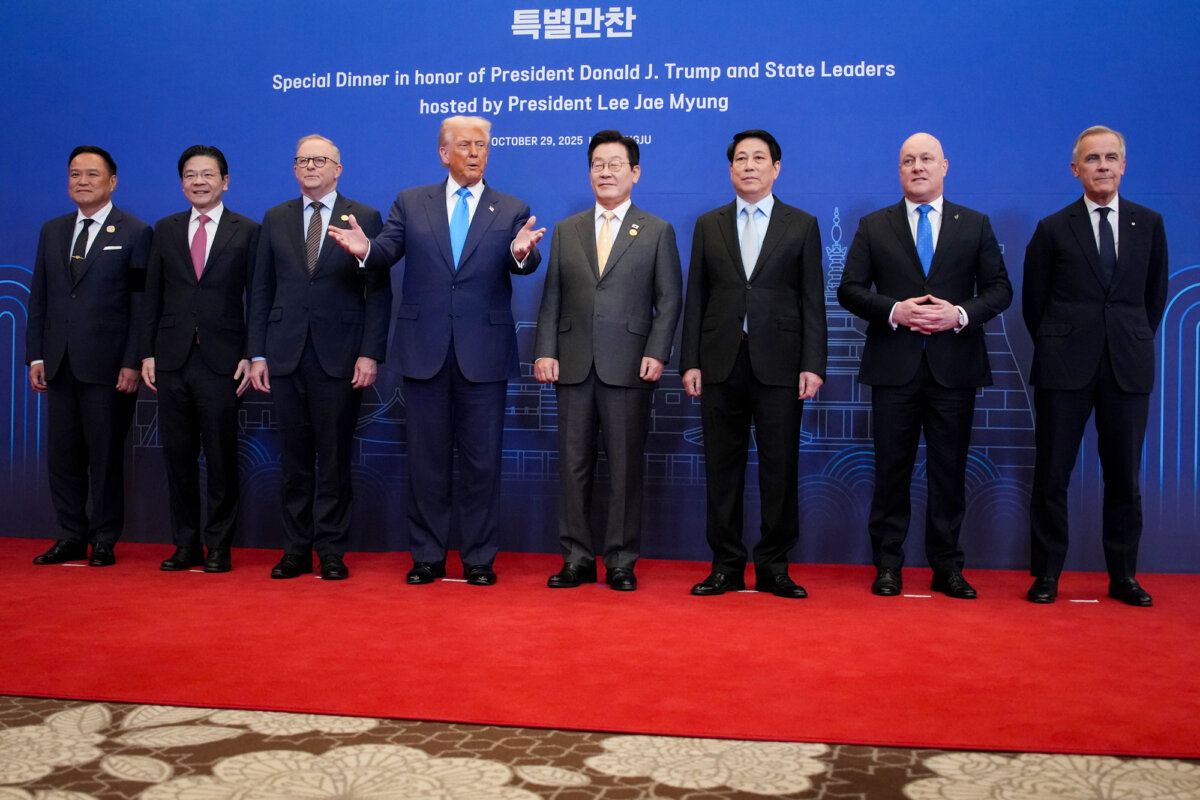
At the Asia-Pacific Economic Cooperation (APEC) conference held in South Korea, President Trump announced trade deals with several Asian nations, removing some market uncertainty and stimulating most financial markets. Trump’s team reached trade agreements with Malaysia and Cambodia, plus a framework for deals with Thailand and Vietnam. The U.S. also announced a trade deal with South Korea, but only after long negotiations leading to a Korean commitment to invest $350 billion in America.
As for China, negotiations are incomplete, but China’s Vice Minister for Commerce, Li Chenggang, told reporters that the two sides “reached preliminary consensus” on solutions for trade issues between China and the U.S., such as China’s promise to resume buying soybeans and other U.S. agriculture products. China’s rare earth export restrictions were also lifted for a year, in exchange for the Trump administration not imposing more tariffs. China and the U.S. also agreed to meet every year to discuss trade and tariffs. President Trump also agreed to visit President Xi in China next year, so the net result is that the dialogue between China and the U.S. has improved after no official meetings with President Xi for six years.
Here are the most important developments recently and what they mean:
– I recently attended a Great Gatsby party at Mar-a-Lago, and like the roaring 20s during the Great Gatsby era, a similar economic boom is now unfolding, but not everyone will participate. It is imperative that we own the stocks behind the AI and data center boom, like Bloom Energy, as well as companies benefiting from the productivity boom.
– We are now in the midst of accelerating GDP growth, with fewer workers expected to result in soaring productivity gains. In the meantime, since the Fed has an unemployment mandate, I am expecting more Fed key interest rate cuts, including at its December FOMC meeting.
– Another reason that the Fed needs to continue to cut key interest rates is that the Institute of Supply Management (ISM) announced that its manufacturing index declined to 48.7 in October, down from 49.1 in September. This is the eighth consecutive month that the ISM manufacturing index has been below 50, which signals a contraction. The New Orders, New Export Orders, Backlog of Orders, and Customers’ Inventories components all improved in October, but all remained below 50, which is not a good sign. Overall, only 6 of the 18 industries that ISM surveyed reported an expansion in October.
– I remain amazed that many small-to-mid capitalization stocks are trading at only 3.4 times forecasted earnings, i.e. remaining grossly undervalued compared to large capitalization stocks. Please remember that small to mid-capitalization stocks behave like “bunnies” that “sit” and “hop,” so get ready for some more upside surprises between now and Thanksgiving. I should add that the holidays are a happy time of year as we gather to meet with friends and family. This positive sentiment typically rubs off on investors, which is just another reason that November is a strong seasonal month.
– I am also keenly aware that the Top 10% of the stocks in the S&P 500 now account for approximately 42% of the index. News broke that Michael Burry’s Scion Asset Management has bearish bets on Nvidia and Palantir Technologies via put options. I, for one, look forward to “squeezing” Michael Burry since I have very different views on Nvidia and Palantir Technologies, which, by the way, announced perfect third-quarter results. Palantir Technologies posted an 8.1% revenue surprise and a 23.5% earnings surprise. The company raised its guidance above analyst estimates. Any dip in Nvidia and Palantir Technologies should be viewed as a great buying opportunity.
– We are now in the midst of the strongest earnings announcement season in the past four years, and earnings momentum is accelerating despite a federal government shutdown over healthcare spending cuts. Frankly, even though I expect the federal government shutdown to end soon, economic productivity actually rose during the shutdown. The simple fact of the matter is that the trillions of dollars in onshoring for data centers, plus the automotive, pharmaceutical, and semiconductor industries, is unprecedented. This onshoring is expected to result in a massive economic boom that will result in over 5% annual GDP growth in 2026. Since small to mid-capitalization stocks are predominantly domestic companies, they should naturally prosper during this accelerating economic boom.
In summary, I want you to feel good about America’s economic boom underway. The Atlanta Fed recently revised its third-quarter GDP estimate up to a 4% annual pace. I realized that the productivity boom is also displacing a lot of jobs, but that also largely boosts corporate earnings and GDP growth. Right now, it feels like we are back in 1998. Next year is shaping up to be like 1999, which was my best performing year. The fact that November is a seasonally strong month with typically an early “January effect” is just the icing on the cake. This is “locked and loaded” time, so prepare for a strong year-end rally and a spectacular 2026.
*Views expressed in this article are opinions of the author and do not necessarily reflect the views of The Epoch Times.
 Friends Read Free
Copy
Facebook
Tweet
Friends Read Free
Copy
Facebook
Tweet