Shares of major U.S. drugmakers rose while foreign stocks slumped after President Donald Trump unveiled new pharmaceutical tariffs.
In a Sept. 25 Truth Social post, the president announced he would impose a 100 percent tariff on “any branded or patented pharmaceutical product” entering the United States next month.
He confirmed that the levy would not apply to companies building domestic drug manufacturing facilities. He also noted that there will be exemptions for companies whose construction projects have already begun, meaning they are either “breaking ground” or “under construction.”
“There will, therefore, be no tariff on these pharmaceutical products if construction has started,” Trump said.
The objective, Trump said, will be to encourage pharmaceutical companies to relocate more of their manufacturing operations to the United States.
Since the president had discussed pharmaceutical tariffs for months, the announcement was not a shock to the industry. The only difference may have been the timeline, as Trump previously suggested delaying higher import duties for about a year to allow companies enough time to stockpile medicines and shift manufacturing.
Shares of Eli Lilly rose by 1 percent while Johnson & Johnson’s jumped by about 0.6 percent. Merck & Co., Pfizer, and Bristol-Myers Squibb gained about 0.3 percent.
The iShares U.S. Pharmaceuticals ETF (IHE)—the largest U.S. pharmaceutical exchange-traded fund by assets under management (AUM)—advanced 0.85 percent.
Over the past several months, drugmakers have committed to billions of dollars in new U.S. manufacturing.
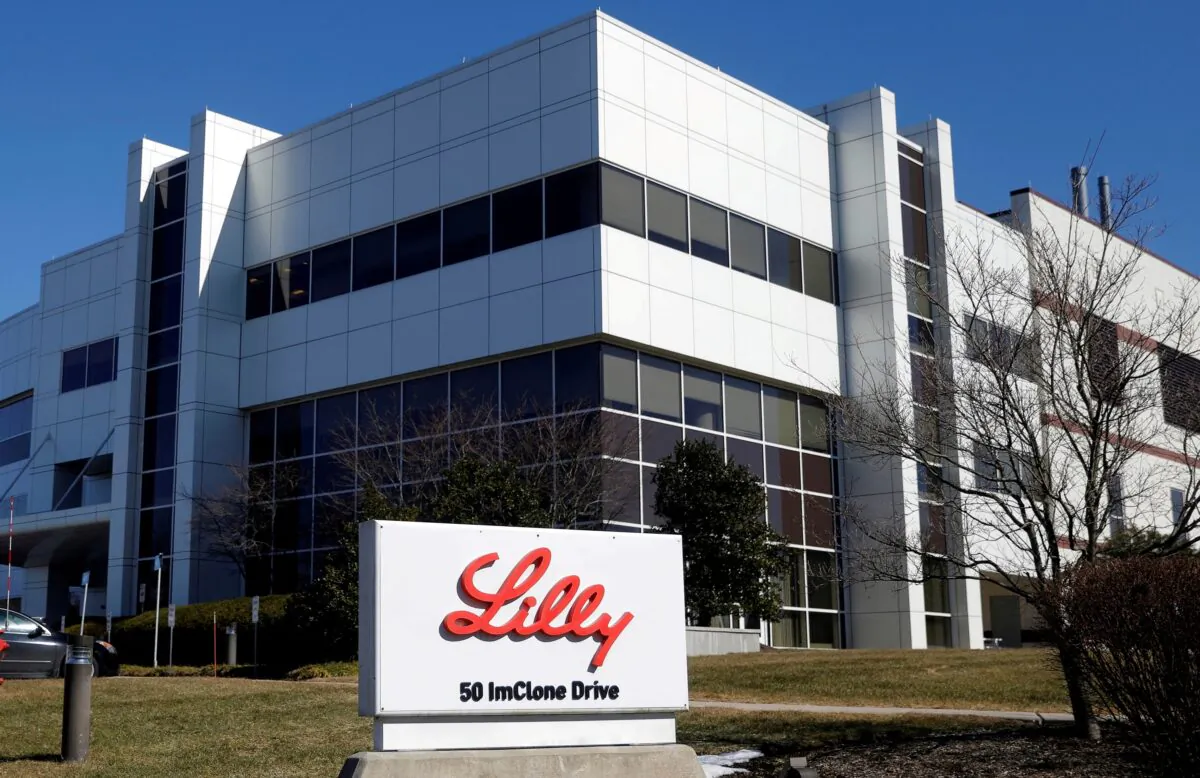
In February, Eli Lilly unveiled plans to bolster its domestic medicine production.
“We are not just building facilities. We are creating a future where American innovation leads the world in pharmaceutical manufacturing, requiring a highly skilled workforce prepared to shape the future of health care,” Executive Vice President and President of Lilly Manufacturing Operations Edgardo Hernandez said.
Eli Lilly has thus far announced four new U.S. sites this year, including a new $6.5 billion facility in Texas, unveiled earlier this week. The latest plant will manufacture active pharmaceutical ingredients and is expected to be operational within five years.
This announcement came shortly after the company confirmed plans to construct a $5 billion manufacturing facility in Virginia.
Merck has unveiled a series of multibillion-dollar U.S. manufacturing investments aimed at strengthening domestic production, with major projects underway in Delaware, New Jersey, and North Carolina.
Johnson & Johnson also announced a $55 billion investment in U.S. manufacturing, technology, and research and development over the next four years. This represents a 25 percent increase from the previous four-year cycle, the company said.
“Our increased U.S. investment begins with the ground-breaking of a high-tech facility in North Carolina that will not only add U.S.-based jobs, but also manufacture cutting-edge medicines to treat patients in America and around the world,” CEO of Johnson & Johnson, Joaquin Duato, said in a March statement.
Implications for Foreign Drugmakers
The United States relies heavily on a global pharmaceutical supply chain, sourcing from various countries.
China and India, for example, manufacture active pharmaceutical ingredients or finished products. The United States also imports drugs, ingredients, and vaccines from countries such as Ireland, Belgium, Denmark, Germany, Switzerland, and Japan.
The 100 percent tariff could squeeze profit margins for these foreign drugmakers. The levies could also reduce their access to the world’s largest pharmaceutical market. Both circumstances would likely necessitate that these companies adjust their supply chains.
As a result, shares of Asian and European drugmakers slumped following Trump’s latest tariffs announcement.
Japan’s Sumitomo Pharma Co. fell by more than 3 percent on the Tokyo Stock Exchange. Denmark’s Novo Nordisk declined by about 2 percent on the New York Stock Exchange, while Danish pharmaceutical giant Zealand Pharma also slumped 2 percent in overseas trading. Swiss-based Roche slipped 0.4 percent.
Last year, the United States imported more than $212 billion worth of pharmaceutical products, approximately double the amount in 2023.
Ahead of Trump’s tariffs, companies accelerated their purchases of foreign pharmaceuticals as part of stockpiling efforts. In March, pharmaceutical imports reached almost $50 billion, representing a 71 percent increase from February, according to the Bureau of Economic Analysis.
Simon Harris, Irish minister for foreign affairs and trade and minister for defence, said that the recent U.S.–EU agreement included a provision capping any new tariffs at 15 percent.
“We will be studying the impact of this announcement, which includes a number of exemptions, together with EU colleagues,” Harris said in a statement.
“I want to stress, however, that the EU and US Joint Statement issued on 21 August last made absolutely clear that any new tariffs announced by the US on pharmaceuticals under its Section 232 investigation would be capped at 15% for pharma products being exported by the EU.”
The Canadian Chamber of Commerce, meanwhile, criticized the tariff, warning of “profound and potentially dire consequences on Americans’ health.”
“Disrupting the supply chain with such a steep tariff would lead to immediate price hikes, strained insurance systems, hospital shortages, and the real risk of patients rationing or foregoing essential medicines,” Pascal Chan, senior vice president of strategic policy and supply chains at the Canadian Chamber of Commerce, said in a statement.
While details could still be ironed out heading into the Oct. 1 deadline, market watchers say pharmaceutical companies—at home and abroad—will likely employ mitigation strategies.
“We predict many drugmakers will mitigate the impact by shifting manufacturing and technology to new locations within the US,” Morningstar said in a Sept. 25 report.
In the medium term, drugmakers are likely to respond by outsourcing production, securing multiple sources for key ingredients, and relocating manufacturing to U.S. facilities where regulatory approvals are already in place, the firm said.
Moving forward, it is likely that companies will overhaul their supply chains to ensure U.S. sales are supplied by American manufacturing facilities.
Jacob Burg contributed to this report.
 Friends Read Free
Copy
Facebook
Tweet
Friends Read Free
Copy
Facebook
Tweet