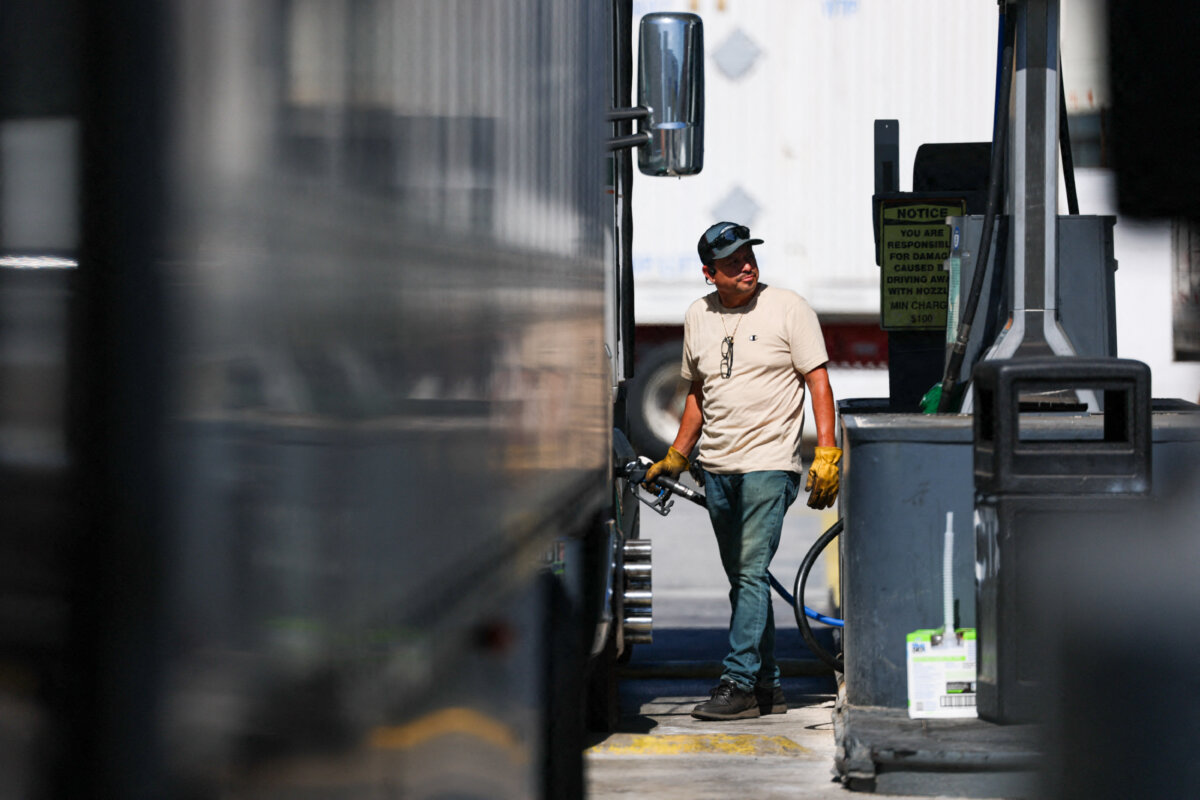

Average U.S. diesel prices jumped to a record high on Friday as a global supply crunch intensified amid renewed U.S.–Iran hostilities and Ukrainian attacks on Russian refineries.
The national average price of diesel hit $5.85 a gallon on Sept. 4, according to the American Automobile Association (AAA), up from $5.78 the previous day and $5.61 a week earlier.
Friday’s price also surpassed the previous record of $5.82 per gallon set on June 17, 2022, in the aftermath of Russia’s invasion of Ukraine, according to fuel price-tracking service GasBuddy.
Patrick De Haan, head of petroleum analysis at GasBuddy, said average diesel prices have remained above $5 a gallon since July 15, putting 2026 on track to become the most expensive year for diesel in U.S. history.
The surge has implications beyond the pump. Diesel powers much of the country’s trucking, freight, farming, and delivery networks, meaning higher fuel prices raise transportation costs across a long list of everyday goods. While businesses can absorb some of those increases, the prospect looms that higher diesel costs will trickle down to consumers.
“All sectors of the economy are affected by diesel. This is one of the reasons why the government bond yields in the United States are so high, it’s the expectation that inflation will continue to go up,” said Claudio Galimberti, chief economist at Rystad Energy.
Oil prices, meanwhile, were on course to gain more than 6 percent for the week as the United States and Iran resumed military exchanges in their ongoing conflict.
After cooling somewhat amid hopes for peace earlier in the summer, oil prices have resumed their climb as fighting escalates. Brent crude, the international benchmark, was trading above $95 a barrel on Friday, up from roughly $70 before the war.
What’s Driving the Diesel Surge
Before the United States and Israel launched attacks against Iran in late February, the national average for a gallon of diesel stood at about $3.76, according to AAA.
Prices quickly climbed as crude oil—the main ingredient in both diesel and gasoline—surged amid production cuts and supply disruptions across the Middle East, including a sharp drop in tanker traffic through the Strait of Hormuz.
Before the war, around 900,000 barrels per day of diesel and 350,000 barrels per day of jet fuel moved through the Persian Gulf, equivalent to roughly 10 percent and 20 percent of global seaborne supply, respectively, according to cargo-tracking firm Vortexa.
Traffic through the Strait of Hormuz remains below normal. Just four commodity vessels transited the key waterway on Thursday, compared with a 10-day average of about 15, preliminary shipping data showed.
Systematic Ukrainian drone attacks on Russian oil refineries have added another squeeze on global diesel supplies. Russia is a major exporter of refined fuels, and damage to its refining system has tightened a market already strained by the conflict in the Middle East.
“Combined disruptions are equivalent to around 20% of global seaborne diesel trade,” ING analysts said in a recent note.
“With little spare refining capacity, meaningful relief requires a recovery in Persian Gulf and/or Russian flows.”
Inventories Near Historic Lows
The strain is also showing up in refining markets. The U.S. diesel crack spread—a measure of the difference between the price of crude oil and the diesel produced from it—surged to a record intraday high of $108.02 a barrel on Wednesday.
The spread later eased after government data showed a modest increase in distillate inventories, but supplies remain historically tight.
U.S. distillate stocks, which include diesel and heating oil, averaged their lowest August levels for this time of year since 1982, according to Energy Information Administration data released Wednesday.
“We’re entering a key period for diesel consumption with the lowest inventories on record for early September,” said David Russell, global head of market strategy at TradeStation.
“Farmers and truckers typically use more diesel in the autumn, which raises the stakes for the current crisis and increases the risk of sharper price increases.”
U.S. refiners have pushed operating rates to multi-year highs to take advantage of strong margins and boost diesel output, but disruptions elsewhere in the world continue to constrain global supplies, according to UBS analyst Giovanni Staunovo.
Gasoline prices have also risen as expensive crude works its way through the market. AAA said Thursday that the national average had reached $4.14 a gallon, putting the upcoming Labor Day weekend on track to be the most expensive ever at the pump.
Reuters contributed to this report.
 Friends Read Free
Copy
Facebook
Tweet
Friends Read Free
Copy
Facebook
Tweet