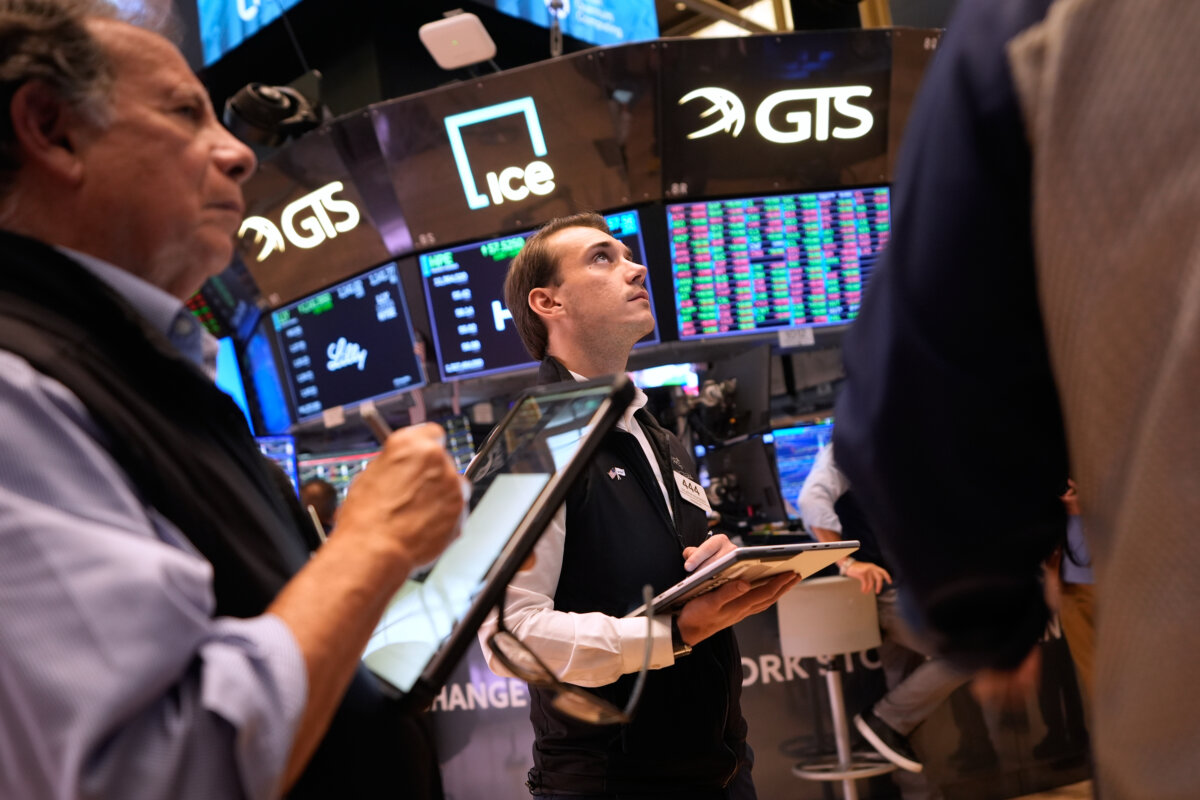

U.S. stocks survived everything the global economy threw at Wall Street in the third quarter.
Investors shrugged off the ongoing war in Iran, persistent inflation woes, Federal Reserve interest rate hikes, and surging U.S. Treasury bond yields from the July to September span.
The tech-heavy Nasdaq composite index reached an all-time high of almost 27,300 in September, logging a quarterly gain of almost 4 percent.
The broad-market S&P 500 topped 7,800 for the first time before paring back its gains. Still, the index posted a third-quarter increase of around 3 percent.
The blue-chip Dow Jones Industrial Average was the lone major benchmark average outcast, logging a modest 2 percent loss.
While major names have been doing the heavy lifting, this has been the norm throughout bull markets, says Ken Mahoney, president and CEO at Mahoney Asset Management.
“The indexes can hide what’s happening underneath,” Mahoney said in an emailed note to The Epoch Times.
“Of course, when this all ends, whenever that is, it will sure be ugly. We do not think that is soon. Markets do not top out as everyone is sitting here worried about breadth.”
Elevated inflation and higher interest rates are complicating the outlook, but the broader economy and stock market have defied gravity so far, he added.
Indeed, many of the headwinds threatening equities in the third quarter continue to linger in the background.
Persistent Inflation Risks
The Federal Reserve’s go-to inflation measure—the Personal Consumption Expenditures (PCE) Price Index—was just released for August.
Last month’s annual PCE inflation rate was unchanged at 3.4 percent, coming in below economists’ expectations. Monthly, PCE inflation rose 0.3 percent, also softer than market estimates.
Renewed inflation pressures have been largely driven by surging oil and gas prices.
A barrel of West Texas Intermediate—the U.S. oil benchmark—surged more than 30 percent in the third quarter, ranging between $70 and $105.
Consumers have been squeezed at the pump, as gasoline prices have stuck firmly above $4 per gallon.
Businesses have been hurt by diesel climbing to a record $6.51 per gallon, and a chorus of experts believe this could filter through the broader economy and cause second- or third-order inflation effects.
Structural inflation, meanwhile, has been tamer this past summer.
Stripping out volatile energy and food prices, the Fed’s preferred 12-month core PCE inflation rate held steady at a lower-than-expected 3 percent.
From August to September, core PCE prices edged up 0.2 percent.
But these trends have Fed watchers penciling in tighter monetary policy.
Federal Reserve Tightening
At the September Federal Open Market Committee policy meeting, officials voted unanimously to raise interest rates by a quarter point for the first time since July 2023.
The benchmark federal funds rate—a key policy rate that influences a range of business, consumer, and government borrowing costs—now sits in a new target range of 3.75 percent to 4 percent.
According to the Summary of Economic Projections—policymakers’ outlook for the economy and policy—the Fed could follow through on another rate hike before the year is over.
Investors are split on whether this will happen in October or December.
Comments by Fed officials since the September meeting amplified bets on a September rate increase, says Paolo Broccardo, CEO at BankPro.
“Recent Fed commentary has increasingly focused on the persistence of price pressures,” Broccardo said in a note emailed to The Epoch Times.
“Governor Lisa Cook highlighted inflation risks from artificial intelligence investment, reinforcing expectations that the tightening cycle could expand.”
But New York Fed President John Williams threw a wrench into rate-hike forecasts by teasing a potential pause in October.
“With the policy action we took at our September meeting, there is no need for urgency, and we have time to gather more information,” Williams said in a Sept. 29 speech
The Fed will hold its next two-day meeting on Oct. 27 and Oct. 28.
US Treasury Yields
The U.S. Treasury bond yield curve shot up in the third quarter to levels unseen in years.
The benchmark 10-year yield has climbed almost 90 basis points since July 1, reaching 5.3 percent.
Likewise, the 30-year U.S. government bond yield has climbed approximately 70 basis points to 5.64 percent.
Both Treasury yields are at their highest levels in more than 20 years.
Market watchers have pointed to a wide array of factors for the spike in yields, including persistent inflation, capital competition, fiscal fears, and a normalization of interest rates.
A concern is that the longer bond yields remain high, the greater the risk to stocks.
But Nancy Tengler, CEO and CIO of Laffer Tengler Investments, does not think that will occur.
“As we have pointed out for years, the 1990s were a period of elevated yields (the 10-year traded between 5 percent and 8 percent during the decade) which coexisted with robust stock price performance,” Tengler said in a note emailed to The Epoch Times.
Additionally, earnings have been solid across multiple industries, so it is “unlikely investors are going to pull money (in a meaningful way) from stocks to invest in bonds, even if yields move up 10 percent from here.”
Despite comparisons between today’s artificial intelligence (AI) boom and the dot-com bubble, tech companies’ earnings growth has outpaced overall stock market performance.
In other words, these firms’ underlying fundamentals are stronger than in the 1990s.
IPO Uncertainty
Since SpaceX’s blockbuster Wall Street debut in June, other firms have been reluctant to join the New York Stock Exchange.
The trillion-dollar rocket-and-satellite company rose to nearly $202 before pulling back and falling about 25 percent to around its IPO price of $150.
AI giant OpenAI delayed its initial public offering—also known as an IPO—until next year. Anthropic postponed its debut until later this year. Smart ring maker Oura and nuclear services provider Holtec paused their IPOs.
“Buyers are being careful about price, and that the companies which can afford to walk away are doing so,” Chan Ahn, founder of Tessera PE and former executive director at Goldman Sachs, told The Epoch Times.
“When deals that different are pulled within weeks of each other, that is a signal about the market, not just about the companies.”
Midterms Ahead
Inflation, war, and the Fed will likely drive headlines in the fourth quarter, but another wildcard could influence U.S. stocks: the November midterm elections.
Prediction markets indicate the Democrats will take the House and Senate.
“Q4 will be big as midterms bring the possibility of change, and at this point, it seems that’s the widespread expectation,” James Stanley, senior strategist at StoneX, said in a Sept. 30 note.
After every midterm election since 1950, the S&P 500 has generally been higher 12 months later. U.S. Bank data suggest average 12-month gains range from 12 percent to 15 percent.
 Friends Read Free
Copy
Facebook
Tweet
Friends Read Free
Copy
Facebook
Tweet