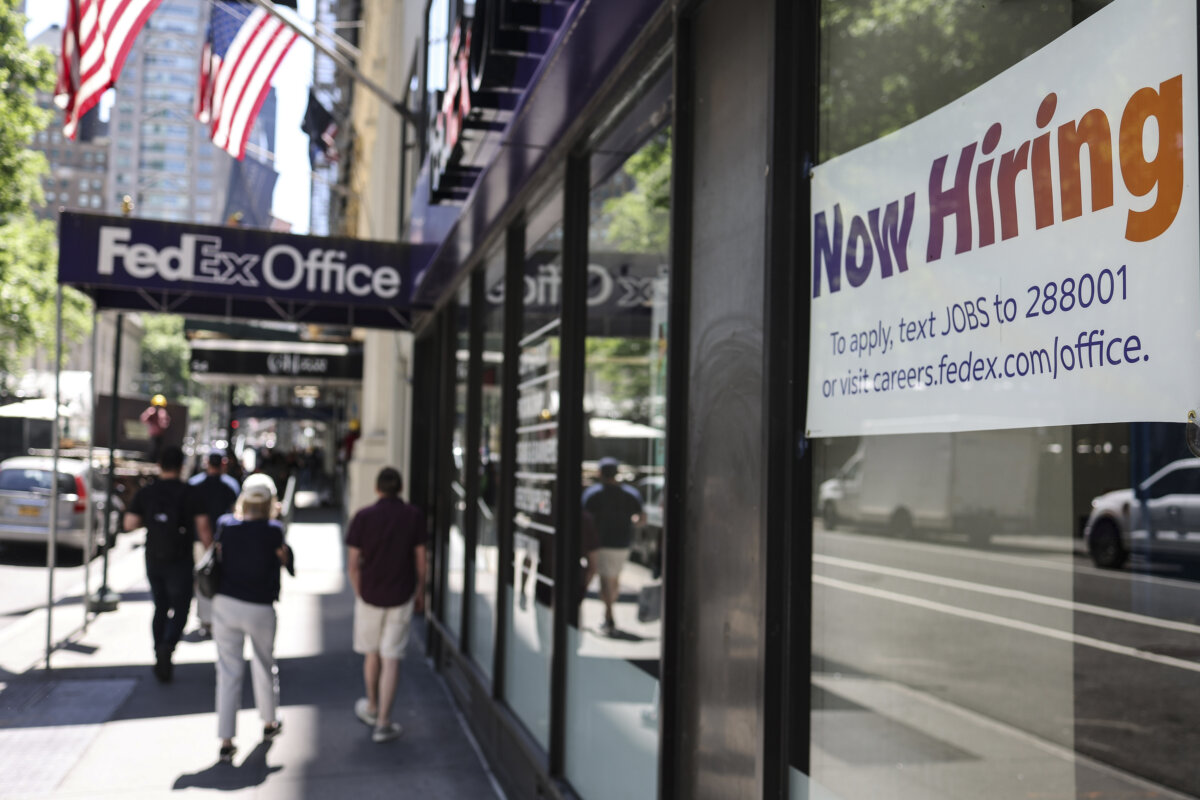

The number of Americans applying for unemployment benefits remained below 200,000 for the second consecutive week as the U.S. labor market continues to stay strong.
Initial jobless claims dipped to a seasonally adjusted 197,000 for the week ending Sept. 19, from an upwardly revised 198,000, according to Department of Labor data released on Sept. 24.
This came in below economists’ expectations of 201,000.
Stripping out week-to-week volatility, the four-week average slowed to 202,250.
All year, unemployment claims have been in a historically low range of 189,000 to 230,000. This reflects the economy’s low level of layoffs, supporting the oft-described “low-fire, low-hire” environment.
Since the recent high of 4.5 percent in November, the unemployment rate has been trending lower, hitting 4.1 percent in July and August.
But while hiring demand has been anemic since the springtime hiring boom, a flurry of new indicators suggest job growth could be picking up steam heading into the fall.
Continuing jobless claims—a measure of Americans currently receiving unemployment benefits—were little changed at 1.72 million. This gauge has been tumbling for a year.
Economists use this statistic as a proxy for challenges workers may have in finding new job opportunities under current employment conditions.
Conversely, it might also signal that recipients are exhausting their benefits, since many states cap eligibility at 26 weeks.
Meanwhile, in the four weeks ending Sept. 5, private employers added an average of 20,000 jobs per week, representing the third consecutive increase, the ADP Research Institute reported earlier this week.
Job postings on Indeed have also steadily risen, reaching a six-month high on Sept. 18.
Chris Osmond, CIO for Fifth Third Wealth Advisors, says low jobless claims send a clear message.
“The U.S. labor market remains resilient, and layoff activity is not accelerating,” Osmond said in a note emailed to The Epoch Times.
Job Market Outlook
Looking ahead, several forecasts suggest the labor market would continue to be robust.
The American Bankers Association Economic Advisory Committee estimates the unemployment rate will remain stable at 4.2 percent over the coming year.
While economic growth is a contributing factor, demographics are also playing a role, says Beth Ann Bovino, committee chair and chief economist at U.S. Bank.
“Slower labor-force growth from demographic developments has reduced the ‘breakeven’ pace of job creation needed to maintain labor market balance,” Bovino said in a Sept. 23 statement.
Estimates vary, but economists say the break-even rate—the number of new jobs needed to keep the unemployment rate—could be close to zero amid lower immigration and more retirements among the baby boomers.
The Federal Reserve updated its unemployment rate forecasts in last week’s Summary of Economic Projections, a quarterly outlook by policymakers for the economy and policy.
Fed officials expect the jobless rate to be 4.1 percent this year, down from the June estimate of 4.3 percent. They also see the median unemployment rate holding steady at 4.1 percent in 2027, 2028, and 2029.
Based on a plethora of recent speeches, the Fed believes the labor market is a source of strength, and upside risks to the price-stability side of its mandate are the key challenge.
“While the upside risks to inflation have increased, labor market conditions seem a bit stronger overall, and the unemployment rate remains low,” Boston Fed President Susan Collins said in a Sept. 22 LinkedIn post.
“With the labor market on a better footing, monetary policy can focus on a timely return to price stability, especially after five and a half years of too high inflation.”
Persistent war-fueled inflation has been at the center of financial markets and the Fed’s decision-making.
Headline inflation is firmly above 3 percent—both the Consumer Price Index and the central bank’s go-to Personal Consumption Expenditures (PCE) Price Index—and the Fed raised interest rates last week for the first time in more than three years to prevent higher energy costs from filtering through the broader economic landscape.
Next week, August’s PCE Inflation data will be released. Early forecasts suggest the annual inflation rate will edge higher to 3.8 percent.
The 12-month core PCE inflation rate, which removes the volatile energy and food categories, is expected to tick up to 3.4 percent.
Financial markets now anticipate the Fed will pull the trigger on a second straight quarter-point rate hike at the October Federal Open Market Committee policy meeting.
 Friends Read Free
Copy
Facebook
Tweet
Friends Read Free
Copy
Facebook
Tweet