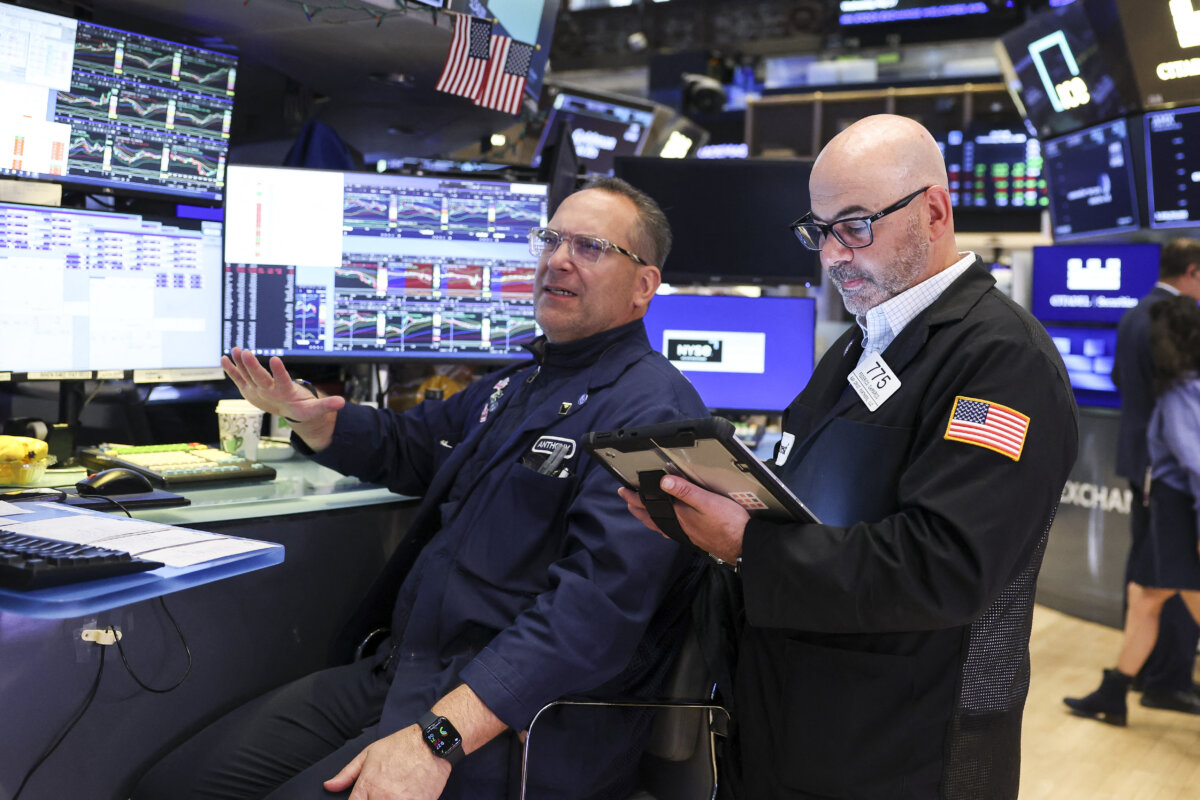

The rally in equities continued for yet another week, with the S&P 500 closing in on 7,600 and the Dow crossing 51,000 for the first time ever amid lower bond yields and strong tech earnings.
For the week, the Dow Jones Industrial Average rose by 1.49 percent to close at 51,032, just below its new record high set earlier Friday. The S&P 500 increased by 1.8 percent to 7,580, near its record high hit the same day. The Nasdaq Composite soared by 2.58 percent, while the Russell 2000 fared the best, up 2.67 percent.
The Chicago Board Options Exchange Volatility Index closed the week at 15.32, down by 8.26 percent.
Stocks opened the shortened week on May 26 sharply higher amid lower oil prices.
West Texas Intermediate crude futures traded below $93 per barrel on the day, near a five-week low, amid optimism that the United States and Iran will reach an agreement to end the war.
Lower oil prices were music to the ears of bullish bond traders, pushing bond prices higher and yields lower, with the yield on the benchmark U.S. 10-year Treasury note edging 6 basis points lower to 4.5 percent.
Lower bond yields were a tailwind for equities, especially the interest-sensitive small caps, with the Russell 2000 gaining 1.79 percent.
Memory chip makers including SanDisk resumed their extended rally, helping the tech-heavy Nasdaq gain 1.19 percent. The S&P 500 gained 0.61 percent, while the Dow posted a small loss of 0.23 percent, due to weakness in healthcare stocks.
Another tailwind for equities on May 26 was a better-than-expected May Conference Board Consumer Confidence report, confirming that U.S. consumers remain resilient despite rising inflation and energy prices.
“May’s consumer confidence reading topped expectations at 93.1, marking its highest level since December. Surprisingly, elevated gas prices and geopolitical worries out of the Middle East haven’t seemed to weigh much on this reading, although confidence remains well below where it stood before tariff worries surfaced last year,” eToro U.S. investment analyst Bret Kenwell told The Epoch Times.
Kenwell attributes the resilience of the U.S. consumer to tax refunds and the stock market’s impressive rebound, which are likely helping consumers feel a bit better, even if the broader backdrop is far from perfect. “If that resilience continues through the summer, it could set the stage for a solid second half of the year,” he added.
Lower oil prices and lower bond yields helped stocks open higher on May 27. But trading turned choppy by late afternoon amid a lack of clarity over the fate of U.S.–Iran negotiations to end the war and open the Strait of Hormuz, and profit-taking in the semiconductor sector.
By the market close, the Dow, the S&P 500, and the Nasdaq edged up slightly, while the Russell 2000 closed flat.
Alexander Guiliano, chief investment officer of Ridgewood, New Jersey-based Resonate Wealth Partners, said the stock market was confident that the United States and Iran would eventually reach a resolution, even if not immediately.
“The stock market has become desensitized to headlines from Iran, and there have been many, and it knows that oil prices near $100 per barrel [are] likely a temporary shock rather than a new normal,” he told The Epoch Times.
After a weak opening, equities resumed their ascent on May 27, led by technology following strong earnings from Snowflake, with the tech-heavy Nasdaq gaining 0.91 percent. Small caps also gained, with the Russell 2000 up by 0.70 percent for the day. The S&P 500 and Dow added 0.58 and 0.05 percent, respectively.
The gains in equities came despite mixed economic data from the United States. The Personal Consumption Expenditures Price Index (PCE) rose at an annual rate of 3.8 percent in April, the highest since May 2023, in line with market expectations.
Meanwhile, the Gross Domestic Product (GDP), a measure of the nation’s output, rose at an annual rate of 1.6 percent in the first quarter, up from 0.5 percent in the fourth quarter of 2025 but below the previous estimate of 2 percent, due to downward revisions to investment and consumer spending.
Kenwell said that while the PCE index came in better than expected, it marked the highest year-over-year increase in nearly three years.
“Even after stripping out energy prices, core PCE is sitting at a multi-year high. In response, the Fed has already taken on a more hawkish posturing in response to higher inflation,” he said.
The in-line inflation numbers combined with weaker GDP numbers were a relief for the bond market, with the yield on the 10-year U.S. Treasury note dropping to 4.46 percent, extending the slide from the 16-month high of 4.7 percent reached on May 20.
Another factor helping ease bond yields was reports of an interim deal between the United States and Iran, which drove oil prices lower, limiting inflationary pressures.
Inflation wasn’t an issue at the opening of trade on May 27 amid lower oil prices, helping push equities higher.
Tech stocks were particularly strong following a robust earnings report from Dell on AI-driven demand, but they trimmed their gains by the market close, with the Nasdaq gaining 0.20 percent. The S&P 500 posted similar gains, while the Dow Jones fared the best, up by 0.72 percent.
Kenwell is concerned about market valuations, with the Nasdaq-100 up by more than 30 percent from its lows and the S&P 500 eyeing its ninth straight weekly gain. Stocks could certainly use a healthy breather.
Dennis Follmer, chief investment officer of Waltham, Massachusetts-based Montis Financial, is skeptical of the relentless rally in equities.
“The S&P 500 is still riding a wave of euphoria from a blowout Q1 earnings season, but with earnings season over for the next couple of months, the likelihood of a summer sell-off is high,” he told the Epoch Times. “The bond market has been sending a pretty strong signal that it sees choppier waters ahead.”
Follmer is also concerned about the growing indebtedness of tech companies, which will make them vulnerable to business cycles.
“The big tech companies are not only just spending their cash flow on AI expenditures, but they will soon be some of the biggest borrowers in 2026,” he said.
“One or two AI chatbot platforms will likely dominate, and the rest will be the largely forgotten Yahoos to the winner’s Google, and there will be a price to be paid for all those trillions spent.”
 Friends Read Free
Copy
Facebook
Tweet
Friends Read Free
Copy
Facebook
Tweet