
Equities staged a strong rebound this week, snapping a five-week losing streak as investors returned to the market amid more attractive valuations and easing concerns over the Middle East conflict.
The rally was supported by a solid retail sales report, which underscored the resilience of consumer spending and broader economic growth. At the same time, weaker labor market data renewed expectations that the Federal Reserve may cut interest rates.
For the week, the Dow Jones Industrial Average rose by 1.18 percent to 46,504, finishing near its weekly high. The S&P 500 gained by 1.63 percent to 6,582, also closing near its peak for the week. The Nasdaq Composite led gains, climbing by 2.20 percent, while the Russell 2000 advanced by 1.47 percent.
Market volatility, which spiked earlier in the week, declined sharply toward the end of the week. The Chicago Board Options Exchange Volatility Index fell by 13 percent for the week to close at 23.87.
Stocks opened the shortened trading week on March 30 higher, driven by bargain hunting after the previous week’s sell-off that had pushed the Dow and Nasdaq into correction territory. However, equities soon came under pressure as oil prices surged.
West Texas Intermediate crude oil futures climbed to $101.7 per barrel, on track for a monthly gain exceeding 50 percent in March, amid ongoing tensions in the Middle East that are disrupting global oil supplies.
Additional pressure on equities came from investor concerns about the disruptive impact of artificial intelligence, which contributed to a shift away from technology shares. As a result, the S&P 500, Nasdaq, and Russell 2000 closed lower by 0.73 percent, 0.39 percent, and 1.46 percent, respectively, while the Dow closed modestly higher by 0.11 percent.
“Stocks are beginning a shortened trading week with continued uncertainties about the duration of the Iran conflict and the duration of high oil prices, which aren’t showing any signs of letting up,” Alexander Guiliano, chief investment officer at Ridgewood, New Jersey-based Resonate Wealth Partners, told The Epoch Times.
“This correction has already lasted one month, and even if the conflict in Iran continues, stock market corrections tend to rebound almost on the same timetable as on the way down.”
Guiliano said the recent correction has compressed valuations to more attractive levels, creating potential opportunities for investors holding cash.
“This can be an entry point for investors looking to be opportunistic after a multi-year run-up in equity markets,” he added.
Bargain hunters returned to the market on March 31, fueling a broad-based relief rally as optimism grew over a possible de-escalation in the Middle East conflict. Oil prices eased toward $100, further supporting equities.
The rally gained momentum throughout the session, aided by quarter-end portfolio adjustments and widespread buying across sectors.
Another factor supporting equities was a weaker labor market report, which strengthened expectations for potential Federal Reserve rate cuts.
The February Job Openings and Labor Turnover Survey showed a decline in job openings compared with January. Adverse weather and health care worker strikes contributed to weaker-than-expected employment growth, with hiring falling to its lowest level since April 2020.
“Aside from the 2020 dip, the hiring level has not been this low since 2014, when the labor market was still rebuilding after the Great Recession. While unemployment in today’s market remains low, the stall in hiring, coupled with a delay in retirement activity, is leading to a locked-out market for many new entrants,” ZipRecruiter economist Nicole Bachaud told The Epoch Times.
Despite labor market concerns, equity investors remained active, pushing major indices sharply higher. The Nasdaq and Russell 2000 led gains, rising by 3.83 percent and 3.41 percent, respectively, while the S&P 500 and Dow Jones increased by 2.91 percent and 2.49 percent, respectively.
Short covering—when investors buy back shares they had sold—also contributed to the upward momentum after several weeks of losses.
The rally extended into April 1 as oil prices declined further and February retail sales data came in stronger than expected, reinforcing confidence in consumer spending.
“Following disappointing readings in December and January, February’s retail sales report offered some reassurance. It was the strongest reading since July, while core retail sales and control group sales, the portion that feeds into GDP, also came in ahead of economists’ expectations,” eToro U.S. investment analyst Bret Kenwell told The Epoch Times.
Technology stocks once again led gains, with the Nasdaq rising by 1.2 percent, followed by the S&P 500 and Dow at 0.7 percent. Gains were driven by strength in semiconductor-related names such as SanDisk, Western Digital, and Nvidia, while the Dow’s more modest rise was supported by a jump in Boeing shares.
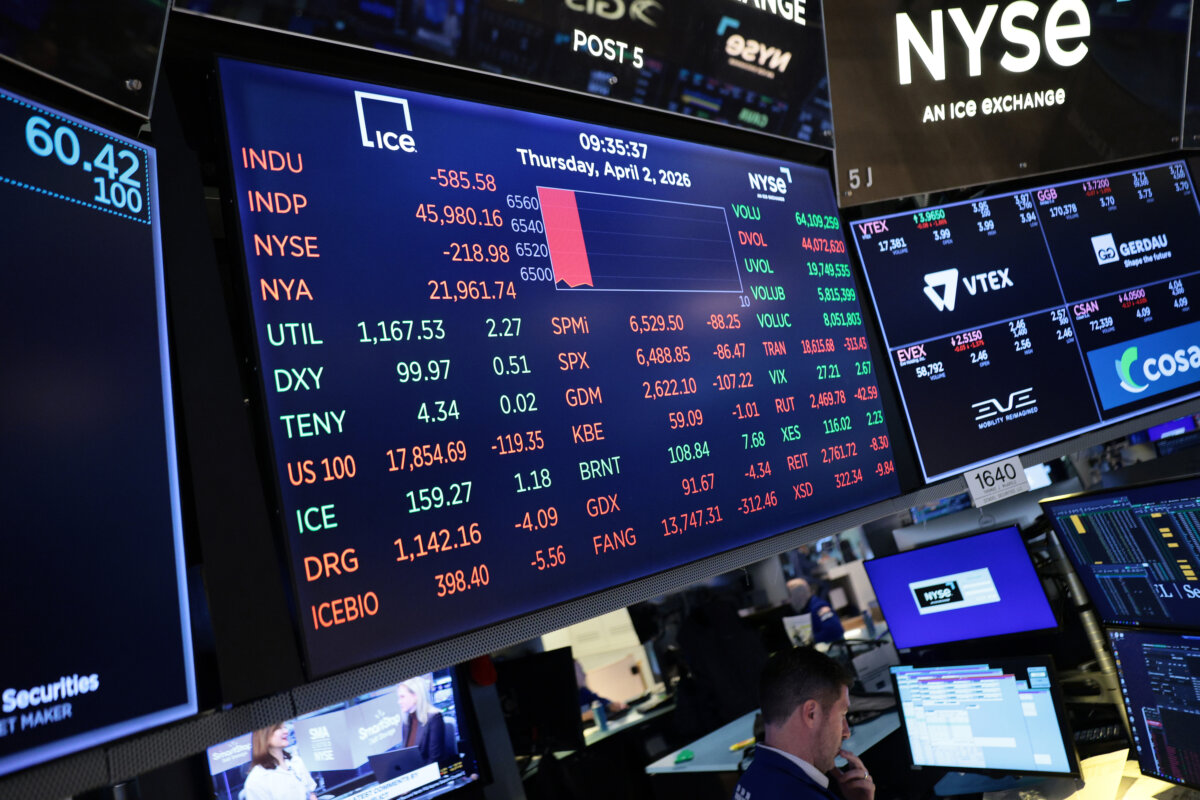
On April 2, the final trading day of the shortened week, equities opened sharply lower amid a renewed rise in oil prices. However, markets rebounded by midday and closed mixed. The Russell 2000, S&P 500, and Nasdaq ended higher by 0.70 percent, 0.18 percent, and 0.11 percent, respectively, while the Dow declined by 0.13 percent.
Kenwell noted that economic data has remained mixed in recent months, with investors now focused on the upcoming earnings season.
“There’s been a disconnect between fundamentals and price action, with stocks moving lower even as earnings estimates continue to move higher. Earnings season will likely prove one of those trends wrong—and bulls are hoping it’s the price action, not the estimates,” he said.
Guiliano emphasized the importance of maintaining discipline in the current environment.
“Geopolitical shocks can impact the market in many unpredictable ways, but investors would be well-served to position themselves opportunistically before clarity arrives,” he said.
 Friends Read Free
Copy
Facebook
Tweet
Friends Read Free
Copy
Facebook
Tweet