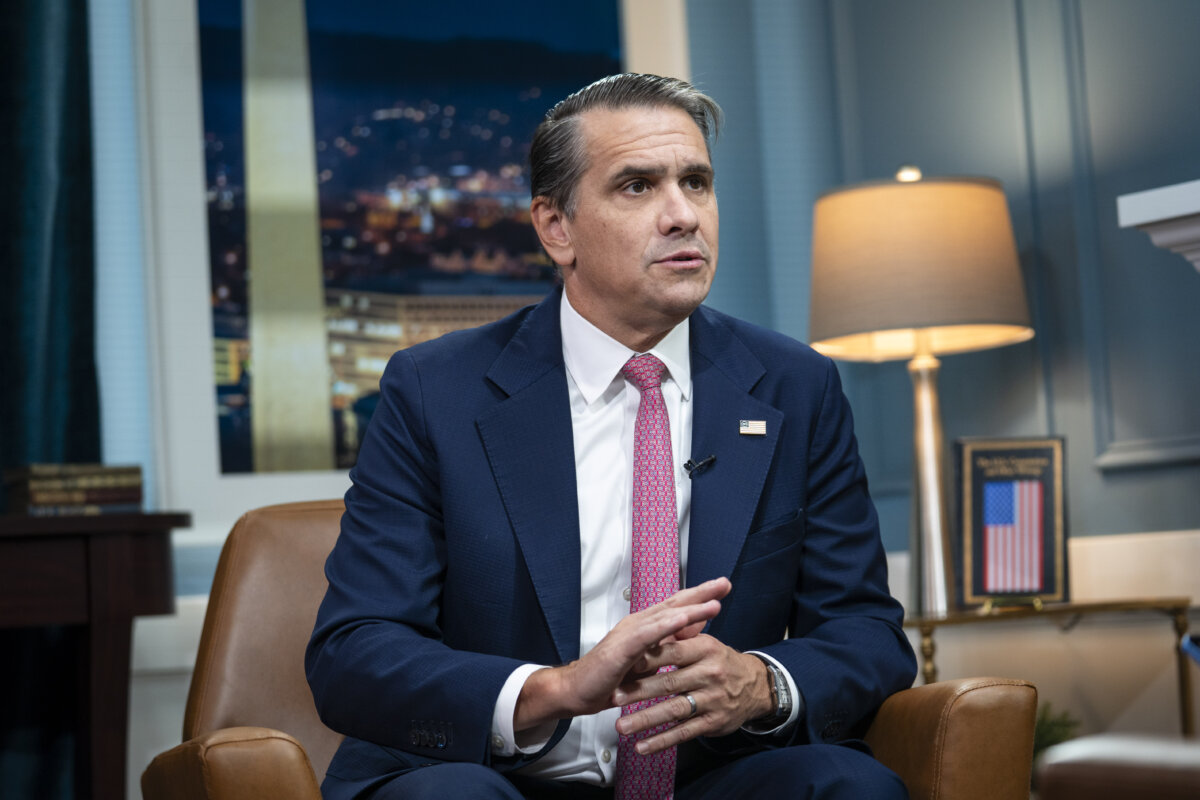


Combating Beijing-linked efforts to repress dissidents in the United States is a major priority for the Department of Justice (DOJ), with Attorney General Todd Blanche pledging ongoing investigations and prosecutions as long as the conduct persists.
Speaking to Epoch Times senior editor Jan Jekielek in an “American Thought Leaders” interview scheduled to air at 9 p.m. ET on Oct. 6, Blanche said the DOJ has charged a number of individuals over the past year in cases involving the Chinese regime’s transnational repression, including efforts that involved physical violence against dissidents.
Countering transnational repression “is a big priority of ours—it’s as it should be,” Blanche said.
He warned that transnational suppression “is a very serious issue,” whether Beijing is exploiting social media as a “very powerful tool” or directly paying people to oppress, harass, and physically attack targeted individuals.
“There’s been a lot of ongoing cases and arrests in that space,” Blanche said, adding that such enforcement will continue “to the extent that the conduct continues.”
Aside from physical violence, other known tactics of the regime’s transnational repression include using artificial intelligence-generated sexual harassment, censorship, and lawfare to target individuals, as well as pressuring targets to return to China and threatening targets’ family members in China, according to a June report published by the Congressional-Executive Commission on China.
Blanche’s remarks come as two recent cases have emerged as examples of the regime’s transnational repression, according to Assistant Director Roman Rozhavsky of the FBI’s Counterintelligence and Espionage Division.
A California woman was arrested at Los Angeles International Airport on Oct. 4 on a charge of acting as an unregistered agent of a foreign government. The woman is accused of surveilling Taiwanese President Lai Ching-te’s U.S.-based son.
A Bronx man was convicted of the same charge in May, accused of operating a Chinese undercover police station in New York City for China’s Ministry of Public Security.
Incidents of physical assault have been documented by a recently released report by New York-based organization Human Rights in China (HRIC), which accused agents of the Chinese Communist Party (CCP) of engaging in organized violence against peaceful protesters on the streets of Washington during Chinese leader Xi Jinping’s state visit from Sept. 23 to Sept. 25.
The report named Xin Qin, a Falun Gong practitioner who suffered injuries after being attacked by several pro-Beijing protesters on Sept. 24.
“HRIC calls on U.S. law enforcement to investigate the assailants’ identities and possible links to Chinese diplomatic missions,” the organization wrote in its weekly brief on Sept. 29.
Blanche emphasized that not every case of transnational repression is as straightforward as the case of the secretive police station in New York City.
“Some of these cases are very difficult to charge criminally because it isn’t obvious that the person doing it is violating the law as opposed to just exercising the rights that we hold dear in this country,” Blanche said.
In other words, the DOJ must distinguish between protected rights and conduct intended to cause harm, according to Blanche.
“If they’re doing it with the motivation to actually exact harm or exact improper influence or lobby the government without registering, then it gets into the area where it’s something that we need to be investigating and prosecuting,” he said.
The CCP’s so-called united front groups are closely linked to its transnational repression.
After similar street violence during Xi’s 2023 visit to San Francisco for the Asia-Pacific Economic Cooperation (APEC) summit, two U.S.-based advocacy groups released a report in 2024 urging the DOJ to investigate China’s united front groups in the United States.
A Jamestown Foundation report published in February said there are more than 900 such Chinese groups in the United States.
FBI Director Kash Patel said in an “American Thought Leaders” interview in August that multiple criminal networks involved in transnational repression in the United States have been dismantled by his agency.
Asked whether the Justice Department has the statutory tools to handle cases involving transnational repression, Blanche said existing laws, along with tools such as sanctions available to the Treasury and Commerce Departments, are “more than enough.”
“This is an area that is complicated because not only [do] you have to know the motivation behind it, but it’s also hard to catch because once you catch one, there’s a lot of others,” Blanche said.
 Friends Read Free
Copy
Facebook
Tweet
Friends Read Free
Copy
Facebook
Tweet