
China will cut the tax rebate it pays exporters of electric cars, the regime’s Ministry of Finance and State Taxation Administration said on Oct. 12—three days after its Commerce Ministry brushed off foreign complaints about Chinese overcapacity as protectionism.
Starting April 1, 2027, the value-added tax (VAT) rebate on exported new energy vehicles, which include battery electric and plug-in hybrid cars, will drop from 13 percent to 9 percent, covering 67 vehicle categories, from sedans and SUVs to commercial vehicles.
Electric cars are the last of China’s “new three” export industries—EVs, lithium batteries and solar products—to have their export support cut. European investigators found that China’s EV industry benefited from government subsidies and built far more capacity than its home market could absorb. Washington has opened trade probes into the same problem.
The cut also comes as Chinese car buyers pull back amid a struggling economy and local government revenue from land sales plummets, leaving the country leaning heavily on foreign buyers. Local governments in China control urban land and have long paid their bills by selling land-use rights, once one of their biggest sources of income.
Denial and Retreat
On Oct. 9, a Chinese Commerce Ministry spokesperson responded to a joint statement on industrial overcapacity signed by the United States and 14 partners. The spokesperson accused certain countries of protectionism and vowed to respond if any of them took steps that hurt Chinese interests.
The same day, European Trade Commissioner Maros Sefcovic said Brussels and Beijing had reached an understanding that could cut projected Chinese hybrid car exports to the bloc by more than half over four years.
Beijing’s own policy record tells a different story from its denials. In January, the finance ministry and tax administration announced that export rebates on solar products would be scrapped from April 1. They also cut the battery rebate from 9 percent to 6 percent, with the rebate ending entirely on Jan. 1, 2027. Both rebates had already been cut from 13 percent in December 2024.
In July, the regime went further. It reinstated a consumption tax on lithium-ion batteries that had been waived since 2015, starting at 2 percent on Sept. 1 and rising to 4 percent in September 2027.
Beijing’s own regulator has described the damage. The State Administration for Market Regulation said in late December that “involution-style” competition had left solar companies widely struggling to make a profit. It blamed low-quality rivalry and duplicate construction. Involution is Beijing’s term for cutthroat price wars.
The China Photovoltaic Industry Association said ending the rebate would help restore rational pricing in foreign markets and lower the risk of trade friction.
Exporting the Oversupply
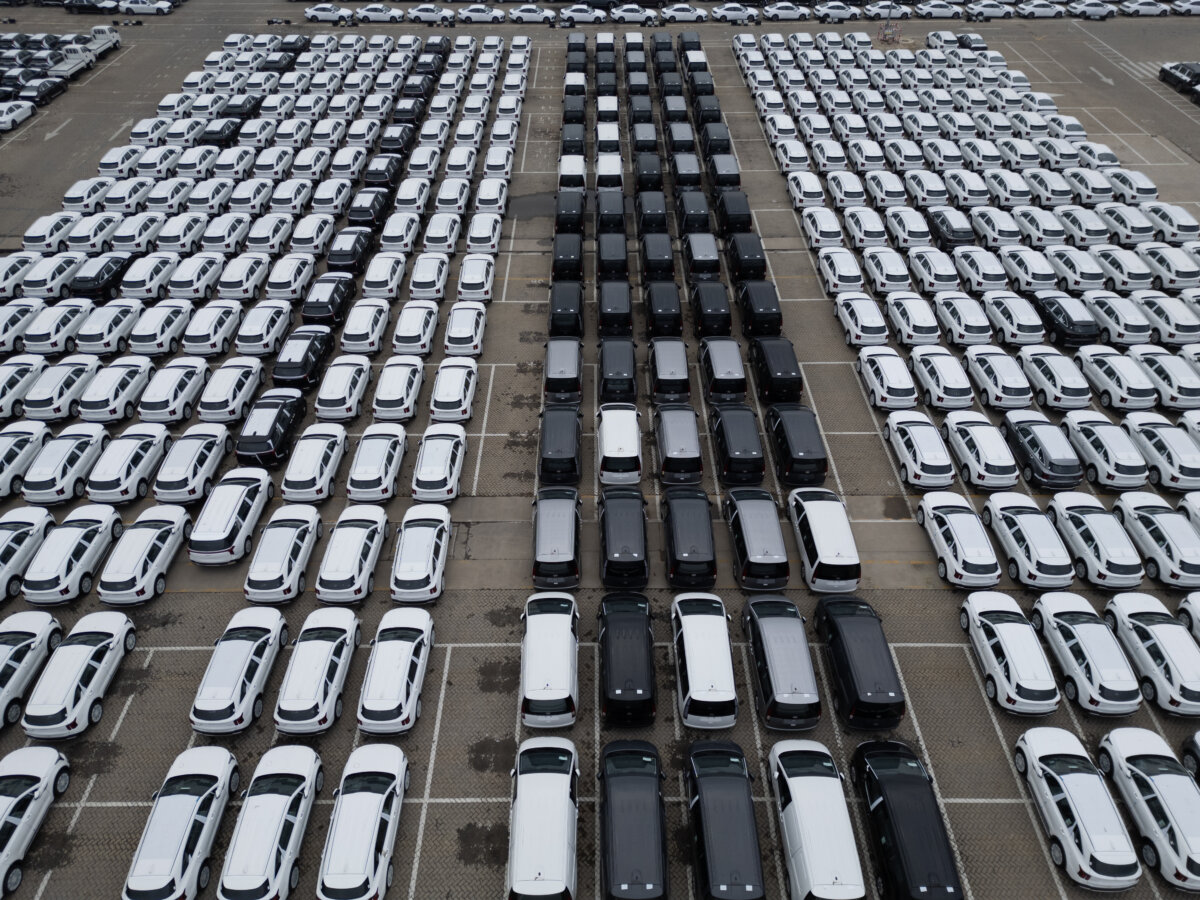
The rebate cut comes as China’s carmakers lean harder on foreign buyers. Domestic vehicle sales fell 26 percent in September from a year earlier, while exports jumped 61.4 percent to 1.05 million vehicles, according to the China Association of Automobile Manufacturers.
The industry ran at 70.8 percent of capacity in the second quarter, and its profits fell 16 percent in the first eight months of the year, China’s National Bureau of Statistics reported.
Chery, one of China’s largest automakers, shipped about 71 percent of its September sales overseas.
The new rate does not take effect for nearly six months, and it is tied to the export date on the customs declaration. That leaves carmakers time to push more vehicles abroad at the old 13 percent rate. After April, exporters will continue to receive a 9 percent rebate.
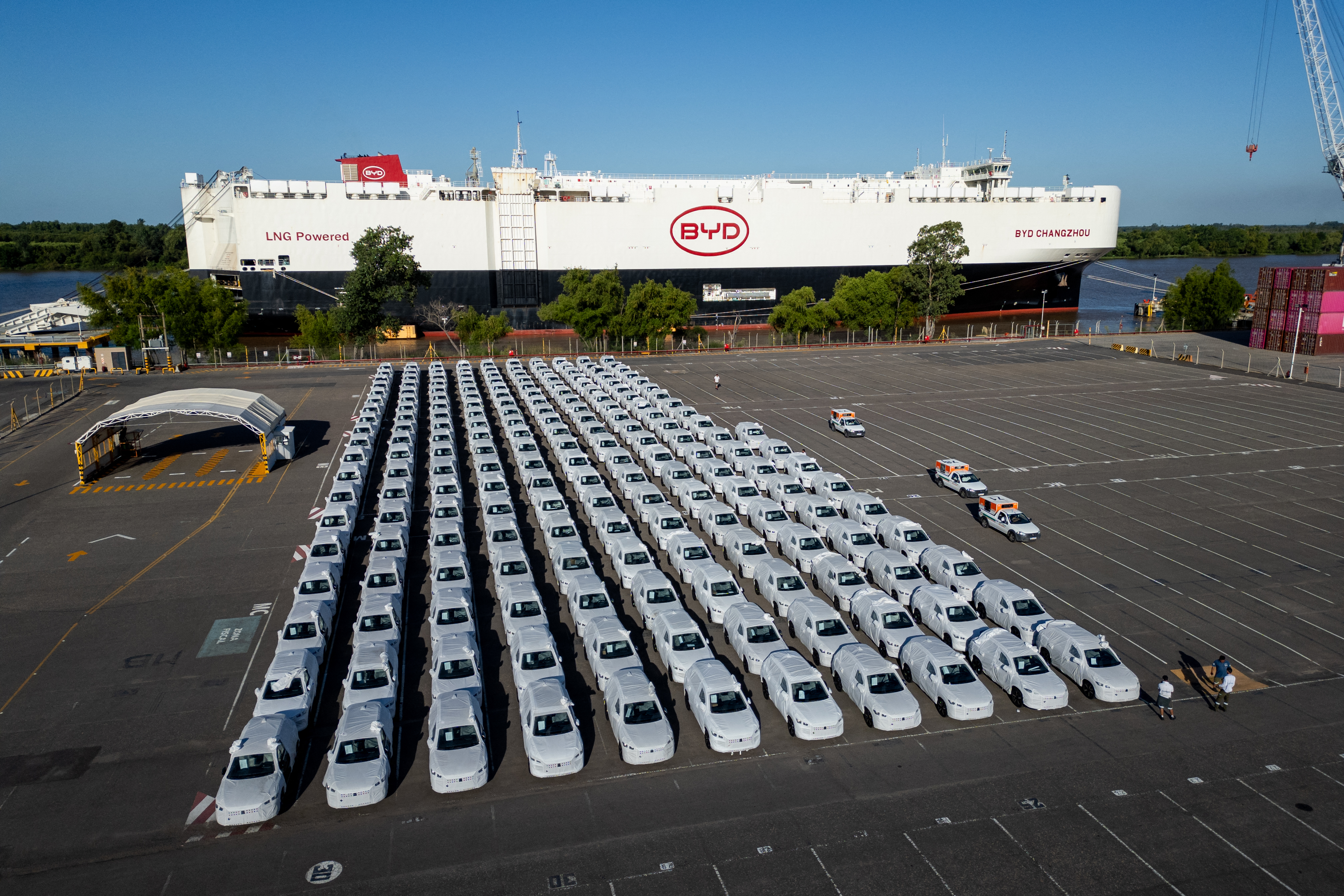 New cars that have been unloaded from the BYD Changzhou ship sit in a parking area at the Zarate Port on the Parana River in Zarate, Buenos Aires Province, Argentina, on Jan. 19, 2026. (Tomas Cuesta/AFP via Getty Images)
Strain at Home
The rebates are costly. Beijing refunded 1.65 trillion yuan (about $245 billion) in value-added and consumption taxes to exporters in the first eight months of 2026, up 4.5 percent from the same period a year earlier, Finance Ministry data show.
Over the same period, local governments took in 1.38 trillion yuan (about $202 billion) from selling land-use rights, a 28.6 percent drop in what has long been one of their biggest sources of cash.
Beijing is also pulling back support at home. It halved a purchase tax break for electric car buyers on Jan. 1, and vehicle purchase tax revenue rose 13.3 percent in the first eight months.
Luo Zhiheng, chief economist at Yuekai Securities, a state-controlled brokerage in Guangzhou, said in commentary published in Chinese state-owned financial media that the rebate change had to balance the industry’s life cycle and global competitiveness against the domestic fiscal situation.
The US Stake
Chinese-made EVs are largely kept out of the U.S. market by steep tariffs and restrictions on Chinese connected-vehicle technology. But Chinese brands compete with American automakers in foreign markets, and they are closing the gap.
Canada began admitting up to 49,000 Chinese-built EVs a year at a 6.1 percent tariff in March, replacing a 100 percent surtax, under a deal Prime Minister Mark Carney struck in Beijing in January. Chinese automaker Geely said on Oct. 9 it will enter the Canadian market in 2027.
The rebate cut also applies to foreign-owned factories in China, including Tesla’s Shanghai plant, which builds the lowest-priced Model 3 the company sells in Canada.
In Washington, a bipartisan House bill that would ban the import, manufacture, and sale of connected vehicles, software, and hardware linked to China has drawn more than 100 cosponsors.
Chinese leader Xi Jinping has long insisted there is nothing to fix. In Paris in May 2024, he told French President Emmanuel Macron and European Commission President Ursula von der Leyen that there was no such thing as “China’s overcapacity problem.”
 Friends Read Free
Copy
Facebook
Tweet
Friends Read Free
Copy
Facebook
Tweet