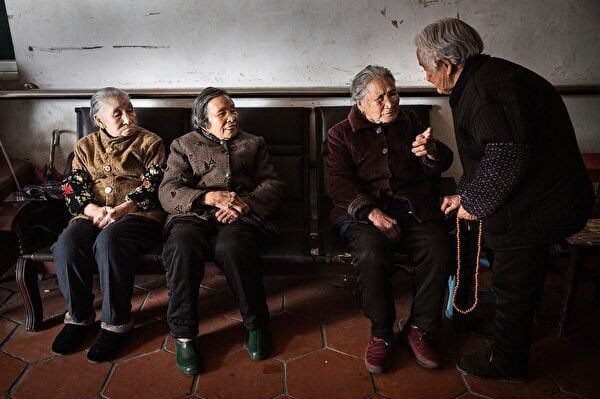
The Chinese Communist Party (CCP) has unveiled a long-term care insurance program that will require pensioners to continue contributing premiums, marking a significant shift in the country’s social welfare system and sparking public backlash.
Chinese state media outlet Xinhua News Agency reported that, under new guidelines jointly issued by the General Office of the CCP and the State Council, retirees will be required to pay into the long-term care insurance scheme at a rate of about 0.15 percent, with payments deducted directly from their pensions or individual accounts.
The policy breaks with longstanding practice in China, where workers typically stop contributing to social insurance programs upon retirement and begin receiving benefits.
Public Backlash
The new requirement has triggered criticism on Chinese social media, with many saying it effectively forces senior citizens to continue paying into the system without meaningful choice.
Several Chinese retirees and analysts spoke to The Epoch Times on condition of anonymity or only publishing their surnames out of fear of reprisal.
A retiree in Beijing told the publication that the change undermines what many had understood to be a basic principle of the pension system.
“We used to believe you contribute while working and receive benefits after retirement,” the retiree said. “Now, retirees are still required to pay. The rules have changed.”
Chinese state television CCTV has defended the policy by stating that more than 90 percent of people with severe disabilities are elderly and requiring retirees to contribute reflects a balance of “rights and obligations.”
However, the change has drawn criticism online. Netizens questioned why participation is mandatory, with some writing that they do not need the insurance and should have the right to opt out.
Critics argue that the policy risks turning social insurance from a welfare benefit into what they describe as a compulsory financial burden.
The rollout comes as China faces mounting demographic challenges. According to official data from the National Bureau of Statistics, the population aged 60 and older reached 323 million by the end of 2025, accounting for 23 percent of the total population.
The rapidly aging population and decreasing birth rate have placed increasing strain on the country’s pension and health care systems, prompting the regime’s policymakers to explore new funding mechanisms.
A scholar who studies China’s social security system, surnamed Ruan, told The Epoch Times that the new program is less about expanding benefits and more about redistributing financial responsibility.
“This separates long-term care costs from the existing medical insurance system and creates a new funding pool,” Ruan said. “In essence, the state is shifting part of the burden away from public finances and onto individuals.”
Limited Benefits Raise Concerns
Under the policy, benefits are restricted to individuals classified as “severely disabled,” and support is primarily provided through care services rather than direct cash payments.
Analysts say this means that many retirees could contribute for years without receiving tangible financial returns.
A human resources professional in Shanghai, surnamed Cao, told The Epoch Times that the structure differs from what many would consider traditional insurance.
“Most people are paying long-term for a low-probability event,” Cao said. “[But] when they actually need financial help, they may only receive limited care services instead of cash support.”
The policy has also reignited debate among academics and the public about fairness within China’s broader social welfare system.
Some critics point to disparities in health care access, noting that senior regime officials are widely believed to receive more comprehensive, state-funded medical care than ordinary citizens.
Scholars warn that requiring retirees to continue contributing could signal a deeper shift in the structure of China’s social contract.
“Traditionally, contributions and benefits were clearly separated—retirement marked the end of payments,” one scholar told The Epoch Times. “Now the two are overlapping, which raises concerns about the long-term direction of the system.”
The CCP plans to expand the program nationwide by about 2028. As implementation moves forward, concerns persist that the added financial burden could affect the economic security of millions of retirees.
Yang Qian contributed to this report.
 Friends Read Free
Copy
Facebook
Tweet
Friends Read Free
Copy
Facebook
Tweet