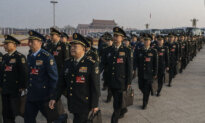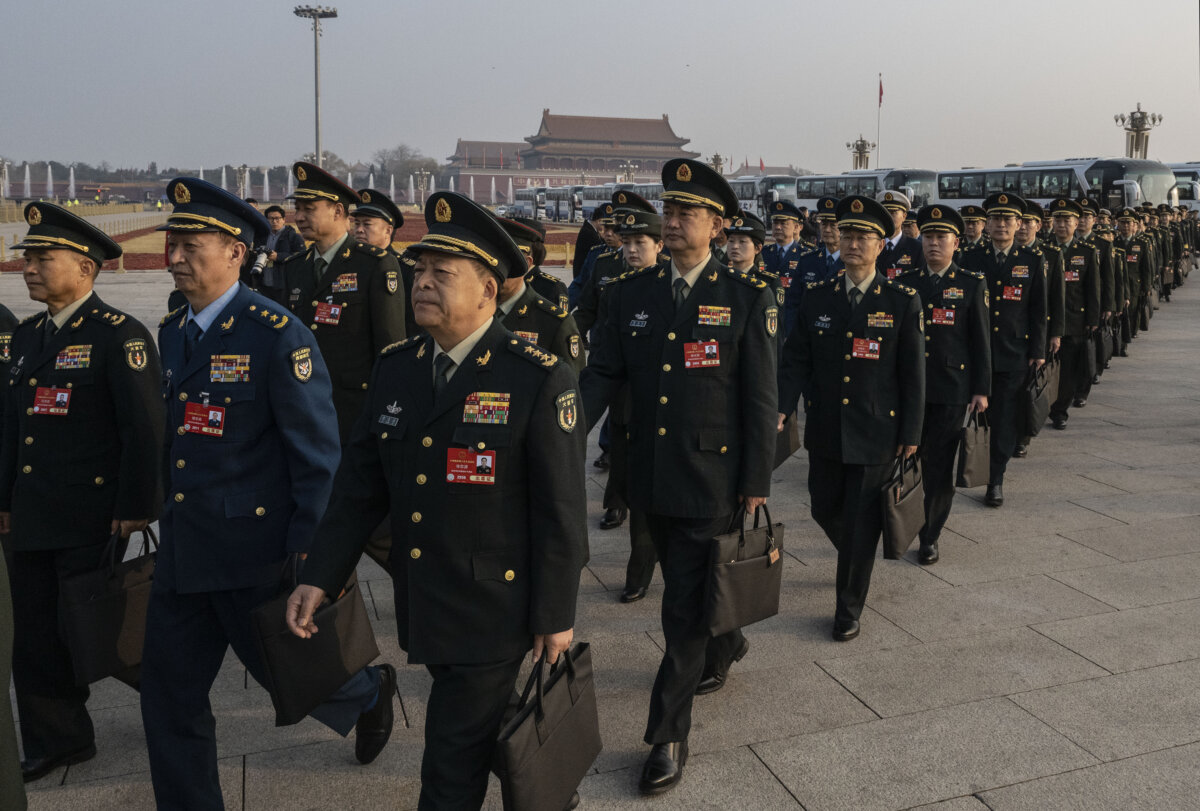

A sweeping political purge within the Chinese military is reaching far beyond the top ranks, as investigators are examining the past 12 years to identify officers connected to former Central Military Commission (CMC) Vice Chairman Zhang Youxia, according to military insiders.
Several People’s Liberation Army (PLA) insiders recently told The Epoch Times that the campaign has already spread across all five theater commands and multiple service branches, involving hundreds of mid-ranking officers and disrupting the military’s command structure.
What began as a high-level power struggle has now widened into a campaign centered on political loyalty, they said. As more officers with combat and technical backgrounds are marginalized, political vetting appears to take precedence over professional standards, raising concerns about the PLA’s ability to operate effectively in a real conflict.
The latest turmoil became public on Jan. 24, when authorities announced that Zhang and CMC member Liu Zhenli—two of China’s top military figures—had been placed under investigation. Earlier, another CMC vice chairman, He Weidong, had disappeared from public view for an extended period.
With Zhang and Liu effectively gone within a short time, the military’s top command has been left largely empty, raising questions about the stability of the PLA’s leadership.
The individuals interviewed requested anonymity or provided only their surnames out of fear of reprisal.
Retroactive Probe Traces 12 Years of Political Ties
A PLA insider identified as Chen told The Epoch Times that the campaign against what authorities call “political disloyalty” has become unusually severe since Zhang’s fall.
“The investigation orders are extremely harsh,” Chen said. “Starting in late January, they required a review going back 12 years.”
Chen said investigators are tracing personnel decisions back to 2013, examining who was promoted during Zhang’s tenure and who had direct or indirect ties to him, including those connected through multiple layers of subordinates.
“They first check the year of promotion, then compare it against a person’s level of connection to Zhang and his close associates,” Chen said. “Starting from the battalion level and above, they are screening people en masse. Many of Zhang’s allies are being taken out one after another.
“Now, even strong professional skills are no protection. Once you are tagged as part of Zhang’s network, you will not be spared.”
He said the probe has effectively become a guilt-by-association campaign that is no longer limited to a small group of senior officers.
Big Data Tools Speed Up Crackdown
Another source close to the PLA, identified as Yang, told The Epoch Times that the crackdown is being led by special teams under the military discipline commission and is progressing rapidly with the assistance of big data systems.
“In just two months, hundreds of core battalion- and regiment-level officers across all five theater commands and different branches have disappeared,” Yang said.
According to Yang, the military no longer mainly depends on traditional background checks or internal reports. Instead, it uses data systems to map personal and professional networks. Once a person’s connections set off a warning, he said, the system automatically flags them.
That process, Yang said, has created a level of fear not seen before, especially among frontline and grassroots command units.
He added that the widening purge may be damaging the PLA itself as an institution.
Concerns Over PLA Combat Readiness and Stability
A mainland Chinese military scholar with the surname Song told The Epoch Times that the campaign shows a deeper shift in how the military operates—from focusing on combat skills to emphasizing political obedience.
“Those being purged are mostly experts in military technology fields,” Song said. “This kind of political operation, which strips away professionalism and technical expertise, is quickly hollowing out the core of the PLA’s combat strength.
“If the military is left with only political opportunists who know how to flatter superiors, it will lose its tactical ability and turn into a force with little real fighting power.”
Song’s concern was echoed by a Beijing-based policy researcher with the surname Wang, whose work focuses on the PLA’s power structure.
Wang told The Epoch Times that China’s post-reform military system had already concentrated power heavily at the top. Now, by using political reviews to remove officers with independent judgment, the leadership is making the command system even more rigid.
He described it as a kind of “brain-dead” management model and said it marks the end of the PLA’s push toward professionalization.
“The current command system is falling into an unprecedented state of silence and rigidity,” Wang said. “When obedience becomes the only rule for survival, all professional military judgment has to give way to politics.
“This distorted power structure is stripping the military of the flexibility it needs for modern warfare and turning it into a political force used to maintain personal power.”
The political tension appears to extend beyond the military. Since November 2025, Chinese leader Xi Jinping has remained in Beijing for an unusually long period and even broke with past tradition by not making his usual Lunar New Year visit to military units.
Wang said Xi’s absence from the military is another sign of how tense the atmosphere has become.
In his view, the Chinese military is undergoing a serious structural setback. Instead of progressing as a modern fighting force built on professional command and division of labor, it is shifting toward a system centered on personal loyalty and political obedience.
If that trend continues, he said, the consequences could be lasting, making the PLA less adaptable, less professional, and less prepared for the demands of modern warfare.
Hu Ying contributed to this report.
 Friends Read Free
Copy
Facebook
Tweet
Friends Read Free
Copy
Facebook
Tweet